

Submarine cables keep the world connected. They can also help us study climate change
- Written by: Cynthia Mehboob, PhD Scholar in Department of International Relations, Australian National University
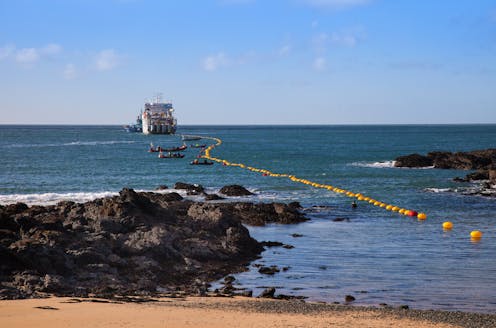
Last month tech giant Meta announced plans to build the world’s longest submarine communication cable.
Known as Project Waterworth, the 50,000-kilometre cable would link five continents. Meta says it would improve connectivity and technological development in countries including the United States, India and Brazil.
Improving global connectivity has been the main purpose of submarine cables since the first one was laid across the Atlantic Ocean in 1858.
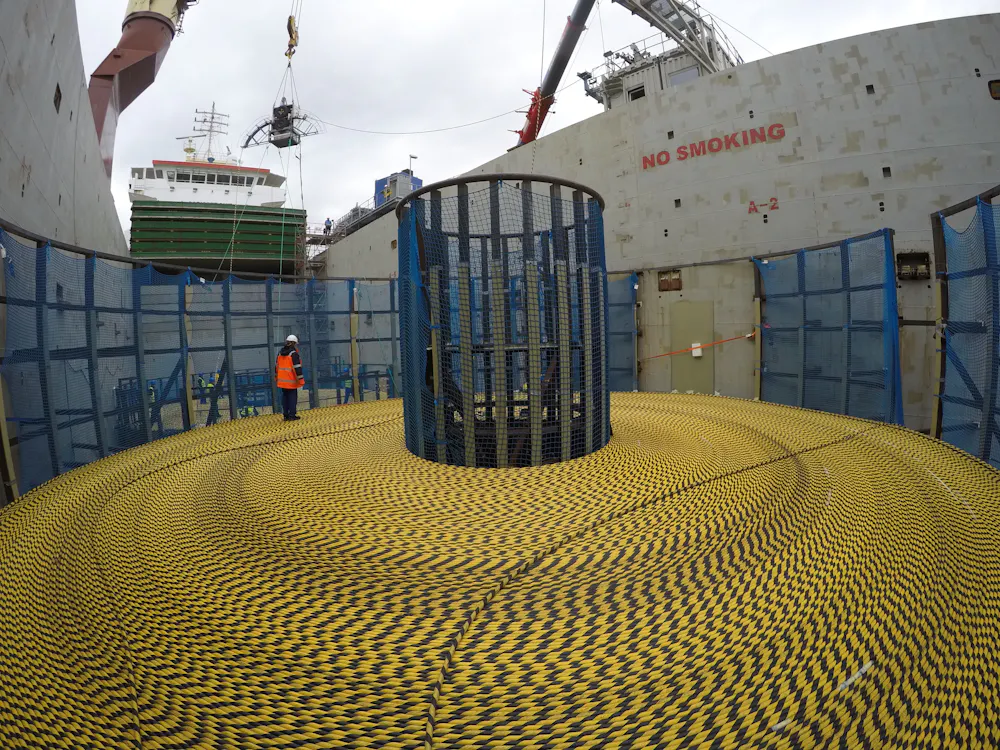
Globally, there are currently around 1.4 million kilometres of these garden hose-sized, plastic-wrapped cables. The optical fibres inside can transmit data at speeds of up to 300 terabits per second.
But submarine cables can do far more than just enhance telecommunications. In fact, a recent conference I attended in London highlighted how a relatively new generation of cables can also be used to keep us safe from threats such as climate change and natural disasters.
Multipurpose cables
SMART – short for Scientific Monitoring and Reliable Telecommunications – cables are designed for environmental monitoring. They are a joint initiative by the International Telecommunications Union, the World Meteorological Organization and UNESCO’s Intergovernmental Oceanographic Commission.

These cables are equipped with sensors that measure vital environmental data in the ocean. This data includes seismic activity, temperature fluctuations and pressure changes. It can be used to improve early-warning systems for tsunamis and earthquakes as well as tracking changes in the climate.
OFS – short for optical fibre sensing – cables are aimed at protecting critical infrastructure. They use the fibre within to detect vibrations surrounding the cable. This allows cable operators to identify potential disruptions from fishing activity, ship anchors and other physical disturbances.
A handful of countries, including France and Portugal, are actively investing in these cables. The European Commission is also supporting SMART cable projects within broader infrastructure strategies.
A slow uptake
The topic of sensing cables comes up at conferences, thanks to industry professionals who work on it pro bono. But the technology isn’t widely adopted by the broader industry and governments. For example, SMART cables have been around since 2010, but there are only two projects in development.
The reasons for this slow uptake boil down to three major concerns, as discussed at the conference.
1. Outdated regulation
The legal framework governing undersea cables is outdated.
While the United Nations Convention on the Law of the Sea regulates international waters, it doesn’t address cables equipped with environmental sensors.
This legal ambiguity introduces additional complexities to already lengthy and complex processes for obtaining permits when sensing technologies are integrated into cables.
2. No clear business model
Industry executives question the financial feasibility of sensing cables. For example, during the conference in London, several industry executives suggested adding sensors raises costs by approximately 15%, with no clear revenue return.
Unlike data traffic, environmental data doesn’t directly generate income. Unless governments intervene with funding, tax incentives or expedited permits, cable operators have little incentive to absorb these added costs and complexities.
3. Security risks
At the subsea cable conference in London, several industry insiders also warned embedding sensors in cables could create new security risks.
Some governments might view sensing-equipped cables as surveillance tools rather than neutral scientific infrastructure.
There is also concern such cables could become attractive targets for malicious actors.
A need for more ocean data
But there are good reasons for more countries and industry to invest in SMART cables.
For example, information on ocean depth, seabed composition and temperature fluctuations is valuable. A wide array of industries, from shipping and offshore energy to fisheries and insurance, could leverage this data to enhance their operations and mitigate risks.
Scientists have also pointed out that in order to better understand climate change, we need more and better data about what’s happening in the ocean.
Current subsea cable regulatory hurdles make investing in sensing technology challenging. But if regulation is updated, projects such as Meta’s Waterworth Project could more easily integrate sensors.
With experts suggesting the Waterworth Project be viewed as multiple cables instead of one, sensors could just be deployed on less geopolitically sensitive cable branches.
They could facilitate the creation of an open-access, publicly funded database for ocean observation data. Such a platform could consolidate real-time data from sensing cables, satellites and marine sensors. This would provide a transparent, shared resource for scientists, policymakers and industries alike.
Of course, deploying sensing technology may not be feasible in volatile regions such as the Baltic or South China seas.
But there is potential in areas especially vulnerable to climate change, such as the Pacific. Here, scientific data could be harnessed to model oceanic changes and explore solutions to rising sea levels and extreme weather patterns.
 Data collected from submarine cables can help us better understand the effects of climate change on the ocean.
somavarapu madhavi/Shutterstock
Data collected from submarine cables can help us better understand the effects of climate change on the ocean.
somavarapu madhavi/Shutterstock
A path forward
Portugal demonstrates a path forward for SMART cables. Despite the regulatory challenges, it is actively investing in SMART cables in order to improve climate data.
Other governments can learn from this if they wish to fulfil their moral duty to invest in infrastructure that serves as a public good.
The idea of embedding sensors in cables may not be the perfect climate change fix. But it’s a step toward understanding the ocean’s invisible rhythms – a small but necessary gesture to stop pretending our planet’s breakdown will fix itself.
Authors: Cynthia Mehboob, PhD Scholar in Department of International Relations, Australian National University


















