

astronomers have discovered a slew of faint circular objects
- Written by: Miroslav Filipovic, Professor, Western Sydney University

Radio astronomers see what the naked eye can’t. As we study the sky with telescopes that record radio signals rather than light, we end up seeing a lot of circles.
The newest generation of radio telescopes – including the Australian Square Kilometre Array Pathfinder (ASKAP) and MeerKAT, a telescope in South Africa – is revealing incredibly faint cosmic objects, never before seen.
In astronomy, surface brightness is a measure that tells us how easily visible an object is. The extraordinary sensitivity of MeerKAT and ASKAP is now revealing a new “low surface brightness universe” to radio astronomers. It’s comprised of radio sources so faint they have never been seen before, each with their own unique physical properties.
Many of the ASKAP results presented here were obtained with one of its major observing programs called EMU (Evolutionary Map of the Universe). EMU is mapping the entire southern sky with an unprecedented sensitivity and will deliver the most detailed map of the southern hemisphere sky to date – a spectacular new radio atlas that will be used for decades to come.
EMU’s all-hemisphere coverage paired with ASKAP’s exceptional sensitivity, especially within the Milky Way, is what’s yielded so many recent discoveries.
Here’s what they’re teaching us.
Unstable stars

The ghostly ring Kýklos (from the Greek κύκλος, circle or ring) and the object WR16 both show the environment of rare and unusual celestial objects known as Wolf-Rayet stars.
When big stars are close to running out of fuel, they become unstable as they enter one of the last stages of the stellar life cycle, becoming a Wolf-Rayet star. They begin surging and pulsing, shedding their outer layers which can form bright nebulous structures around the star.
In these objects, a previous outflow of material has cleared the space around the star, allowing the current outburst to expand symmetrically in all directions. This sphere of stellar detritus shows itself as a circle.
Exploded stars
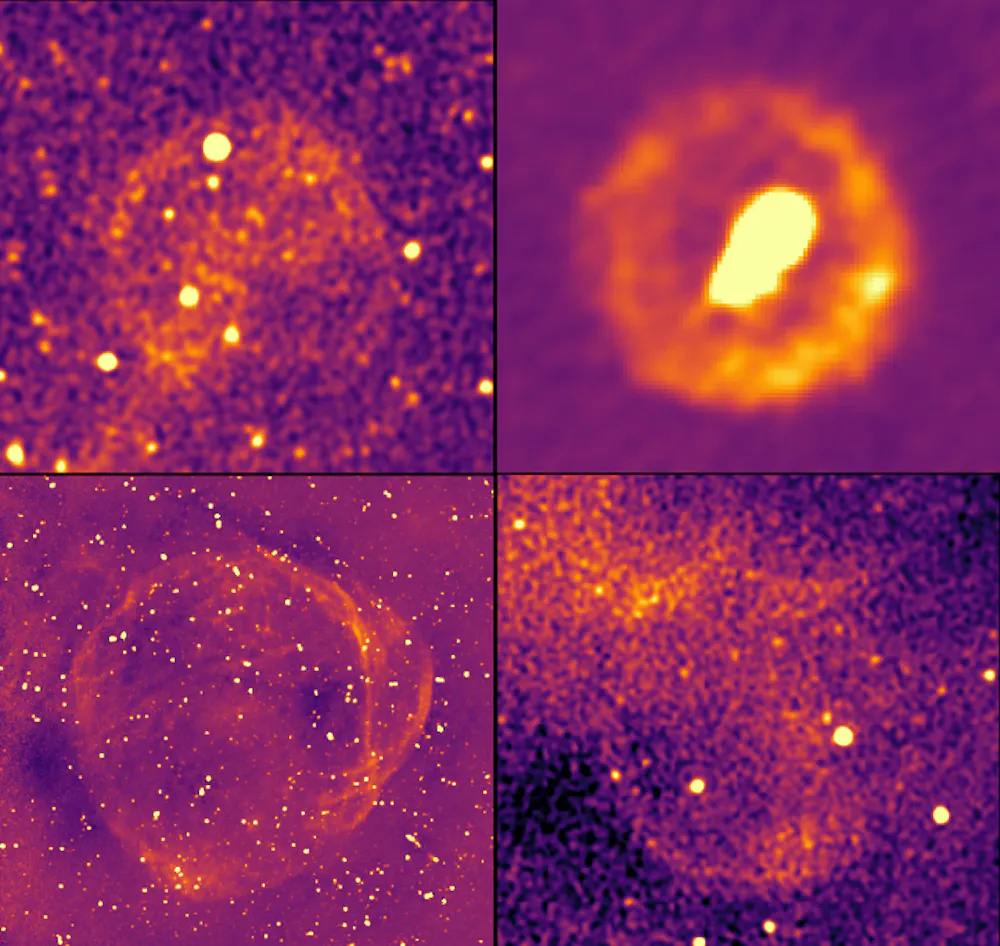
Stingray 1, Perun, Ancora and Unicycle are supernova remnants. When a big star finally runs out of fuel, it can no longer hold back the crush of gravity. The matter falling inwards causes one final explosion, and the remains of these violent star deaths are known as supernovas.
Their expanding shockwaves sweep up material into an expanding sphere, forming beautiful circular features.
The supernova remnant will be deformed by its environment over time. If one side of the explosion slams into an interstellar cloud, we’ll see a squashed shape. So, a near-perfect circle in a messy universe is a special find.
Teleios – named from the Greek Τελεɩοσ (“perfect”) for its near-perfectly circular shape – is shown below. This unique object has never been seen in any wavelength, including visible light, demonstrating ASKAP’s incredible ability to discover new objects.
The shape indicates Teleios has remained relatively untouched by its environment. This presents us with an opportunity to make inferences about the initial supernova explosion, providing rare insight into one of the most energetic events in the universe.
 ASKAP EMU radio image of the Teleios supernova remnant.
Author provided
ASKAP EMU radio image of the Teleios supernova remnant.
Author provided
At the other extreme, we can take an object and discover something entirely new about it. The Diprotodon supernova remnant is shown below.
This remnant is one of the largest objects in the sky, appearing approximately six times larger than the Moon. Hence the name: the animal Diprotodon, one of Australia’s most famous megafauna, a giant wombat that lived about 25,000 years ago.
ASKAP’s sensitivity has uncovered the object’s full extent. This discovery led to further analysis, uncovering more of the history and the physics behind this object. The messy internal structure can be seen as different parts of the expanding shell slam into a busy interstellar environment.
 ASKAP radio image of Diprotodon, a supernova remnant. Green circle shows the previous measured size, and the yellow circle shows the new ASKAP measured size. Earth’s Moon size is shown in the top right for scale, and Diprotodon’s namesake is shown in the top left.
Author provided
ASKAP radio image of Diprotodon, a supernova remnant. Green circle shows the previous measured size, and the yellow circle shows the new ASKAP measured size. Earth’s Moon size is shown in the top right for scale, and Diprotodon’s namesake is shown in the top left.
Author provided
A cosmic mirror
Lagotis is another object that can show how new telescope data can reclassify previously discovered objects. The reflection nebula VdB-80 has been seen before, within the plane of our Milky Way galaxy. The light we see was emitted by nearby stars, and then reflected off a nearby cloud of gas and dust.
 Lagotis, with its cloud of ionised hydrogen or HII region seen on the right.
Author provided
Lagotis, with its cloud of ionised hydrogen or HII region seen on the right.
Author provided
However, with newly available ASKAP EMU data, we were able to discover an associated cloud of ionised hydrogen (known as an HII region, pronounced “aitch two”), where stellar energy has caused the gaseous matter to lose its electrons.
This HII region is seen to coexist with the reflection nebula, sharing the same stellar centre, and is created from the star pushing into a molecular cloud. This movement is akin to burrowing, so the object earned the name Lagotis after Macrotis lagotis, the Australian greater bilby.
Outside the galaxy
ASKAP and MeerKAT are also illuminating objects from outside our Milky Way galaxy – for example, “radio ring” galaxies. When we use visible light to look at the stars in this galaxy, we see a rather plain disk.
But in radio light, we see a ring. Why is there a hole in the middle? Perhaps the combined force of many exploding supernovas has pushed all the radio-emitting clouds out of the centre. We’re not sure – we’re looking for more examples to test our ideas.
Finally, LMC-ORC is an Odd Radio Circle (ORC), a prominent new class of objects with unfamiliar origins. Only being visible in radio light, they are perhaps the most mysterious of all.
 A radio ring galaxy (left) and LMC-ORC (r).
Author provided
A radio ring galaxy (left) and LMC-ORC (r).
Author provided
The next generation
MeerKAT and ASKAP are revealing incredible insights into the low surface brightness universe. However, they are precursors for the Square Kilometre Array, an international collaborative endeavour that will increase the abilities of radio astronomers and reveal even more unique features of the universe.
The low-surface brightness universe presents many mysteries. These discoveries push our understanding further. Currently, the EMU survey using ASKAP is only 25% complete.
As more of this survey becomes available, we will discover many more unique and exciting objects, both new to astrophysics and extensions on previously known objects.
Acknowledgements: Aaron Bradley and Zachary Smeaton, Masters Research Students at Western Sydney University, made valuable contributions to this article.
Authors: Miroslav Filipovic, Professor, Western Sydney University


















