

NZ hopes to store carbon in marine ecosystems – but some are so degraded they’re already a source of emissions
- Written by: Simon Francis Thrush, Director of the Institute of Marine Science, University of Auckland, Waipapa Taumata Rau
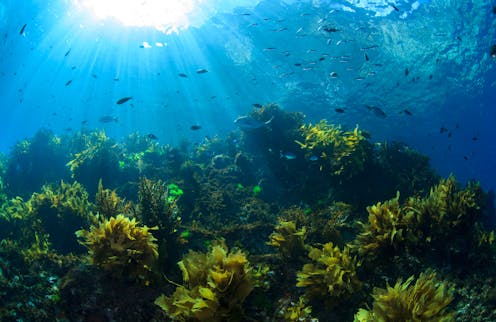
For New Zealand, a country with an underwater territory 14 times its landmass, marine ecosystems present a significant opportunity to investigate carbon storage options.
Prompted by a 2023 report from the Parliamentary Commissioner for the Environment, the government recognised the need to focus on the oceans in addressing climate change.
In its emissions reduction plan for 2026-2030, it highlights the potential to harness marine habitats as carbon sinks and to count this towards the country’s efforts to slow climate change.
Several blue-carbon studies report on stocks of carbon in sediments and mangrove, saltmarshes and kelp forests. This tells us how much carbon is stored in these ecosystems – but very little about how carbon flows through them and the factors that influence whether it is stored or emitted.
This is important. Marine ecosystems can be both sinks or sources of carbon. If we don’t understand how organic material is transformed or how carbon dioxide (CO₂) is either taken up by plants or emitted into the atmosphere, we will likely make poor decisions about nature-based solutions.
To address this, we have invited researchers from the Scandinavian research partnership CoastClim – an innovative project linking seafloor biodiversity and climate – to bring their unique set of instrumentation to New Zealand to explore patterns in greenhouse gas emissions from the seafloor.
The measurements we made this summer are tracking emissions of methane and CO₂ from seafloor sediments in the upper reaches of several harbours (Waitemata, Mahurangi and Whangateau) in the Auckland region.
We found CO₂ concentrations were up to eight times higher than atmospheric levels in more disturbed and polluted parts of these harbours. Methane concentrations were up to 30 times higher. This shows that degraded habitats are indeed transformed into net emitters of greenhouse gases.
Paying attention to land-coast connections
There has been concern about the health of the Firth of Thames, at the back of the Hauraki Gulf, because the area drains a large catchment with intensive agriculture.
We found this region is a significant source of greenhouse gases.
Our sampling on the open coast revealed high draw-down of CO₂ in healthy patches of kelp. But this effect was reversed in areas where New Zealand’s endemic sea urchin, kina, has grazed off the kelp. These regions are known as kina barrens and they dominate many non-protected reefs.
Our data highlight an important finding relevant to how we manage marine ecosystems and address both the biodiversity and climate crises. As we stress and degrade these ecosystems, they have less capacity to process carbon in ways that store it or move it into food webs. The system fails in its self-regulation and transforms into a net source of greenhouse gases.
We argue that we have to manage these ecosystems in an integrative fashion, considering the long-term stores of carbon and the time it takes to build them up, along with the many processes that move carbon from one part of the ecosystem to another.
Considering the dynamics of marine carbon and restoring or protecting coastal ecosystems are good options for addressing multiple challenges. We shouldn’t just be looking for good places to bank carbon but also those where good management can reduce seafloor disturbance and therefore limit the release of greenhouse gases.
Considering climate and biodiversity
This project highlights the importance of considering both biodiversity and climate together. If we manage one ignorant of the other, we risk failure because biodiversity matters to how we address climate change.
This holistic understanding of the stock and flows of carbon (long-term sequestration and carbon in living organisms) is necessary if we are to identify viable long-term carbon stores. It is also crucial to assessing how the stresses we put on the marine environment can turn an ecosystem from a carbon sink to a source.
Working with our Scandinavian colleagues also confirmed our earlier research. For a number of years, we have been studying how different stressors – including sediment disturbance, nutrient flows from land and microplastic pollution affect the way nitrogen, carbon and oxygen are processed in coastal sediments.
These processes have implications for the release of greenhouse gases. But until now, we have not been able to test some connections and close the loop on some of our ideas.
As with most interventions to natural ecosystems, we are better off accepting they are complex, and that any supposed “silver bullet” solutions can have unintended consequences.
Authors: Simon Francis Thrush, Director of the Institute of Marine Science, University of Auckland, Waipapa Taumata Rau



















