

No-take marine areas help fishers (and fish) far more than we thought
- Written by: Dustin Marshall, Professor, Marine Evolutionary Ecology, Monash University
One hectare of ocean in which fishing is not allowed (a marine protected area) produces at least five times the amount of fish as an equivalent unprotected hectare, according to new research published today.
This outsized effect means marine protected areas, or MPAs, are more valuable than we previously thought for conservation and increasing fishing catches in nearby areas.
Previous research has found the number of offspring from a fish increases exponentially as they grow larger, a disparity that had not been taken into account in earlier modelling of fish populations. By revising this basic assumption, the true value of MPAs is clearer.
Read more: Protecting not-so-wild places helps biodiversity
Marine Protected Areas
Marine protected areas are ocean areas where human activity is restricted and at their best are “no take” zones, where removing animals and plants is banned. Fish populations within these areas can grow with limited human interference and potentially “spill-over” to replenish fished populations outside.
Obviously MPAs are designed to protect ecological communities, but scientists have long hoped they can play another role: contributing to the replenishment and maintenance of species that are targeted by fisheries.
Wild fisheries globally are under intense pressure and the size fish catches have levelled off or declined despite an ever-increasing fishing effort.
Yet fishers remain sceptical that any spillover will offset the loss of fishing grounds, and the role of MPAs in fisheries remains contentious. A key issue is the number of offspring that fish inside MPAs produce. If their fecundity is similar to that of fish outside the MPA, then obviously there will be no benefit and only costs to fishers.
Read more: More fish, more fishing: why strategic marine park placement is a win-win
Big fish have far more babies
Traditional models assume that fish reproductive output is proportional to mass, that is, doubling the mass of a fish doubles its reproductive output. Thus, the size of fish within a population is assumed to be less important than the total biomass when calculating population growth.
But a paper recently published in Science demonstrated this assumption is incorrect for 95% of fish species: larger fish actually have disproportionately higher reproductive outputs. That means doubling a fish’s mass more than doubles its reproductive output.
When we feed this newly revised assumption into models of fish reproduction, predictions about the value of MPAs change dramatically.
 Author provided
Fish are, on average, 25% longer inside protected areas than outside. This doesn’t sound like much, but it translates into a big difference in reproductive output – an MPA fish produces almost 3 times more offspring on average. This, coupled with higher fish populations because of the no-take rule means MPAs produce between 5 and 200 times (depending on the species) more offspring per unit area than unprotected areas.
Put another way, one hectare of MPA is worth at least 5 hectares of unprotected area in terms of the number of offspring produced.
We have to remember though, just because MPAs produce disproportionately more offspring it doesn’t necessarily mean they enhance fisheries yields.
For protected areas to increase catch sizes, offspring need to move to fished areas. To calculate fisheries yields, we need to model – among other things – larval dispersal between protected and unprotected areas. This information is only available for a few species.
We explored the consequences of disproportionate reproduction for fisheries yields with and without MPAs for one iconic fish, the coral trout on the Great Barrier Reef. This is one of the few species for which we had data for most of the key parameters, including decent estimates of larval dispersal and how connected different populations are.
Author provided
Fish are, on average, 25% longer inside protected areas than outside. This doesn’t sound like much, but it translates into a big difference in reproductive output – an MPA fish produces almost 3 times more offspring on average. This, coupled with higher fish populations because of the no-take rule means MPAs produce between 5 and 200 times (depending on the species) more offspring per unit area than unprotected areas.
Put another way, one hectare of MPA is worth at least 5 hectares of unprotected area in terms of the number of offspring produced.
We have to remember though, just because MPAs produce disproportionately more offspring it doesn’t necessarily mean they enhance fisheries yields.
For protected areas to increase catch sizes, offspring need to move to fished areas. To calculate fisheries yields, we need to model – among other things – larval dispersal between protected and unprotected areas. This information is only available for a few species.
We explored the consequences of disproportionate reproduction for fisheries yields with and without MPAs for one iconic fish, the coral trout on the Great Barrier Reef. This is one of the few species for which we had data for most of the key parameters, including decent estimates of larval dispersal and how connected different populations are.
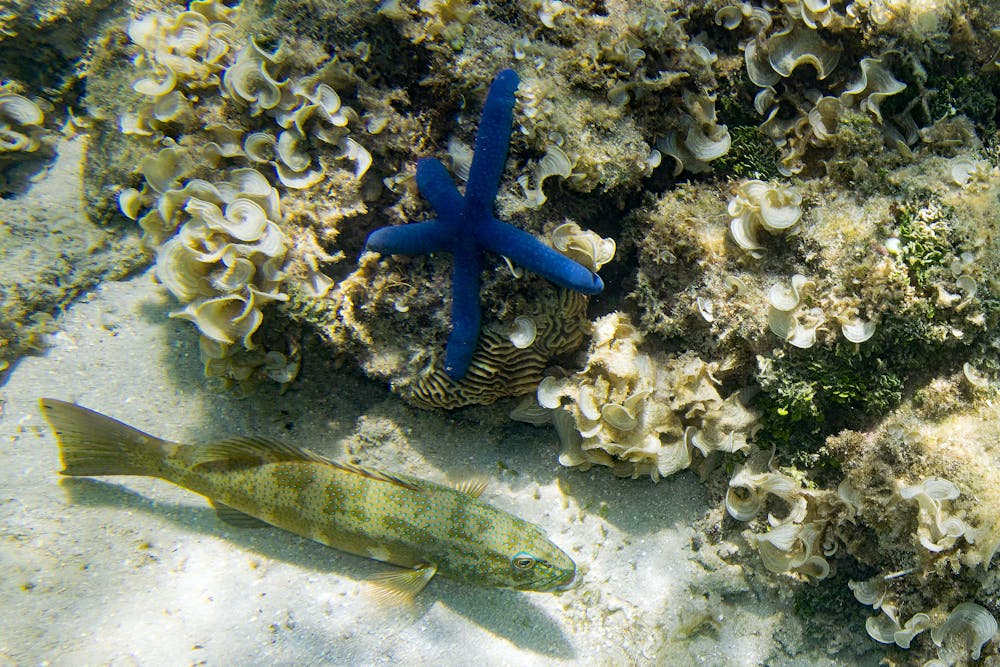 No-take protected areas increased the amount of common coral trout caught in nearby areas by 12%.
Paul Asman and Jill Lenoble/Flickr, CC BY
We found MPAs do in fact enhance yields to fisheries when disproportionate reproduction is included in relatively realistic models of fish populations. For the coral trout, we saw a roughly 12% increase in tonnes of caught fish.
There are two lessons here. First, a fivefold increase in the production of eggs inside MPAs results in only modest increases in yield. This is because limited dispersal and higher death rates in the protected areas dampen the benefits.
Read more:
Caught on camera: Ancient Greenland sharks
However the exciting second lesson is these results suggest MPAs are not in conflict with the interests of fishers, as is often argued.
While MPAs restrict access to an entire population of fish, fishers still benefit from from their disproportionate affect on fish numbers. MPAs are a rare win-win strategy.
It’s unclear whether our results will hold for all species. What’s more, these effects rely on strict no-take rules being well-enforced, otherwise the essential differences in the sizes of fish will never be established.
We think that the value of MPAs as a fisheries management tool has been systematically underestimated. Including disproportionate reproduction in our assessments of MPAs should correct this view and partly resolve the debate about their value. Well-designed networks of MPAs could increase much-needed yields from wild-caught fish.
No-take protected areas increased the amount of common coral trout caught in nearby areas by 12%.
Paul Asman and Jill Lenoble/Flickr, CC BY
We found MPAs do in fact enhance yields to fisheries when disproportionate reproduction is included in relatively realistic models of fish populations. For the coral trout, we saw a roughly 12% increase in tonnes of caught fish.
There are two lessons here. First, a fivefold increase in the production of eggs inside MPAs results in only modest increases in yield. This is because limited dispersal and higher death rates in the protected areas dampen the benefits.
Read more:
Caught on camera: Ancient Greenland sharks
However the exciting second lesson is these results suggest MPAs are not in conflict with the interests of fishers, as is often argued.
While MPAs restrict access to an entire population of fish, fishers still benefit from from their disproportionate affect on fish numbers. MPAs are a rare win-win strategy.
It’s unclear whether our results will hold for all species. What’s more, these effects rely on strict no-take rules being well-enforced, otherwise the essential differences in the sizes of fish will never be established.
We think that the value of MPAs as a fisheries management tool has been systematically underestimated. Including disproportionate reproduction in our assessments of MPAs should correct this view and partly resolve the debate about their value. Well-designed networks of MPAs could increase much-needed yields from wild-caught fish.
Authors: Dustin Marshall, Professor, Marine Evolutionary Ecology, Monash University
-far-more-than-we-thought&media=https://www.modernaustralian.com/https://images.theconversation.com/files/282380/original/file-20190703-126400-1rlyoxs.png?ixlib=rb-1.1.0&q=45&auto=format&w=754&fit=clip&description=No-take%20marine%20areas%20help%20fishers%20(and%20fish)%20far%20more%20than%20we%20thought "Pin It")

















