

romancing the moon – space dreaming after Apollo
- Written by: Mitch Goodwin, Faculty of Arts, University of Melbourne
Last weekend I sat down for a chat with Lisa Sullivan, senior curator at the Geelong Gallery, to get a handle on the gallery’s new exhibition, The Moon. Two and a half years in the making, the exhibit is timed to coincide with this month’s 50th anniversary of the Apollo program’s crowning achievement: a manned spaceflight to the lunar surface.
The exhibition is an ambitious take on this event and, more broadly, our relationship with our nearest celestial neighbour. Or as Sullivan characterises it: “a beautiful poetic presence in the night sky”.
The moon is of the Earth, the product of a celestial collision, whether in part or in whole. We consider it as we would a fellow traveller. After all, the near side of the moon is perhaps the grandest example of pareidolia – the psychological phenomenon that makes us see patterns (often human characteristics) in random objects. And so it is that we see our likeness emblazoned on its crater-filled surface.
We are enamoured by the courting arc of this shapeshifter across our night sky. We anthropomorphise its gaze – the “man in the moon” is said to be “facing us”, while the concealed facade is known as “the dark side”. The moon has revealed itself to be a complicated character.
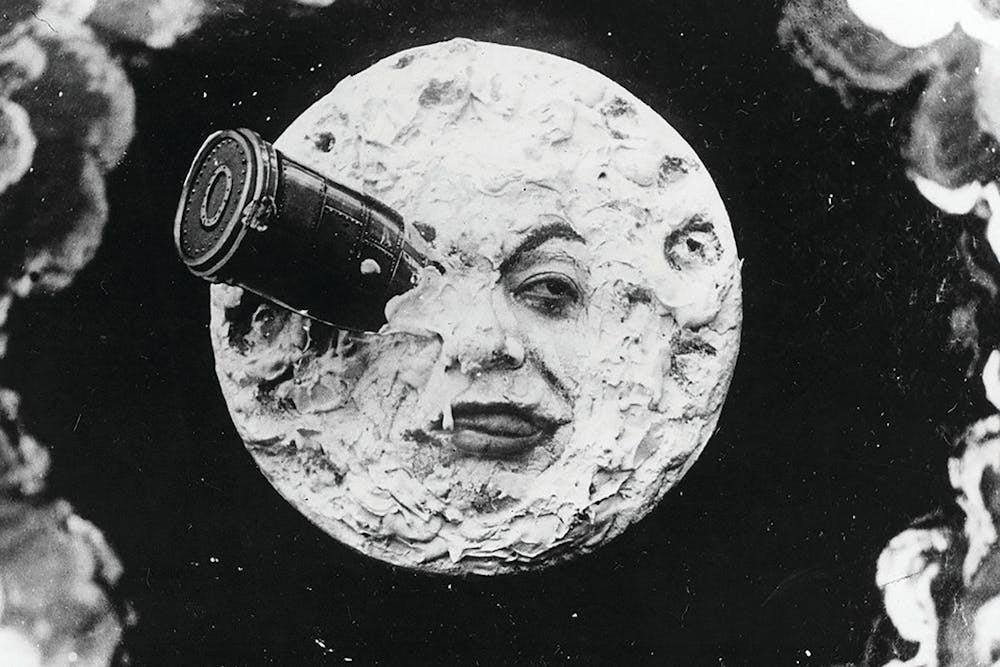 Georges Méliès, A trip to the Moon (Le voyage dans la lune) (still, detail) 1902, black and white; silent, duration 00:10:19.
Australian Centre for the Moving Image, Melbourne
Georges Méliès, A trip to the Moon (Le voyage dans la lune) (still, detail) 1902, black and white; silent, duration 00:10:19.
Australian Centre for the Moving Image, Melbourne
The Geelong Moon exhibition is an opportunity to examine this relationship, to pause and reflect on how our perception and interpretation of the moon has evolved. This is particularly relevant now, not only with the Apollo anniversary, but also in the absence of a return to the moon and our retreat from manned space exploration. We do so now at a distance, via Twitter and YouTube. Our experience of the moon and space has become a virtual one.
Read more: Satellite of love: our on-off relationship with the moon
In the exhibition, one is reminded not of the record of history so much – though it’s there in those iconic photos, the media sampling and the multitude of graphical renderings – but more so how an object so ubiquitous as the moon becomes a conduit for a shared narrative.
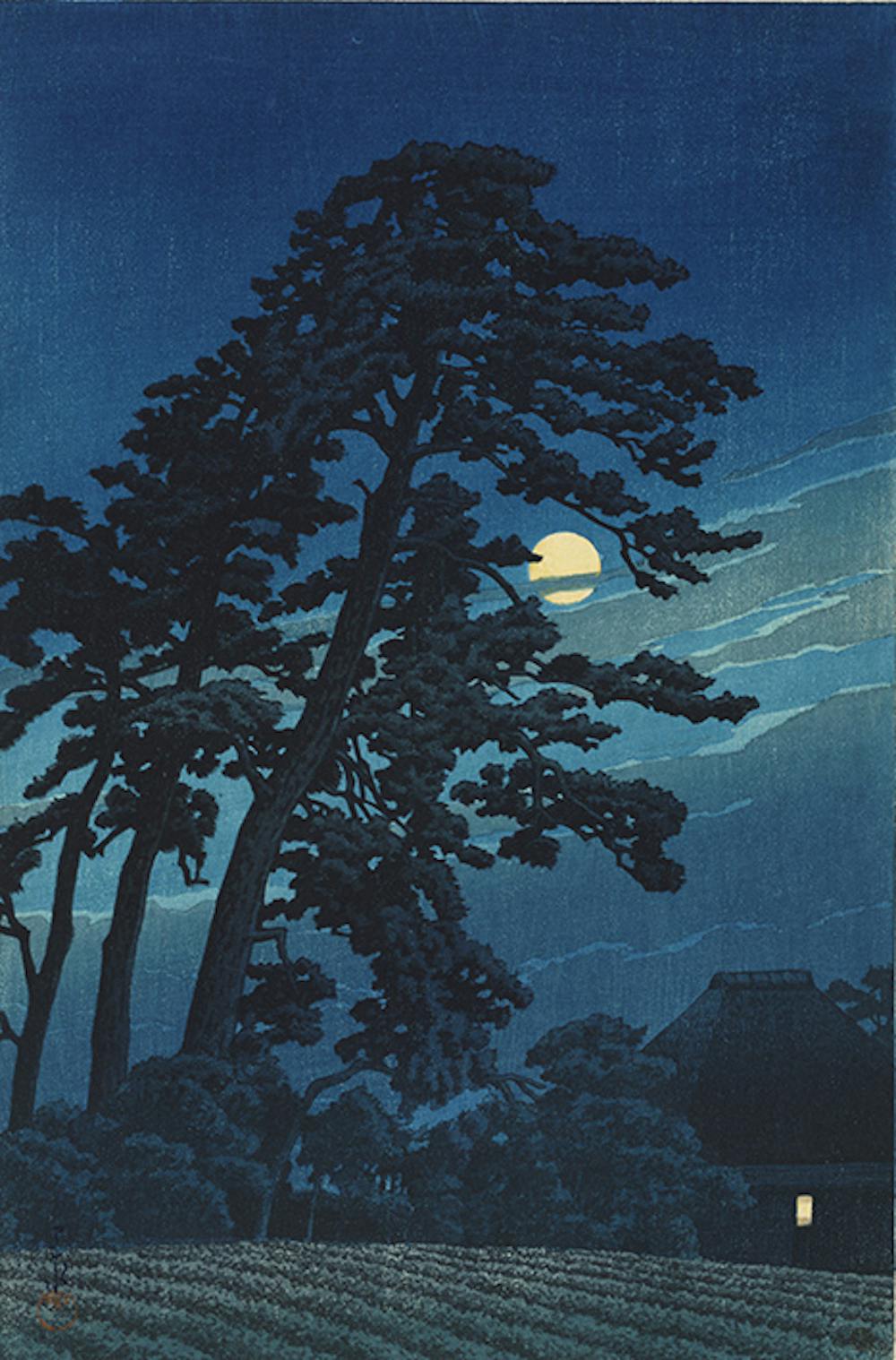 H Kawase Hasui, Full Moon in Magome 1930, colour woodcut.
Art Gallery of New South Wales, Sydney. Purchased 1960.
Photographer: Felicity Jenkins, AGNSW
H Kawase Hasui, Full Moon in Magome 1930, colour woodcut.
Art Gallery of New South Wales, Sydney. Purchased 1960.
Photographer: Felicity Jenkins, AGNSW
There are no werewolves in Geelong, but there is a blend of fantasy, the domestic and the ancient. There is Arthur Loureiro’s painting Study for The spirit of the New Moon (1888), inspired by an epic poem in which the goddess Venus wards off the dangerous seas allowing safe passage for the explorer Vasco de Garma.
And there is a James Gleeson painting, The Siamese Moon (1951), demonstrating in exquisite detail the moon’s ethereal embrace, and according to Sullivan, how “important the moon was to the surrealists in terms of dreams and the subconscious and representing the unknown”.
Images of the moon, like Kawase Hasui’s Full Moon in Magome (1930), evoke a familiarity with the moon as a companion, a beacon or as a singular yet powerful light source; a seductive aesthetic if there ever was one.
The moon across time and culture
It is impossible to imagine today, but there was a time when only moonlight lit the streets and the pathways, its luminance stretching out across the moors and the ocean swells. It wasn’t until as recently as around 1807 that 23 of the first gas-fired street lamps were installed in London. By 1825, there were 40,000.
When electricity finally did arrive in the 1870s, the economical route to municipal lighting was by erecting light towers, designed to mimic the moon, the first appearing in San José, California, in December 1881.
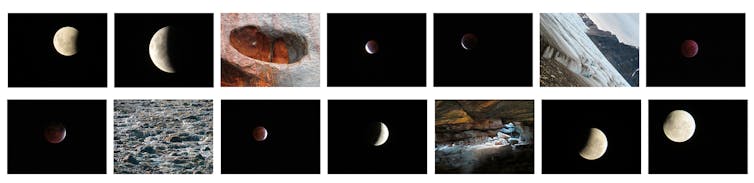 Felicity Spear, Somnium 2016, inkjet pigment print.
Courtesy of the artist and Stephen McLaughlan Gallery, Melbourne © Felicity Spear
Felicity Spear, Somnium 2016, inkjet pigment print.
Courtesy of the artist and Stephen McLaughlan Gallery, Melbourne © Felicity Spear
There are ancient stories to tell here too. Oral traditions of Indigenous Australians not only mapped the night sky, but the stars helped to choreograph one of the earliest cultural dreamings of space. First Nations people had a sophisticated understanding of the subtle variations in the night sky.
The moon too is a strong romantic presence in Indigenous culture. Hector Jandanay’s moon dreaming Garnkeny (Moon man) (1993), on display in the Geelong exhibition, tells a story of forbidden love, the merging of Earth and Moon and the endurance of love eternal, reborn in the lunar cycle.
Through Sullivan’s curation of the exhibition, cultures speak across time, the works becoming a collective voice that detail the technique of space exploration but also the mystery of what it goes in search of. “People do ask me, ‘Is it about the science?’ and I say, ‘No, it is about the romance.’”
Photographs behind glass appear like rare artefacts from a distant time. Familiar iconic photo plates – the Earthrise image from Apollo 8, a moon boot in the space dust, the Apollo 11 Landing Module hurtling towards the lunar horizon – sit alongside the rare and the uncommon, such as photographic prints of the Russian Luna 3 flyby of the far side of the moon in 1959 and the landing of Lunar 9 spacecraft in 1966.
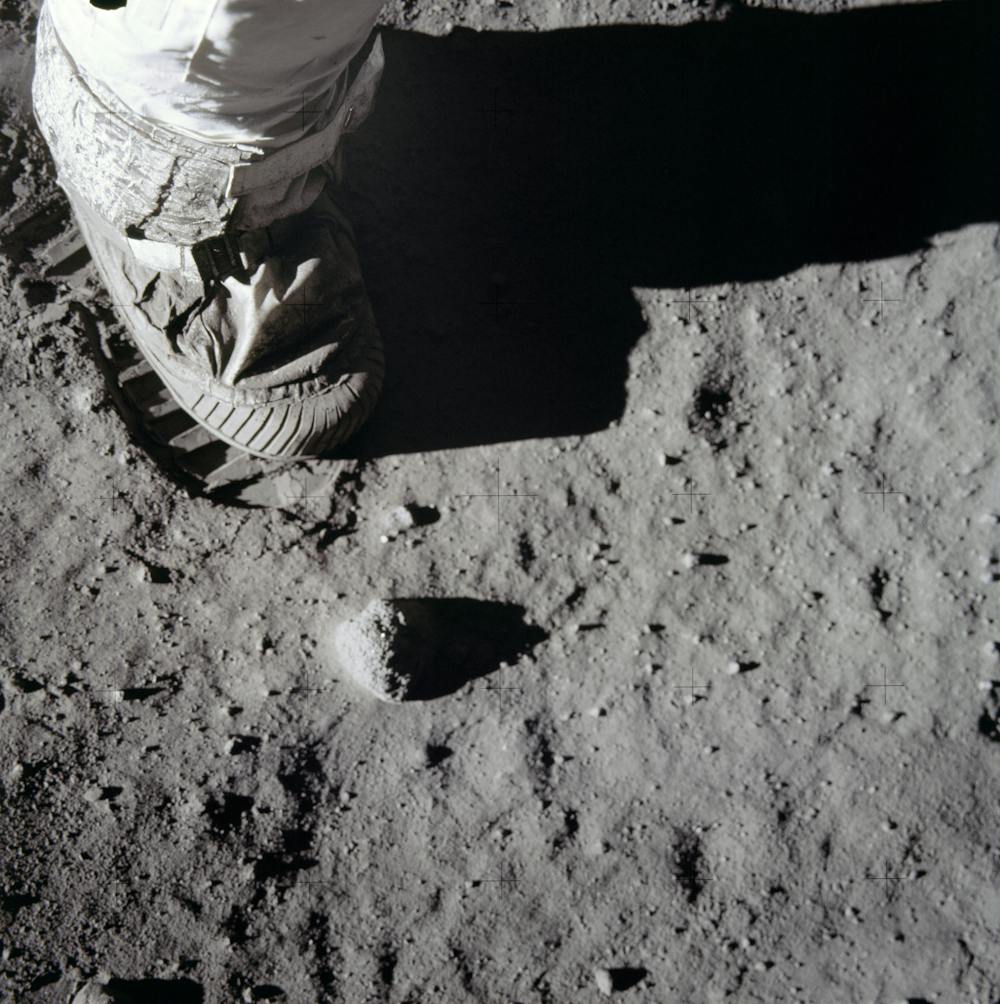 NASA Washington DC, Close-up view of astronauts foot and footprint in lunar soil 1969,
black and white photograph.
Collection of Theodore Wohng
NASA Washington DC, Close-up view of astronauts foot and footprint in lunar soil 1969,
black and white photograph.
Collection of Theodore Wohng
There is a stunning engineering document, The Apollo 11 Earth Orbit Chart (1969), showing in detail the rocket revolutions, ground tracking trajectories and burn initiation points of the launch vehicle as prepared by the US Department of Defence.
And then there is the lunar map Almagestum Novum (published in 1651) by 17th century astronomer Giovanni Battista Riccioli, which has been playfully decoded and re-purposed by Mikala Dwyer in her installation piece, The Moon (2008).
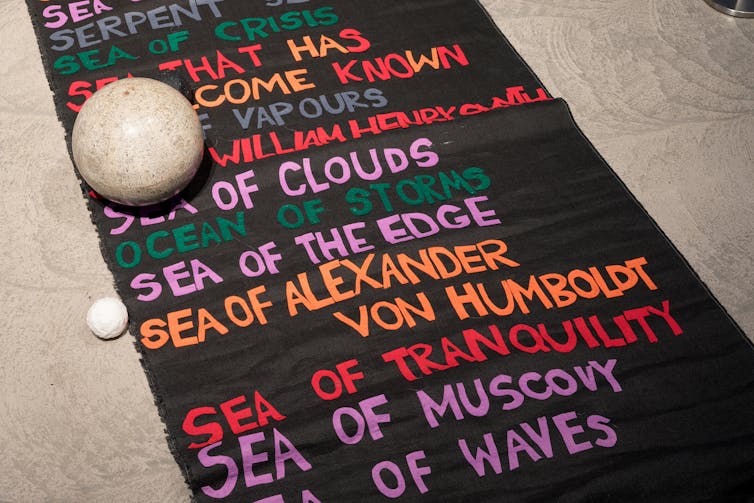 Mikala Dwyer, installation view, The Moon 2008 , hessian, felt, modelling clay, glitter, cardboard, found object. National Gallery of Victoria, Melbourne,
375.0 x 175.0 x 375.0 (variable, installation). Gift of Robert Nubbs and Michaela Webb through the Australian Government’s Cultural Gifts Program, 2016.
Supplied
Mikala Dwyer, installation view, The Moon 2008 , hessian, felt, modelling clay, glitter, cardboard, found object. National Gallery of Victoria, Melbourne,
375.0 x 175.0 x 375.0 (variable, installation). Gift of Robert Nubbs and Michaela Webb through the Australian Government’s Cultural Gifts Program, 2016.
Supplied
Sullivan points out that “while some may say this is not art, that these images are not taken by artists”, she counters that these images are “a part of our visual culture. They are ingrained in our psyche and I very much wanted this exhibition to create that nexus between art and the sciences”.
The moon and the media
The Apollo moon landing represented the dawn of the global media event. Bringing the images back to Earth – the descent to the surface, those first steps down the gantry, and those immortal words of Neil Armstrong – were just as important as bringing back the crew.
After all, this was a time of war – a Cold War – this was nation building stuff, this must be seen, this must be recorded and most significantly transmitted as it happens. In 1969, live television would emerge as an important cornerstone of American public life.
 The Apollo 11 lunar module, the moon, and the Earth.
NASA/Wikimedia Commons
The Apollo 11 lunar module, the moon, and the Earth.
NASA/Wikimedia Commons
The Apollo program was also a prized commission for American artists. In 1969 Robert Rauschenberg was invited by NASA to witness the preparation and eventual launch of Apollo 11, producing a series of 34 lithograph prints he called Stoned Moon (1969-70).
Meanwhile, that year’s Pulitzer Prize winner Norman Mailer was charged with writing the definitive journalistic account of the mission for Life magazine, over three sprawling essays.
The Apollo missions had already provided the perfect heroic setup, a tragic (Apollo 1) and euphoric (Apollo 8) narrative built around a cast of characters, that Mailer would describe as “men with a sense of mission so deep it could not be communicated”. And yet, it sat uneasily with Mailer – he found the power of the Saturn V and the pomp of NASA’s patriotism a difficult sell.
Of the astronauts, he could not reconcile the fact these men were walking contradictions, “technicians and heroes, robots and saints, adventurers and cogs of machine”. Where Rauschenberg was enamoured by the promise of technology and its relationship with nature, Mailer sensed a foreboding. America, he was sure, was being “gassed by the smog of computer logic”.
Read more: Friday essay: shadows on the Moon - a tale of ephemeral beauty, humans and hubris
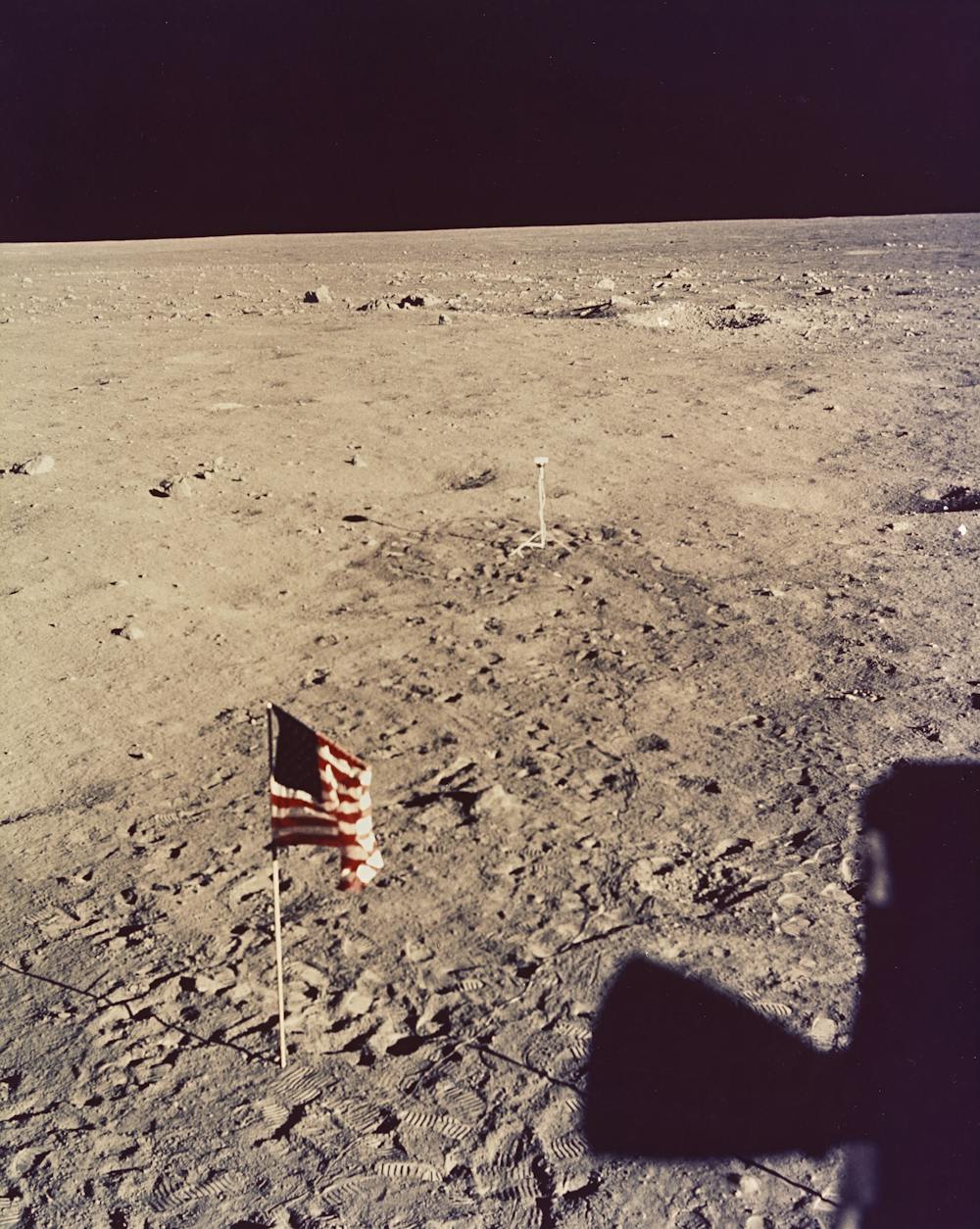 NASA Washington DC, United States flag on moon surface with lunar surface television camera in background 1969, type C photograph.
National Gallery of Victoria, Melbourne. Purchased 1980
NASA Washington DC, United States flag on moon surface with lunar surface television camera in background 1969, type C photograph.
National Gallery of Victoria, Melbourne. Purchased 1980
NASA was guilty of Cold War posturing to be certain, and the Apollo program was not one without its critics and satirists. In 1968, Stanley Kubrick had provided the cinematic warm-up in his epic ode to space exploration 2001: A Space Odyssey. Here, he anticipated the celestial dance of the slowly rotating Command and Service Module, the descent of the Lunar Module to the surface, and the docking of the two vehicles.
David Bowie, who had seen the film on more than one occasion stoned “off my gourd”, understood the irony of Kubrick’s film. The space fever that pre-occupied those months leading up to the Apollo 11 launch would foreground the writing of his own playful moon cabaret, Space Oddity.
Virtualising the moon
Sullivan tells me there are other efforts to tap into the Apollo anniversary. Locally, the Powerhouse Museum in Sydney and the Queensland Museum are both conducting an object based survey of the period, while the Grand Palais in Paris and the Aga Khan Museum in Toronto are hosting similar artistic reflections on the moon’s cultural significance.
It is certainly the season for such reflections. I have recently attended two moon-related installations at Scienceworks in Melbourne, the Museum of the Moon by Luke Jerram and the Earthlight Lunar Hub VR (virtual reality) experience.
The Earthlight narrative was simple: it is 2038 and we have colonised the moon. As a participant, you don a VR headset and a PC backpack enabling full movement and navigation of the VR world. You are an astronaut exploring the technology and the habitation environment of this new lunar colony.
Eventually you and your fellow crew members – also in VR gear but represented in the experience as other (very realistic) astronauts – step out onto a bridge-like structure, and before you is the lunar landscape, and in the distance – the Earth.
It is akin to the stunning scene at the end of Damien Chazelle’s film, First Man (2018), when Ryan Gosling’s Neil Armstrong steps down onto the lunar surface and the camera pans around to reveal his perspective. Like Alfonso Cuarón’s Gravity, and Ridley Scott’s The Martian, the realism is palpable.
These image constructions try to make the remoteness of space a tangible reality, to evoke a sense of realism. Clearly, the hope – from NASA, from Hollywood, from space agencies in Japan and China and from the entrepreneurial space exploration community – is to bring the spectator in all of us a little closer to the action.
Stunts and gimmicks
Despite the clamouring towards commercialising the cosmos, from space tourism to the quest to mine the moon and even asteroids for resources, manned missions to the moon or even to Mars seem like a very remote and distant proposition. The economics don’t add up and the rise of robotic exploration provides a safe, if remote alternative.
And so human interactions in space have become a gimmick, a floor show for the underlying science that makes them possible. Remember astronaut Chris Hadfield singing David Bowie’s Space Oddity from the International Space Station? (Oh, how I would have loved to have seen Bowie in space!). And then there was model Kate Upton sporting a bikini for a Sports Illustrated photo shoot aboard a zero gravity test facility, and skydiver Felix Baumgartner, adorned in Red Bull garb, live streaming his free fall from the edge of space.
Read more: Five ethical questions for how we choose to use the Moon
And then of course, perhaps the most audacious advert of them all, Elon Musk stowing a Tesla Roadster vehicle into the SpaceX Heavy Falcon rocket, to be jettisoned into Earth’s orbit during the vehicle’s maiden voyage in February 2018.
The cherry-red Tesla, replete with a Starman at the wheel, has since sailed passed Mars on its journey into the cosmos to the soundtrack of Bowie’s Space Oddity. And yet, as we know, in space no one can hear the unexpected harmonic shifts of a stylophone.
As our chat about all things moon-like, dreamt or otherwise foretold draws to a close, Sullivan notes that we are left with what can only be a virtual space dream. I tend to agree, perhaps it has always been so. This is the near and the far of the lunar embrace. All we admire, so clear and stark in the night sky, is perceptibly a thing of beauty but so tantalisingly out of reach. As Sullivan says:
The majority of the Earth’s population will never experience what it is like to walk on the moon. That experience will always be unattainable. Even if we see some lunar dust in a museum, or handle a sample of moon rock, it is not the same as seeing the lunar landscape, of experiencing what it is like to walk on the lunar surface. Perhaps that is part of the romance of the moon. This ever-present but ever shifting shape in our night sky.
The Moon is on at Geelong Gallery until September 1.
Authors: Mitch Goodwin, Faculty of Arts, University of Melbourne
Read more http://theconversation.com/friday-essay-romancing-the-moon-space-dreaming-after-apollo-119816


















