

What does the Quran say about the rights and status of women?
- Written by: Christopher van der Krogt, Honorary Research Associate, Te Kunenga ki Pūrehuroa – Massey University
Muslims believe the Quran to be the final revelation of God (Allah) revealed to the Prophet Muhammad (c.570-632 CE). It has quite a lot to say about the rights and status of women though its meaning is not always clear.
Raising the status of women
Our knowledge of women’s place in pre-Islamic Arab society is limited, but the Quran evidently called for some improvements. It condemned, for instance, the live burial of unwanted newborn girls – and all infanticide motivated by poverty.
The Quran recognises women’s right to own property: a woman, like a man, may keep a share of what she earns. Amidst the complex rules of inheritance, the Quran affirms that a female inherits half the share of a male.
This is usually explained by saying a woman’s property is hers alone, whereas a man must use his wealth to support his family. A groom must give his bride a suitable gift, which remains her personal property even if he later divorces her.
A scripture for men?
Muhammad’s wife Umm Salama is said to have asked him why women were not mentioned as much as men in the revelations that make up the Quran. Her answer came in 33:35, which commends “submitting [ie. Muslim] men and submitting women”, listing a range of virtues applicable to both.
Women and men are equally required to live in submission to Allah and will both be rewarded in paradise. Still, the promise of access to amorous heavenly virgins seems designed to appeal primarily to men.
The Quran often addresses men rather than women. At the Final Judgement, the righteous will be told, “Enter paradise, you and your wives”. There the “companions of paradise” will recline on couches in the shade with their wives.
Women are not equal to men in worldly affairs. If two men are not available to witness a financial contract, one man and two women will suffice since, if one of the women makes a mistake, the other can remind her.
This advice has often been generalised to other legal matters so that two female witnesses are considered equivalent to one male.

Interpreting the Quran
While the Quran theoretically provides the basis of Islamic law, we cannot simplistically read “the Muslim view of women” from this text. Islamic jurisprudence also draws upon sayings attributed to the Prophet and the interpretations of scholars.
To non-Muslims, it seems obvious all these sources (just like the Bible and its interpretation) reflect the cultures that produced them – even though Muslims believe the Quran is entirely divine in origin.
In practice, Islamic views on women continue to reflect the diverse cultures in which Muslims live. They vary from the misogynistic outlook of Afghanistan’s Taliban to the liberating views of Muslim feminists, such as Amina Wadud, who are willing to set aside traditional views and reconsider the meaning of the Quran and other sources for today.
Wives and husbands
The Quran describes men as the supervisors or protectors of women, apparently because men spend their wealth supporting them.
Wives are to obey their husbands, and those who seem rebellious are to be admonished. If necessary, their husbands may send them to their beds or even strike them. While these three options are obviously listed in order of severity, modern interpreters try to minimise a husband’s right to strike his wife, proposing that “physical discipline should be gentle and not cause harm”.
Men are told their women are like a field in which they sow, so they should go to their field when they wish and send forth something for themselves, evidently progeny. However, they should not have sexual relations with menstruating women, who are ritually unclean.
A passage warning against exploiting the property of orphans says, “If you fear that you will not act fairly toward orphans, marry what seems good to you of the women: two, or three, or four”. “The women” here are variously understood as orphan girls or widowed mothers (a later passage also alludes to the practice of marrying orphan girls).
The reference to “two, three, or four” is traditionally interpreted as permitting a man to marry up to four wives at one time. Nevertheless, the same passage goes on to say, “But if you fear that you will not be fair, marry only one, or those your right hand possesses.” (We’ll come back to the latter phrase.)
Reading this instruction alongside another, which declares the impossibility of treating wives equally despite a man’s best intentions, some modern interpreters claim the Quran really advocates monogamy.
Slave women
If being restricted to four wives at a time, let alone one, is understood as constraining men’s exploitation of women, such a view is undermined by men’s sexual access to female slaves (those their right hand possesses) – without having to marry them. Since most of these women would have been captured in war, some would already be married but now lost to their husbands.
Today, most Muslims reject the permissibility of any kind of slavery. In Iraq during the 2010s, the Islamic State movement (ISIS) was condemned by prominent Muslims for, among other actions, reviving the enslavement of women and children.

According to the Quran, if a man cannot afford a free wife, he can, to avoid sin, marry a slave woman, doubtless owned by someone else (she would have fewer rights than a free woman). Shi'i (or Shi'a) Muslims claim this passage permits temporary marriage, which is, therefore, legal though understandably disreputable in Iran.
Muhammad’s wives
Muhammad himself was married to only one wife, Khadija, as long as she lived. As a widower, he married perhaps a dozen women. Some were widows needing protection, others cemented political alliances, and others were said to be beautiful.
Any (male) believers who had occasion to visit the apartment of one of Muhammad’s wives was to speak to her through a screen – a hijab. This word came to be applied to a Muslim woman’s head covering.
While the Quran does not require women to wear veils, the Prophet’s wives, called the “Mothers of the Believers”, naturally serve as role models. Both men and women are told to dress and behave modestly.
The Quran explicitly affirmed the legitimacy of Muhammad’s multiple marriages and ownership of slave women but told him he could marry no more, not even exchanging his current wives for others. He was not required (apparently unlike other husbands) to sleep with them all in turn or equally often, and he could take further slave women.
When this verse was revealed, Muhammad’s youngest wife, Aisha, acerbically remarked, “I feel that your Lord hastens in fulfilling your wishes and desires.”
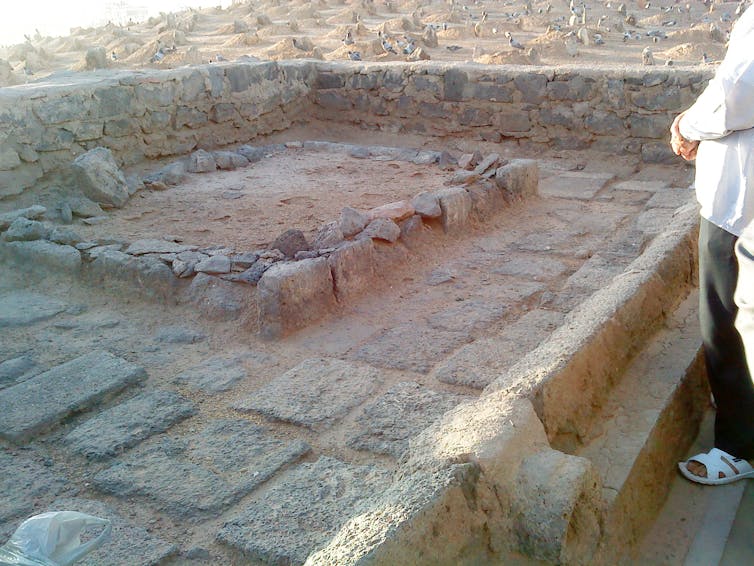
 Grave of the wives of Muhammad in al-Baqīʿ Cemetery, Medina, Saudi Arabia.
Md iet (talk)/Wikimedia Commons, CC BY-SA
Grave of the wives of Muhammad in al-Baqīʿ Cemetery, Medina, Saudi Arabia.
Md iet (talk)/Wikimedia Commons, CC BY-SA
Divorce
Detailed regulations in the Quran concerning divorce assume it is a male prerogative. A woman can, however, return some or all of her marriage gift to ransom herself; if her husband resists, he may be overruled by a judge.
Unless guilty of some moral offence, wives being divorced should remain with their husbands until they have menstruated three times to demonstrate they are not pregnant and to provide an opportunity for reconciliation.
If a wife is pregnant, the divorce is not completed until she has delivered her baby. Men are warned to provide suitable maintenance and not to make life difficult for wives they are divorcing.
These are the main points the Quran makes about the status of women. In principle, all Muslims accept the authority of their scripture, yet they often understand it in ways that mitigate its more chauvinistic aspects.
Authors: Christopher van der Krogt, Honorary Research Associate, Te Kunenga ki Pūrehuroa – Massey University
Read more https://theconversation.com/what-does-the-quran-say-about-the-rights-and-status-of-women-247792


















