

Modern Australian
Times Advertising

NZ’s glaciers have already lost nearly a third of their ice – as more vanishes, landscapes and lives change

  • Written by Shaun Eaves, Senior Lecturer in Physical Geography, Te Herenga Waka — Victoria University of Wellington
NZ’s glaciers have already lost nearly a third of their ice – as more vanishes, landscapes and lives change

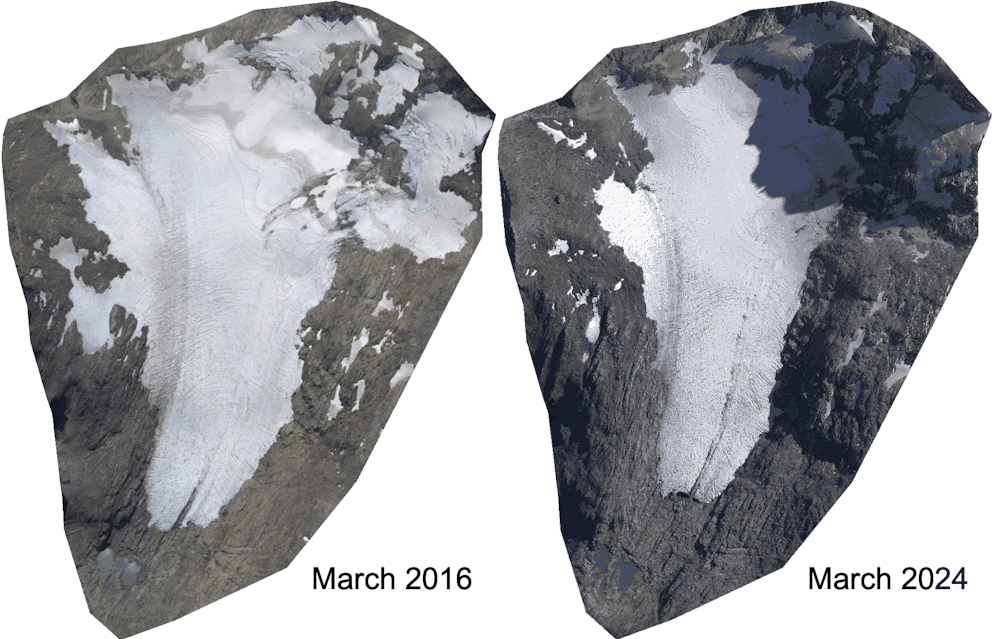
New Zealand ranks third globally in the proportion of ice lost from glaciers. Almost 30% of ice volume has melted during the past 24 years and what remains is disappearing at an accelerating pace, according to a recent global assessment.

Almost 300 glaciers have now vanished completely from New Zealand’s mountains.

An aerial view of a mountain glacier and its outflow stream.
Diminishing ice has impacts on the landscapes in New Zealand’s southern alps. Andrew Lorrey/NIWA, CC BY-SA

As warming temperatures melt glaciers, the ice loss has repercussions for climate and water cycles. This in turn has significant impacts on landscapes, rivers, ecosystems and, ultimately, people and economies.

New Zealand is tracking glacial ice loss closely, thanks to a long-running monitoring programme going back to 1977.

Each year, a team of scientists carries out aerial surveys of the end-of-summer snowline to determine how much of the previous winter snowpack has survived the summer melt season.

Winter snow supplies new mass to glaciers and must balance summer melt if glaciers are to maintain their size. Recent surveys have shown that summer melt far exceeds winter inputs.

During extremely warm years, the winter snow pack is almost entirely removed from some glaciers and the underlying ice has thinned by several metres.

Like a bank account where expenses continually exceed income, the glaciers are out of balance. If left unchecked, eventually the bank account runs dry.

New Zealand is home to just under 3,000 glaciers, covering about 794 square kilometres – equivalent to about 75% of Auckland’s urban area.

Many of these ice bodies are small. Most of the ice is contained in just a few larger glaciers situated close to Aoraki Mt Cook.

Satellite image of mountains with glaciers in the Southern Alps, with labels showing the main glaciers
Most of glacial ice in New Zealand exists around the high peaks near Aoraki Mt Cook. Shaun Eaves; based on Copernicus Sentinel data 2025, CC BY-SA

We don’t have accurate measurements of glacier thickness but estimate they hold as much water as Lake Te Anau. If all of the ice in New Zealand melted – a possibility under some climate scenarios for the coming centuries – the impact on global sea levels would be barely perceptible, but we would be affected in many other ways.

Physically, snow and ice have a cooling effect on their surrounding environment. The highly reflective surface of snow and ice means a high proportion of solar radiation (up to 90% on fresh snow) is reflected back to space.

A reduction in seasonal snow cover and glacial ice due to warming increases the absorption of solar radiation. This further warms the surface and adjacent air and sets off a feedback loop that accelerates further ice loss.

The same effect applies to the loss of sea ice in both the Arctic and Antarctica and is a key reason why alpine and polar regions warm faster than other parts of the globe.

Loss of glacial ice also destabilises the surrounding landscape, with potentially hazardous impacts. Glacial retreat is causing weakening and collapse of steep valley sides that were once supported by ice. The lowering and flattening of ice surfaces means rain and meltwater form ponds that can drain without notice.

The retreat of Fox Glacier destabilises adjacent hillslopes. Source: Brian Anderson.

Biologically, seasonal snow plays an important role in maintaining ecological diversity. Snow insulates and protects alpine insects during winter and regulates flowering times and seed production of alpine flora.

Glacial meltwater cools stream water, supporting cold-water fish populations. Furthermore, the fine silt produced by the slow grinding of rock under the weight of flowing glacial ice is redistributed by wind and rivers and can maintain productive arable land and help regulate atmospheric carbon dioxide levels.

Annotated satellite image of ponds on glacial ice covered in debris.
The lowering of the ice surface on the summit of Mount Ruapehu is causing ponding of rain and meltwater against the emerging rocky topography. Shaun Eaves, CC BY-SA

Snow and ice are also culturally and economically important in New Zealand. Winter snow draws skiers and alpinists to the mountains, while the glaciers of the central Southern Alps are internationally recognised icons that provide the economic backbone to entire regional communities.

The science of glacier loss is clear: in a warming world, less snow will be retained and more ice will melt. This is why the United Nations has designated 2025 the International Year of Glaciers’ Preservation and March 21 as the World Day for Glaciers.

The only way to sustainably arrest the current global retreat of glacial ice is to tackle the root cause: global heating. Achieving this requires international coordination to move energy generation away from fossil fuels quickly.

Failing this, we may soon only remember our glaciers from stories, paintings and photographs.

Authors: Shaun Eaves, Senior Lecturer in Physical Geography, Te Herenga Waka — Victoria University of Wellington


Read more https://theconversation.com/nzs-glaciers-have-already-lost-nearly-a-third-of-their-ice-as-more-vanishes-landscapes-and-lives-change-250617

Winter Sanitation Gaps in Parramatta Kitchens: A Hidden Pest Risk

Winter brings a host of changes to our homes, from the chill in the air to the cozy warmth indoors. However, this season also introduces sanitation ch...

When to Seek Advice from Employment Lawyers in Melbourne

Australian employment law is detailed and, at times, complex, with rights and obligations that aren't always obvious to employees or employers witho...

7 Benefits of Professional Gutter Cleaning for Australian Homeowners

Gutters aren't exactly glamorous. They sit up there on the edge of your roof, doing their job quietly - until they stop working. Clogged, overflowing ...

Pipe Floats Strengthening Pipeline Performance In Demanding Environments

Pipelines often travel through environments that are anything but predictable, water currents shift, terrain changes, and materials keep moving unde...

Why Ceiling Fans Are Essential For Comfort, Efficiency, And Modern Living

Creating a comfortable indoor environment is not just about temperature; it is about how air moves, how a room feels, and how efficiently energy is ...

Why Duct Cleaning In Melbourne Is A Smart Investment For Healthier Living Spaces

Behind your walls, ceilings, and vents lies a network quietly working every day to keep your home comfortable. Yet over time, this system can become...

Disability Service Providers Supporting Inclusive And Independent Living

Finding the right support system can feel like assembling a puzzle where every piece must fit just right. For individuals and families navigating di...

A Beginner's Guide to Owning a Caravan in Australia

Owning a caravan opens up a style of travel that's hard to match for freedom and flexibility. However, for those just starting out, the process of c...

Preparing Your Air Conditioner for Summer: What Most Homeowners Overlook

As temperatures rise, many homeowners switch on their air conditioning for the first time in months — only to find it’s not performing the way i...

What Actually Adds Value to Properties in Newcastle

Newcastle has seen steady growth over the past few years, with more buyers looking beyond Sydney for lifestyle, space, and long-term value. As dema...

What is Design and Build in Construction?

Imagine you’re about to start a new construction project, maybe it’s a custom home or a commercial building. You’ve got the idea, the land, an...

Commercial roof leak detection: why early action protects your building

Water ingress is one of the most disruptive and costly issues facing commercial properties. For property managers and facilities teams, even a minor...

Custom Photo Frames: Turning Everyday Moments into Lasting Displays

Photos capture moments, but how you display them determines how they’re experienced every day. A meaningful photograph deserves more than a generi...

Managed IT Services: A Smarter, More Predictable Way to Run Your Business Technology

If you’ve ever had your systems go down in the middle of a busy day, you’ll know how quickly things can unravel. Phones stop ringing, emails sto...

Landscaping Geelong — Coastal Elegance Meets Practical Design

A Landscape Shaped by Location Geelong occupies a unique position within Victoria’s broader landscape. It carries the energy of a growing city, y...

Electric Adjustable Beds: A Simpler Way To Sleep Better

Sleep should feel natural. It should come easily, without discomfort, without constant repositioning, and without waking up feeling sore. But for ma...

Healthy Snacking Sorted: Premium Beef Jerky

In today's fast-paced world, finding a snack that's both satisfying and genuinely good for you can feel like a mission. Many readily available optio...

What to Know Before Getting Dental Implants: A Guide for First-Time Patients

Dental implants Perth patients often look for a long-term solution for missing teeth without the hassle of dentures or bridges. If you are thinking ...















