

Is the National Rugby League legally liable for the long-term impacts of concussions?
- Written by: Annette Greenhow, Assistant Professor, Faculty of Law, Bond University
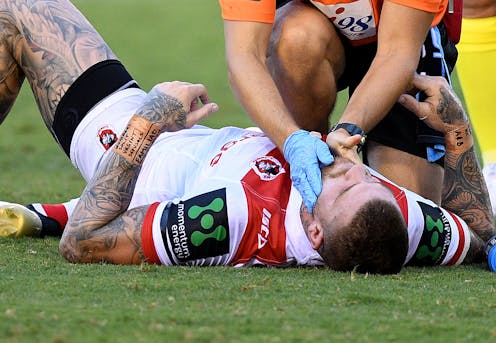
In the not too distant past, players who suffered head injuries in professional contact sports quickly returned to the field of play, sometimes in the same game, seemingly able to shake off any concussion concerns.
Australian professional sports leagues likewise were unconvinced of the long-term effects of head injuries – and specifically the US-based research suggesting a connection between head injuries and chronic traumatic encephalopathy, or CTE - preferring instead to wait for Australian scientific evidence to lead the way.
Last month, however, a report was released by researchers from the University of Sydney and the Royal Prince Alfred Hospital finding scientific evidence of CTE in the brains of two middle-aged, former National Rugby League (NRL) players who had each played more than 150 games over many years.
The report, published as a “letter to the editor” in a medical journal, is the first time CTE has been identified in rugby league players anywhere in the world.
Medical experts have described CTE as
a degenerative brain disease found in athletes, military veterans, and others with a history of repetitive brain trauma.
The Sydney researchers acknowledge that their report is limited by a lack of clinical information collected during the lifetimes of the two NRL players and note that
it is difficult to assess whether these two CTE cases are serendipitous findings, or emblematic of a more common issue with Rugby League and other Australian football codes.
Nonetheless, in the face of this discovery, a legal question has arisen in the rugby league world: who should be responsible for brain injuries suffered by former players? The answer is likely to be determined in Australian courts if a threatened class action lawsuit is brought by former NRL players against the league and its clubs.
Read more: What does concussion do to the brain?
The key questions for a class action lawsuit
According to media reports, several former, but as yet unnamed, NRL players have expressed interest in joining a proposed class action suit, claiming the league and its clubs failed to provide a safe workplace.
Without full details of the complaints, media reports have suggested the case will revolve around whether the league and clubs did enough to protect players from the long-term effects of repetitive concussive and subconcussive injuries and whether they knew or ought to have known about the risks associated with mismanaging such injuries.
Central to the case will be whether the players can demonstrate they were owed a duty of care by the league and whether that duty was breached. Another critical question will be whether players can prove that any breach of duty caused or contributed to the players’ long-term injuries.
A key challenge in any class action suit is to first establish that the claims of several parties are against the same person or organisation, and arise from the “same, similar or related circumstances” involving a substantial common issue of law or fact.
Read more: Who should be responsible for brain injuries in sport?
Like most professional sports leagues, the NRL has adopted its own concussion protocols over the years to properly manage how and when players can return to the sport following a head injury. As NRL chief executive Todd Greenberg says:
We have made huge changes going back to 2014 and I’m very confident those rules are in place for the primary reason for the care of our players.
A key question in the proposed class action, therefore, is how this was handled in the past, before the current protocols were put in place. Were players returning to competition too soon after a head injury? And were the concussion protocols properly implemented and enforced?
These questions rely on first establishing whether the NRL, as the sport’s governing body, owed a legal duty to provide and invest in a safe workplace to prevent or reduce the risk of mismanaging head injuries.
Another important question is the level of scientific understanding of the risks associated with mismanaging concussions at the time the players were injured. Was the sport following best practices based on the scientific understanding at the time?
Who is legally responsible for players’ safety?
A professional sportsperson can legally be classified as an employee, with the right to expect a safe working environment. In professional team sport, this includes an obligation to remove a player from a game or training when they are believed to have suffered a concussion.
In 2000, the High Court in Agar v Hyde established that the governing body of a sport does not owe a duty to voluntary, amateur participants to amend the rules of the game to make it safer. One of the reasons for this decision was a finding that a sport governing body lacked any real or effective control over recreational or amateur participants.
However, the court left open the possibility of re-examining whether professional athletes who are classified as employees and injured at work fall within a different category.
Since the Agar v Hyde case, this question has not been determined in any Australian case, so it is likely to arise in a rugby league class action suit, should it proceed to trial.
How cases have been handled elsewhere
The heightened awareness around CTE in Australia follows the 2011 class action lawsuit filed in the United States by former football players against the National Football League. The case involved allegations the league knew about the dangers associated with repetitive concussive and subconcussive injuries but, among other things, fraudulently concealed this information and failed in its duty of care to ensure the safety of players.
The NFL case settled for US$1 billion before going to trial, so these allegations were not tested in court. The NFL case did, however, bring into sharp focus the role of a sport’s governing body and who is ultimately responsible for the long-term health of players.
Read more: Concussions and CTE: More complicated than even the experts know
In a culture known for its litigation appetite, hundreds of legal cases have since been filed in US courts – against clubs, schools, colleges, doctors, coaches, hospitals and insurers, to name a few. The National Hockey League has also been sued by former players, but the case was settled last year.
But the US and Australian sports and court systems are different, and any Australian case will need to be based on Australian law in accordance with the federal or state-based civil procedures.
The long-term impact of such lawsuits also remains to be seen. In the US, there are fewer high school students playing football due to concerns over the long-term effects of brain injuries. Whether the links between CTE and rugby league players will have the same effect on participation rates in Australia is another issue worth further study.
Authors: Annette Greenhow, Assistant Professor, Faculty of Law, Bond University


















