

Why conspiracy theories and misinformation spread in the long wait for Cyclone Alfred
- Written by: Naomi Smith, Lecturer in Sociology, University of the Sunshine Coast
Last Monday, March 3, the Bureau of Meteorology warned residents of Queensland and New South Wales that Tropical Cyclone Alfred was coming their way. The storm was expected to hit the coast on Thursday or Friday.
By Wednesday, landfall was expected on Thursday night, and residents braced for impact. And then the waiting began.
The storm stalled, dithered and eventually weakened before reaching land early on Saturday morning. But alongside punishing winds, rain and flooding, another kind of damage spread during the long wait: conspiracy theories and misinformation were rife on social media.
They were part of a growing worldwide trend. As climate change ramps up, extreme weather proliferates and trust in authorities declines. Every large natural disaster triggers a wave of conspiracy theorising.
Suspicions of ‘weather modification’
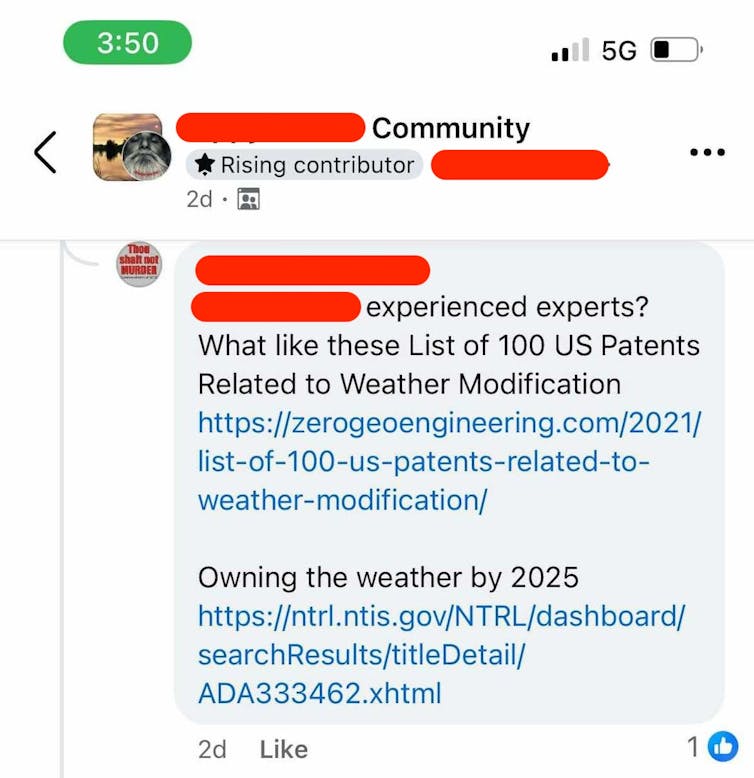
The most persistent theme among the conspiracy theorists is the idea that Cyclone Alfred was “geoengineered” – the result of human efforts to control weather or climate. “Weather modification is real,” one member of a Facebook community group ominously posted, linking to a site listing patents for geoengineering.

The post argued that the position of the cyclone as far south as Brisbane was due to deliberate human intervention.
Of course, tropical cyclones have crossed the coast of southeast Queensland before – and as recently as 2019 one came very close.
However, it is true that human activity may have played an indirect role in Cyclone Alfred’s behaviour. As the Australian Institute for Disaster Resilience has noted, human-driven global warming means cyclones are likely to move farther south more often.
The spectre of geoengineering
What is geoengineering exactly? Among climate experts, the word is often used to describe proposed actions to mitigate climate change, such as adding tiny particles to the upper atmosphere to reflect away sunlight or attempting to suck carbon dioxide out of the atmosphere.
However, in conspiracy theories, geoengineering is more likely to refer to supposed secretive attempts to directly control weather. Like many conspiracy theories, these ideas often contain elements of the real and the fantastical.
A common element of the Cyclone Alfred theory (and others like it) is that the storm was created by the High-Frequency Active Auroral Research Program (HAARP). This project, originally created by the United States military and now at the University of Alaska, studies auroras by transmitting radio waves into a layer of Earth’s atmosphere called the ionosphere.
Though HAARP is real, there is no evidence that radio waves can create a weather event. Weather forms much closer to the ground, in a layer of the atmosphere called the troposphere.
Another theory claimed that Cyclone Alfred was the result of cloud seeding. This is the practice of “seeding” the atmosphere with tiny particles that trigger the formation of rain clouds under the right conditions. Cloud seeding has really been attempted, but the jury is out on how effective it is.
However, triggering some rain is quite different to creating a cyclone or changing the path of one. Experts say these are impossible, mainly due to the amount of energy it would take to produce and then control a cyclone’s path.
Despite the lack of scientific support for these theories, the seemingly endless wait between preparation and impact gave plenty of time for people to spread misinformation and conspiracy theories on social media.
This led some to declare the cyclone a “media beat-up”, or a fever dream based on media lies. It was, they claimed, “just like covid” – the government and media were conspiring to induce people to give up their freedoms.
A growing problem
Misinformation around natural disasters and climate change is a growing problem.
Last October in the US, Hurricane Milton hit Florida and caused catastrophic flooding in Georgia and South Carolina. Online conspiracy theories suggested Milton too was “seeded” or engineered. Social media was flooded with AI-generated clips and out-of-date media.
In January, the Los Angeles wildfires also saw disinformation, conspiracy theories and faked images run wild.
Unmoderated content
The problem of climate-related misinformation is getting worse. Last year, when the United Nations recommended urgent action to combat misinformation and disinformation, climate change was one key area of focus.
As online misinformation and conspiracy theories rise, social media companies such as Meta (owner of Facebook, Instagram and Threads) and X (formerly Twitter) are withdrawing from active content moderation strategies. Instead, they are shifting the burden onto users through community-driven fact checking.
The problem of misinformation is particularly pronounced in community groups on Facebook. These groups may have thousands of members and often only loose moderation.
In times of disaster, people flock to social media. Community groups and pages are important sources of help, information and reassurance.
However, they are increasingly becoming sources of misinformation and conspiracy theories intermingled with genuine information and sound advice.
Why conspiracy theories?
Why are we so compelled by misinformation and conspiracy theories?
Climate change is unpredictable, and is creating more intense weather events than before. In the face of such uncertainty it may be easier to retreat to the clear narratives offered by conspiracy theories.
If a cyclone was created by the government, it has a clear cause. Those affected have a clear place to direct their fear, frustration and anxiety.
What can be done?
There is plenty governments and social media platforms can do to combat the spread of misinformation, if they have the desire to do so. But the everyday user should be cautious.
In times of disaster, seek out trusted sources of information. Remember that nature is unpredictable and advice can and will change. Community groups can be excellent places for practical support, but they are not filled with experts.
Latching on to a conspiracy theory may feel good. It can create a clean-cut world of heroes and villains.
However, spreading these theories online does demonstrable harm. It limits our capacity to prepare for and respond to disaster events. What’s more, it erodes our trust in governments, and sometimes each other.
Authors: Naomi Smith, Lecturer in Sociology, University of the Sunshine Coast


















