

Kultarrs are tiny, cryptic creatures that only come out at night. Scientists are finally learning how they live
- Written by: Hayley Stannard, Senior Lecturer in Animal Anatomy and Physiology, Charles Sturt University
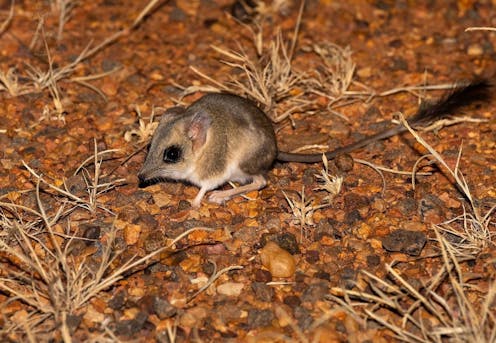
In Australia’s arid and semi-arid zones lives a highly elusive predator. It’s small but fierce and feisty, with big eyes, long hind legs and a pointy nose. A carnivorous marsupial, it comes out at night to hunt its favourite foods: insects and spiders.
It’s rare for people to see this animal in the wild, owing to a combination of its remote habitat, habit of hiding underground in the daytime, small size, camouflaged coat, and fast speed. For anyone lucky to see one in the wild, they’re very easy to confuse with a mouse.
But this animal isn’t a rodent – it’s a marsupial known as a kultarr (Antechinomys laniger). And only recently have scientists – including us – started to get a better grasp of their unique behaviour and crucial role in the ecosystem.
A cousin of the Tasmanian devil
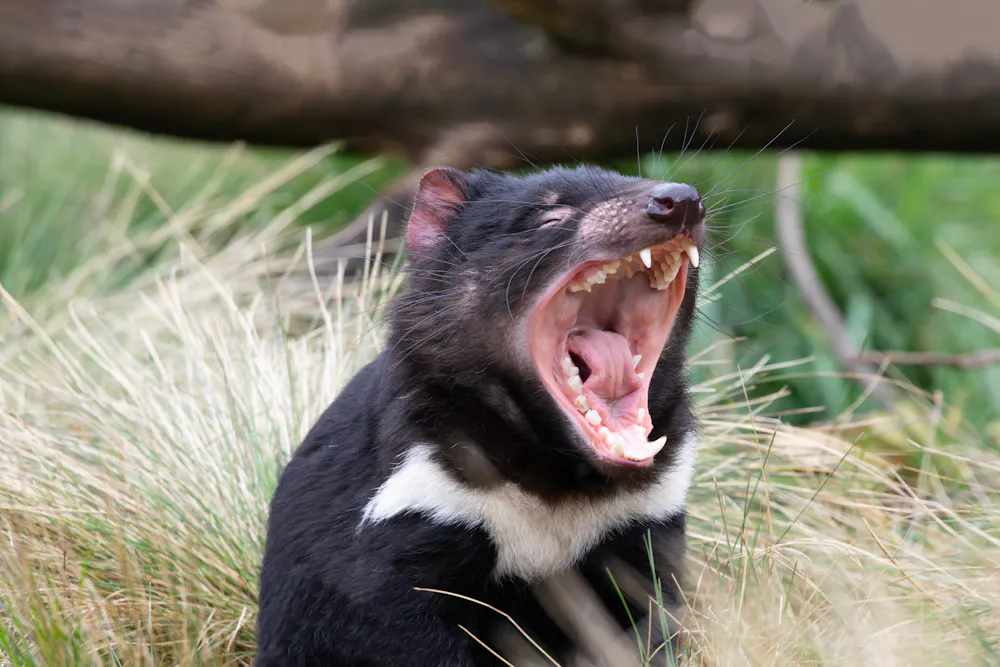
The kultarr is a cousin of the Tasmanian devil (Sarcophilus harrisii), as well as dunnarts, antechinuses and phascogales.
Antechinuses and phascogales are known for “suicidal reproduction” or semelparity – dying after reproducing. Even though naturalist John Gould first described kultarrs as a type of phascogale (Phascogale laniger) in 1856, they do not reproduce in this way.
This small marsupial was given its unique genus name by Australian scientist Gerard Krefft in 1867. In 1906, a subspecies was named by British zoologist Oldfield Thomas.
Australian palaeontologist Mike Archer suggested it was a type of dunnart in 1981, but more recent studies have confirmed kultarrs and dunnarts are cousins, and likely originated from a common ancestor.
Nevertheless, some clarity is needed as there are differences between the two subspecies we recognise today (A. l. laniger and A. l. spenceri). These include their geographic range, the length of their tail and body, mammary glands and some cranial features.
Perhaps there is more than one species of kultarr?
A fierce predator
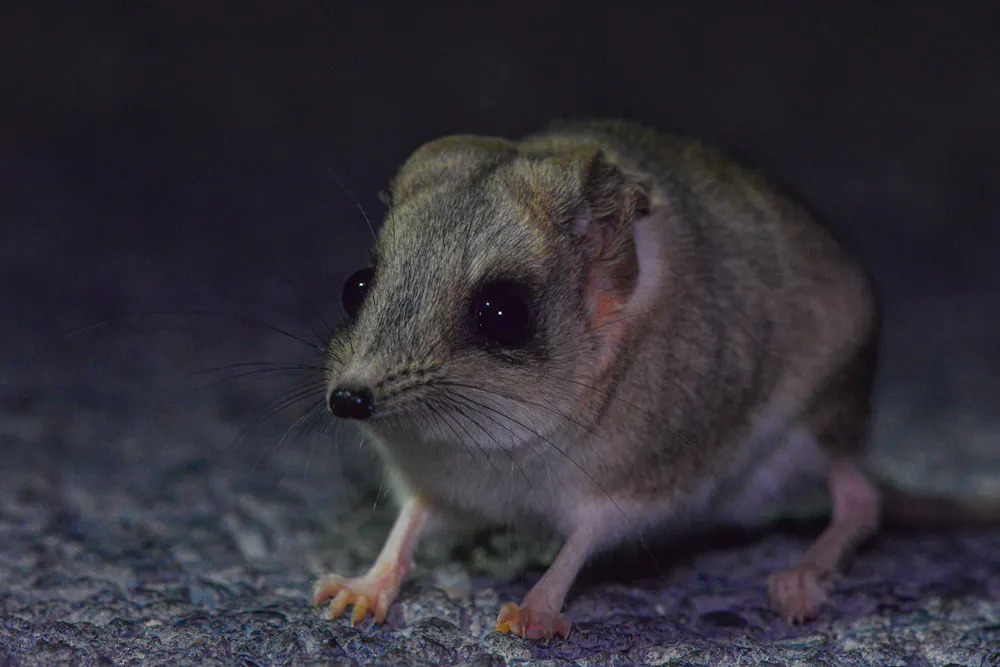
Kultarrs are found across most states and territories except Victoria and Tasmania. They are about the size of a mouse, weighing up to 30 grams. Their fur is brown, fawn or sandy coloured, and their belly fur is white. They also have a long tail with a brush‐like tip, and large elongated hind legs.
Although the long legs of the kultarr make it look like it hops, it is a quadruped. So rather than hopping like a kangaroo, kultarrs walk or run using all four legs at speeds of up to 13.8 kilometres per hour. In comparison, the average human walking speed is roughly 4 km per hour.
Like the Tasmanian devil, the kultarr is a fierce predator, although its prey is smaller – mainly consisting of arthropods. Studies of kultarrs in captivity have shown they have a very simple digestive tract and digest food very quickly, in about an hour.
During the daytime, kultarrs hide in cracks in the soil or burrows made by other animals such as native hopping mice. These cracks and burrows keep the kultarrs safe from predators while they sleep and provide a stable temperature that helps save energy. At night they come out in search of food and mates.
Kultarrs also use torpor, a reduction in metabolic rate and body temperature, to save energy. They can adjust their body temperature to as low as 11°C, and stay in torpor for around 2–16 hours, particularly at times when temperatures are low and food is scarce.
Rarely observed in the field
As kultarrs are so elusive and rarely observed by field researchers, much of what we know about their biology is based on studies of them in captivity.
For example, captive studies have provided information on their reproduction and their behaviour, such as warming up on heat rocks after using torpor to save energy.
Two recent studies analysed historic footage of a captive colony of kultarrs to learn more about their behaviours.
The studies found the most common behaviours displayed in captivity were exploration of their environment and foraging for food. They were also looking out for potential predators by staying alert.
These behaviours are important when breeding animals for conservation actions, such as translocation and reintroduction, which involve relocating animals from one area to another to avoid threats or reintroducing captive bred animals into their former habitat.
The studies highlight the importance of having captive colonies of native marsupials to further understand behaviour and other aspects of their biology that are difficult to study in the wild, particularly in elusive nocturnal species like the kultarr.
 Being a marsupial, kultarrs give birth to underdeveloped young that are permanently attached to the nipples for 30-48 days, as shown here.
Hayley Stannard
Being a marsupial, kultarrs give birth to underdeveloped young that are permanently attached to the nipples for 30-48 days, as shown here.
Hayley Stannard
A kultarr colony
Very few captive colonies of marsupials exist in research institutions.
In 2007, we established a kultarr colony at Western Sydney University. We learned a huge amount about kultarr biology during the six years the colony was operational. It helped provide new knowledge to aid species conservation and inform translocation or reintroduction programs.
Threats to kultarrs include habitat degradation, natural flooding events, fire and pesticides. Introduced and native predators, such as feral cats, foxes, owls and snakes, also prey on kultarrs.
Whole populations of kultarrs may migrate to new locations seasonally. We think that’s the case because researchers will do extensive surveys, find many, and then survey again, and there are none. Unlike rodents that boom after rainfall in response to better conditions – more food and habitat (plant growth) – kultarrs appear to be more readily seen in drier conditions.
The International Union for Conservation of Nature listed the kultarr as “data deficient” in 2008. Eight years later, it upgraded the species to the status of “least concern”.
But there is still a great deal we don’t know about these elusive little animals, particularly the current population stability – and even if there is more than one species of kultarr out there.
Authors: Hayley Stannard, Senior Lecturer in Animal Anatomy and Physiology, Charles Sturt University


















