

Devastating landslides have hit Milford Sound in the past – if it happened today, the impact would dwarf Whakaari/White Island
- Written by: Tim Davies, Adjunct Professor of Disaster Risk and Resilience, University of Canterbury
The 2019 volcanic explosion on Whakaari/White Island, which killed 22 people touring the crater and severely injured 25, is one of New Zealand’s worst disasters.
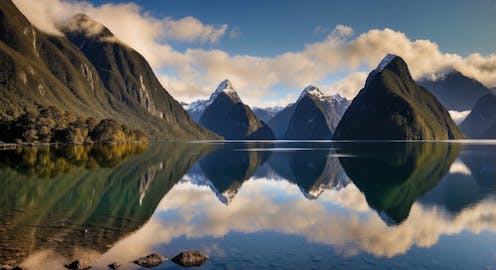
But an even more devastating catastrophe could happen at one of New Zealand’s most iconic tourism destinations, Piopiotahi/Milford Sound. And it is unclear how this disaster can be prevented.
The outcome of the Whakaari tragedy was that tourism on the island ceased immediately. The risk of tourism-related deaths there was considered too high to be acceptable to New Zealand society.
This is also clear from the inquiry and prosecutions that followed the tragedy and the civil law suits initiated on behalf of those killed or injured.
Our new analysis backs this up. We estimate the risk to life on Whakaari in 2019 was more than a hundred times greater than international risk acceptability criteria used to calculate tolerable risk levels from natural hazards.
Our research also estimates the statistical risk of tourism-related fatalities at Milford Sound to be about 50 times higher than at Whakaari.
This is because an earthquake-generated landslide can fall into the sound and turn it into a violent, long-lasting maelstrom of waves up to 17 metres high. This would devastate the shoreline and any vessels present, including cruise ships.
Our hazard estimate is based on the 16 landslide deposits of more than a million cubic metres that lie on the bed of Milford Sound. All of these must have fallen since the sound became ice-free about 17,000 years ago.
This animation shows how a landslide triggers a maelstrom of tsunami waves in a Norwegian fiord. Milford Sound would be similar.The number of visitors (more than a million per year) and employees exposed to this hazard means that, on average, such an event could kill about 750 people every 1,000 years (based on visitor numbers at 2019 levels). Obviously, this would be catastrophic.
The consequences of this catastrophe would be much more severe and far-reaching than the Whakaari tragedy because of the large number of likely fatalities. Also, any cruise ships, with thousands on board, would be severely affected, perhaps even sunk.
Currently New Zealand has no specific regulations governing the degree of risk to which tourists may legitimately be exposed. But there is widespread international agreement that the maximum level of societally acceptable risk to life from natural hazards at a site is about one death per 10,000 years.
The occurrence of an earthquake-triggered landslide tsunami at Milford Sound cannot be predicted in advance. Nor can preventive measures ameliorate it.
The only warning would be the earthquake itself, giving people, at most, about seven minutes before the tsunami waves arrived. Because the wave run-up onto the shore would be about 100 metres high, escape would be impossible.
The only way to mitigate this catastrophe is to reduce the number of people exposed to the risk to about 1,000 per year, which in effect means closing Milford Sound to mass tourism.
This would, however, be an extremely contentious measure because of the international status of Milford Sound as part of a UNESCO world heritage area under New Zealand government auspices, and because the catastrophe might not occur for many centuries.
Stopping tourism has been the chosen solution at Whakaari. But the much smaller scale of the tourist operations there, and the correspondingly lower national impact of closure, contrast starkly with the Milford situation.
The alternative strategy at Milford would be for New Zealand society to collectively decide to accept the risk that, at any time in the future, hundreds of tourists could be killed. Beyond that, there would be the corresponding impacts on tourism and New Zealand’s reputation.
However, if we know a landslide-triggered tsunami at Milford Sound has the potential to kill hundreds of people and cause severe damage, the risk to life ought to be grossly unacceptable and only manageable by abandoning mass tourism at the site. These are the choices we face.
Authors: Tim Davies, Adjunct Professor of Disaster Risk and Resilience, University of Canterbury


















