

the highlights of Perth Festival 2025
- Written by: Jonathan W. Marshall, Associate Professor & Postgraduate Research Coordinator, Western Australian Academy of Performing Arts, Edith Cowan University
In the Perth Festival exhibitions brochure, artistic director Anna Reece noted that the city is “uniquely positioned in relation to Southeast Asia considering proximity and shared time zones”.
Together with the gripping yet inhuman dance work Larsen C, it was the presentation of Australian First Nations and contemporary Southeast Asian storytelling that most resonated for me in this year’s festival.
Big Name, No Blankets
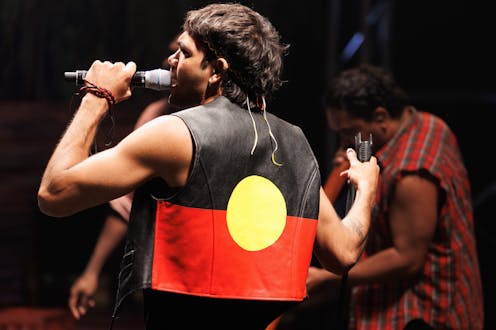
Big Name, No Blankets chronicled the history of the Warumpi Band, the first rock band to be nationally broadcast singing in an Aboriginal language.
When I saw their clip for Jailanguru Pakarnu on ABC TV in 1987, it felt like an electrified message expressing an experience of modern life very different to that of white city dwellers like me.
The Warumpi band was founded at the Papunya settlement (“Warumpi”), 240km north of Alice Springs, by Butcher brothers Sammy (on guitar) and Gordon Tjapanangka (drums), singer George Rrurrambu Burarrwanga, and white guitarist Neil Murray.
The band soon attracted a following in regional Black and mixed race communities, later touring Australia’s major cities and the world. They eventually broke up under the pressures of being away from Country. The stage show shares the name of the 2013 documentary profiling Rrurrambu, but this production is told from the perspective of Sammy.

The songs go off. Taj Pigram as Rrurrambu does a fantastic rendition of the frontman’s open legged bounce, emphatic gestures and shreddingly powerful vocals.
A particular highlight is My Island Home sung in Rrurrambu’s language as an “act of reclamation”.
It makes for inspiring rock stomp.
Samsara
The feature film Samsara looks at contemporary Balinese arts, and was performed with live musicians.
Filmmaker Garin Nugroho collaborated with gamelan percussion orchestra Yuganada, and the double act of DJ Kasimyn on noise, beats and drone, and Ican Harem performing death metal vocals and throat singing.
Nugroho was inspired by 1930s Euro-American cinema, especially German Expressionism.
His straightforward depiction of village life and training in ritual dance recalls early ethnographic cinema. His tendency to use theatrical tableaux – sometimes framing the elegiac choreography of Indonesian Australian dancer Juliet Widyasari Burnett – evokes the work of American Surrealist and dancer Maya Deren.

In order to secure a dowry and wed the high born Sinta (Burnett), Darta (Ario Bayu) passes through a black, volcanic expanse to perform a dark version of the masked monkey dance. In return, the monkey god demands the couple’s son, who is shown lips drawn, teeth flashing, turned animal.
Absorbing as the film was, the live music dominated. The gamelan percussion tended to be played in alternation with the noise materials, rather than the two being combined. Kasimyn’s harsh electronica and Harem’s otherworldly growls signalled cosmic chaos.
The gamelan compositions had a staggered, rhythmically stepped feeling, featuring the blurring tonal colours and polyphony characteristic of the instrument. This one-off “cine-concert” was a rare and absorbing event.
The Mahabharata
The Mahabharata offered an on-stage retelling of Southeast Asian mythology.
From Canadian company Why Not Theatre, this is the first contemporary stage adaptation of the Hindu epic by artists of Southeast Asian descent, contrasting with the famous 1988 production by Franco-British and international artists led by Peter Brook.
Told in two parts, the first two and a half hours were quite similar to Brook’s staging, taking the form of simplified storytelling alternating with moments of high drama.
 This is the first contemporary stage version of the Mahabharata by artists of Southeast Asian descent.
Apurva Gupta/Perth Festival
This is the first contemporary stage version of the Mahabharata by artists of Southeast Asian descent.
Apurva Gupta/Perth Festival
The kingdom is in crisis. The ruler Janamejaya has ordered all the snakes burned because one had killed his father. The storyteller (Miriam Fernandes, also co-creator of the piece) arrives to tell the king to wait and hear how it was that the snake, reincarnated out of a line of frustrated rulers, came to swear vengeance against the king’s family.
The storyteller recounts the tale of the great rivalry between his heirs: the rightful rulers of the Pandava clan, who nevertheless used treachery and broke the rules of war to win their kingdom from the many-times-wronged (if vain and unscrupulous) Kaurava clan, who also had a claim.
The battle between the cousins, related in part two, destroys the known world. Standing before a line of ropes hanging down at the back of the stage, the storyteller tells the audience that, while she spoke to the king, the snakes remained frozen in the air above the flames. It was a poetic image she asked us to hold in the back of our minds throughout.
The second part of the show departed more from Brook’s precedent.
 Jay Emmanuel as Shiva the Destroyer.
Apurva Gupta/Perth Festival.
Jay Emmanuel as Shiva the Destroyer.
Apurva Gupta/Perth Festival.
Live projections amplify the on-stage action. They show close-ups of actors faces during a failed attempt at reconciliation; walls of flames as conflict approached; and bold, abstract images for the portion representing the Bhagavad Gita, one of the most important sections of the original Hindu epic, here presented as an operatic solo.
The company’s most innovative touch was to eschew depicting the battle. Instead, the god Shiva the Destroyer (Jay Emmanuel) continuously circled, stamped and posed about the stage.
After the bloodshed, a survivor asks an observer: who showed themselves to be the greatest warrior on the battlefield? The onlooker claimed only to have seen Shiva’s feet, crushing everything into dust.
Larsen C
The most intriguingly otherworldly offering in the festival was Christos Papadopoulos’ Larsen C. Misleadingly promoted with the tagline “have you ever seen a glacier dance?”, Papadopoulos’ production did nothing of the kind, offering a disturbingly sexy portrait of hidden bodily rhythms.
The Antarctic ice shelf after which the production was named was but one of many images used to generate choreography.
Papadopoulos is concerned with the emergence and withdrawal of bodily sensation in groups and individuals. He relates this feeling to a story of himself driving and suddenly feeling like he was travelling to his grandfather’s house, down to “the sense of taste”; or when people on a train, engaged in their own internal rhythms, come into synchronicity as the carriage takes a turn.
Papadopoulos’ choreography explores this “unknown territory” lying “inside the core of the body” where rhythm and sensation exist, which can surface to govern movement, independent of conscious control.
 Larsen C had a dark eroticism.
Pinelopi Gerasimou/Perth Festival
Larsen C had a dark eroticism.
Pinelopi Gerasimou/Perth Festival
The performance has a dark eroticism, enhanced by stretchable shiny black costumes which sometimes hug, sometimes obscure, flesh.
Dancers shudder in horizontally staggered lines, or work at tiny movements in different parts of the stage. Heads are often obscured by a drop at the back of the stage.
Georgios Kotsifakis stands with his back to us, the sheen of his costume marking a diagonal across his shoulders and down to the curve of his buttocks.
Dancers excel at an almost Noh theatre-like slide sideways, effected by rotating the flat of the feet at the ankles. Elsewhere, there is a communal rising and falling, as if skating.
Catching these micro-rises of energy morphing into briefly shared exchanges requires the audience to fall into the dance’s temporality. Here, perhaps, a glacial time frame is evoked. For long periods nothing seems to happen, then bodies come into receding parallel lines, or scatter.
An atmospheric hiss gradually morphs into deep minimalist techno, the dancers briefly smiling and getting down, crafting pulsing, slippery trajectories. This too melts away, and we are back to sideways slides, performers staring ambiguously outwards.
Shimmering percussion comes in, highlighting this as a work of repetitions with slight variation. The piece concludes with an almost deformed dance, both of Alexandros Nouskas Varelas’ elbows and forearms awkwardly scissoring on one side of his body as he disappears sideways into black space.
While much of the festival revolved around humans as mythic storytellers, Larsen C offered an explicitly post-human message – that, deep in our core, our bodies are producing strange, irregular rhythms and structures, the emergence of which can be both unnerving and ecstatic.
Authors: Jonathan W. Marshall, Associate Professor & Postgraduate Research Coordinator, Western Australian Academy of Performing Arts, Edith Cowan University


















