

Fragments of a million-year-old face found in Spain shed new light on ancient human migrations
- Written by: Laura Martín-Francés, Postdoctoral Fellow, PalaeoDiet Research Lab, Monash University
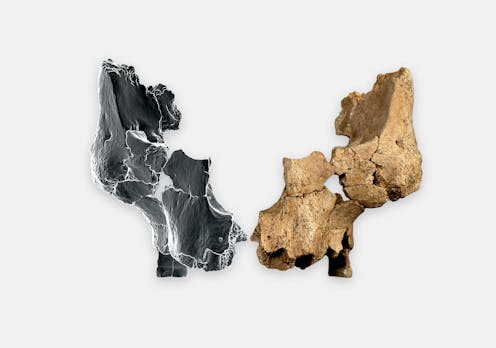
In a system of caves in the Atapuerca Mountains in Spain, nearly 50 years of systematic archaeological excavations have unearthed evidence of increasingly ancient human occupation.
The result of this systematic work has yielded human traces stretching from the Bronze Age to hundreds of thousands of years into the past – before modern humans like us (Homo sapiens) even existed.
In new research published in Nature, our team shares another find from Atapuerca: the earliest human remains ever found in Western Europe. We discovered fragments of face bones from a species of extinct human previously unknown in this region, dating from between 1.2 million and 1.4 million years ago.
Sima del Elefante
Back in 2022, during our annual field season, our team unearthed a series of bone fragments from a cave called Sima del Elefante (Pit of the Elephant). The fragments are from the left side of the mid-face of an adult human.
In 2008, a human jawbone more than 1.1 million years old had been found at the same site. The new fragments were found around two metres deeper than the jawbone, which suggests they are even older.
Since the discovery, our team has spent more than two years meticulously studying the remains. We wanted to find out which species of ancient human they belonged to, and understand the lives and environment of these long-extinct cousins.
Which species does the face belong to?
Evidence from the Gran Dolina site, not far from Sima del Elefante, has shown that a species of ancient humans known as Homo antecessor once populated the Atapuerca region. Direct dating of H. antecessor fossils has shown they lived in the region around 850,000 years ago.

The first question we asked about the new face fossil was whether it belonged to H. antecessor. This species had a relatively modern-looking face: quite vertical, rather than the strongly sloping shape often seen in older species.
The shape of our new face bones was not a match for H. antecessor, so what could it be?
We compared the remains to those of other earlier hominin groups, including ones from the Dmanisi site in the Republic of Georgia, which have been dated to around 1.8 million years ago. The Sima del Elefante face differs from the Dmanisi hominins, especially in the area around the nose.
However, it does share some similarities with Homo erectus, the first human species to spread from Africa to Asia, beginning around 2 million years ago, and now also found in Western Europe. The similarities include the lack of a projecting nose and the forward-projection of the midface.
However, key details about the Sima del Elefante face are still missing. For now, we are classifying it as Homo aff. erectus, which means it appears to be closely related to H. erectus but lacks some defining features.
Beyond the hominin fossils
At Sima del Elefante, we recovered stone tools and the remains of animals alongside the hominin fossils. The marks of use on the tools as well as the cut marks found in the animal remains suggest that this species practised butchery in the cave.
We also know, thanks to pollen and the remains of small animals, that the ancient humans lived in an environment dominated by a humid forest landscape.
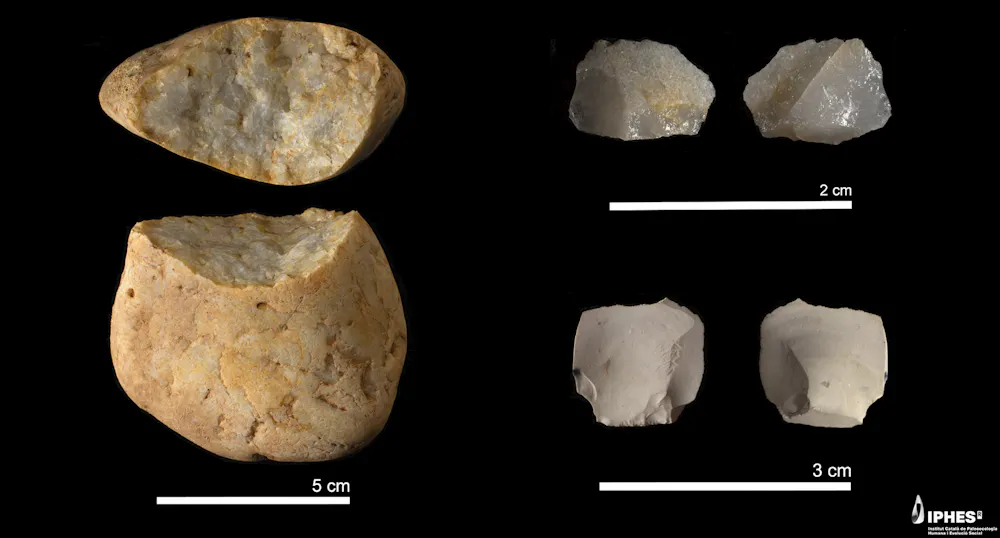
Our discovery opens new possibilities for understanding the origins and population dynamics of the earliest human settlements in Western Europe.
From the fossils at Dmanisi, we know that hominins had left Africa at least 1.8 million years ago. Now, the Sima del Elefante finding tells us that within a few hundred thousand years, hominins had made it to the westernmost part of Europe. What’s more, the shape of their faces had evolved during that time.
The finding also raises questions about whether there were two populations of different hominins living in the Atapuerca region at the same time. Did H. antecessor and H. aff. erectus coexist? Or had H. aff. erectus died out by the time H. antecessor arrived?
If the latter is true, what drove one species to extinction while another flourished? In this second scenario, we need to consider the factors behind both the extinction of the species and their dispersal.
Earlier research has suggested that hominin populations were strongly affected by climate and other environmental conditions. Hominins may have spread into Europe when conditions were kind, and died out when the climate became less hospitable.
There is still much work ahead of us. Year after year, we return to Atapuerca to continue unearthing evidence that pieces together the story of our origins. Each new discovery is a step forward in understanding our past.
Authors: Laura Martín-Francés, Postdoctoral Fellow, PalaeoDiet Research Lab, Monash University



















