

Who gets to be political in Australian art?
- Written by: Catherine Speck, Emerita Professor, Art History and Curatorship, University of Adelaide
When the invitation for artist Khaled Sabsabi and curator Michael Dagostino to represent Australia at the 2026 Venice Biennale was rescinded, the statement from Creative Australia’s board said their selection now posed “an unacceptable risk” and “could undermine our goal of bringing Australians together”.
This is at odds with the 2023 cultural policy Revive, which stresses inclusion, cultural diversity and increased participation from under-represented voices.
Sabsabi had been criticised for two works.
You (2007) features a sophisticated manipulation of images – loaded with ambiguity – of Hezbollah leader Hassan Nasrallah, well before the organistion was proscribed as terrorist.
Thank You Very Much (2006) is an equally ironical work consisting in 18-second video montage of the 9/11 World Trade Centre attacks overlaid with imagery of George W Bush thanking the American public prior to launching devastating attacks on the Middle East.
These are nuanced works, produced 20 years ago in differing political circumstances, and previously shown without critique. They have been taken out of context and misunderstood.
At the same time as this controversy unfolded, it was revealed the National Gallery of Australia requested permission from curator Rosanna Raymond and the Indigenous SaVAge K'lub art collective to cover up the Palestinian flags in their larger tapestry on display. Raymond is still shocked that such a step was taken.
Surely this runs counter to the imperative in the nation’s cultural policy Revive, to provide “a place for every story”.
Australian artists have long featured political figures or political statements in their work. Who gets to be political in Australian art?
‘Pragmatism of cruelty’
Civil society is built on freedom of expression. At certain times artists, steeped in ideas of the avant-garde but with a contemporary inflection, feel an urgency to respond to cultural fissures.
The Vietnam war was one such fissure.
In the early 1970s Australian society was divided over participation in this American-led war, and Moratorium marches were held across the nation.
Ann Newmarch, a member of the radical Progressive Art Movement (PAM) opposed to American imperialism, focused on the Vietnamese women caught up in the conflict.
In her evocative Vietnam Madonna (1975), she portrays a mother trying to protect her children.
This was a PAM poster, produced to be widely distributed. Its anti-American message merged with feminist statements about motherhood was easily understood. It was hung in students’ quarters, artists’ studios and factory canteens.

Another fissure in Australian society is our treatment of asylum seekers and refugees.
Alex Seton’s moving memorial Someone died trying to have a life like mine (2013), showing 28 life jackets carved in marble, refers to the lives lost in May 2013 when a boatload of men, women and children washed up against the rocks at Cocos Island, and 28 empty life jackets were found on the beach.

Setons’ installation evokes a shared humanity – people hoping for a better life. It was shown in Nick Mitzevich’s 2014 Adelaide Biennial exhibition, Dark Heart, in which his operating premise was that the open generosity of the Australian psyche had been replaced by a dark uncaring national soul.
Joanna Mendelssohn in her exhibition review called it “the terrible pragmatism of cruelty”.
Speaking out
Artists are the conscience of the nation, often giving visual form to beliefs and ideas ahead of their more widespread acceptance.
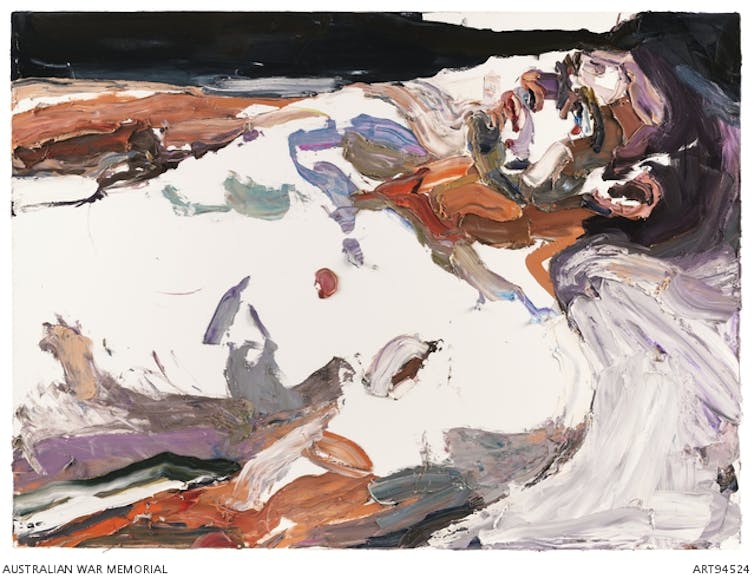
Ben Quilty’s highly emotive series depicting traumatised and psychologically wounded soldiers who had fought in Afghanistan shone a light on a subject no-one wanted to touch.
 Ben Quilty, Captain S, after Afghanistan, 2012.
© Australian War Memorial, CC BY-NC
Ben Quilty, Captain S, after Afghanistan, 2012.
© Australian War Memorial, CC BY-NC
Quilty’s in-your-face expressive canvases of 2012 moved audiences and politicians profoundly. Not only was post-traumatic stress disorder (PTSD) real, governments had to deal with it. PTSD is now talked about more openly as an issue veterans live with.
Hoda Afshar works in a similar vein. Her moving photographic portraits in Agonistes (2020) show men and women who chose to speak out about wrong-doing in the military, intelligence, and other government agencies. They live with devastating consequences.
 Hoda Afshar, Agonistes, 2021, Installation view at the Ramsay Art Prize 2021, Art Gallery of South Australia, Adelaide.
Photo: Saul Steed. Image courtesy the artist and Milani Gallery, Meeanjin/Brisbane.
Hoda Afshar, Agonistes, 2021, Installation view at the Ramsay Art Prize 2021, Art Gallery of South Australia, Adelaide.
Photo: Saul Steed. Image courtesy the artist and Milani Gallery, Meeanjin/Brisbane.
Her whistleblowers are shown with chiselled features, white faced and immobile: they are warriors for the truth. For Afshar it is “the essence of tragedy”.
For many, her portraits are a call for action for injustice. Afshar’s moving work was shown to much acclaim in a recent Art Gallery of New South Wales solo exhibition, A Curve in a Broken Line.
Erasures of history
Glass artist Yhonnie Scarce, of the Kokotha and Nakuna people, employs her medium to draw attention to the erasure of history about our nation’s First Peoples. None more powerfully than in her moving Thunder raining poison (2015) commissioned for the Tarnanthi Festival of Aboriginal and Torres Strait Islander Art at the Art Gallery of South Australia.
This five-metre high installation consisting of 2,000 opaque glass yams symbolically recreates the mushroom cloud released by British atomic tests at Maralinga, South Australia. It led to poisonous chemicals raining down on nearby Aboriginal people and destroying their land.
The disjuncture between the glistening presence of the glass and the shocking reality it evokes brings a shameful history alive. This important work was rapidly acquired by the National Gallery of Australia, while a related work, Death Zephyr (2017), features a hovering mist of poisonous clouds over Aboriginal lands. It is in the collection of the Art Gallery of New South Wales.
The war on Gaza
The current cultural fissure, the war in Gaza, has had a profound effect on the lives of many including Mike Parr. Parr is a celebrated performance artist, who has been creating work on a variety of political issues for decades.
In December 2023, he was dropped by his gallerist, Anna Schwartz, after he painted words including “Palestine”, “Israel” and “apartheid”, and the sentence “Hamas raped women and cut off the heads of babies” on the walls of her gallery during an artwork.
 Australian artist Mike Parr performs Towards an Amazonian Black Square in 2019.
AAP Image/Dan Himbrechts
Australian artist Mike Parr performs Towards an Amazonian Black Square in 2019.
AAP Image/Dan Himbrechts
Despite this, Parr’s commitment to this political cause has continued. In a blind painting durational performance at the 2024 Adelaide Festival, he inscribed the words “Gaza is a Warsaw Ghetto” and “Free Palestine” as under-painting in his black square homage to the Russian artist Kazimir Malevich.
Thought-provoking encounters
Australia has a rich history of artists actively engaging in political issues, and of such work being shown without timidity in state and national galleries, arts festivals and biennials.
All the artworks discussed here have been shown in such spaces. Galleries provide mediated, safe environments in which curatorial expertise is employed to display artworks in ways that promote meaningful and thought-provoking encounters between the viewing public and the work on display.
They are there to promote debate, to advance thought and to navigate cultural fissures.
Authors: Catherine Speck, Emerita Professor, Art History and Curatorship, University of Adelaide
Read more https://theconversation.com/who-gets-to-be-political-in-australian-art-250648


















