

Modern Australian
The Times

Saturn now has 274 moons – but exactly what makes something a moon remains unclear

  • Written by Laura Nicole Driessen, Postdoctoral Researcher in Radio Astronomy, University of Sydney
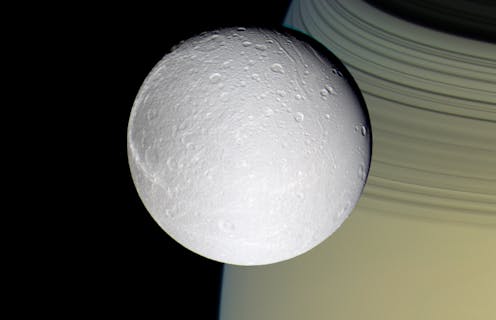
Saturn now has 274 moons – but exactly what makes something a moon remains unclear

Earlier this week, Saturn gained a whopping 128 new official moons, as the International Astronomical Union recognised discoveries from a team of astronomers led by Edward Ashton at the Academia Sinica in Taiwan. The sixth planet from the Sun now has a grand total of 274 moons, the most of any planet in the Solar System.

The discovery has raised a lot of questions. How do you spot moons, and why hadn’t anybody seen these ones already? Doesn’t Jupiter have the most moons? What are they going to call all these moons? Are there more out there? And what exactly makes something a moon, anyway?

A grey scale image with a black back ground. Saturn’s rings are at the bottom of the image and appear as a stripy half-oval in varying shades of grey. Two partially eclipsed moons hover above the rings, appearing as crescents of light.
Two moons, Enceladus and Janus, hover over Saturn’s rings. This image was taken by the Cassini mission. NASA/JPL-Caltech/Space Science Institute

These new discoveries cement Saturn’s place as the winner of the Solar System’s moon competition, with more confirmed moons than all of the other planets combined. But it hasn’t always been this way.

Jupiter’s four largest moons – Io, Europa, Ganymede and Callisto – were the first ever discovered orbiting another planet. They were spotted by Galileo Galilei more than 400 years ago, in 1610. Saturn’s first known moon, Titan, was discovered by Dutch astronomer Christiaan Huygens 45 years later.

A grey scale image of four moons. Each moon is a half-moon. The far left moon is the third largest and is splotchy and patchy. The second left moon is smooth with faint lines and is the smallest. The third moon is the largest and is streaky with a starbur
Jupiter’s four largest moons: Io, Europe, Ganymede and Callisto. These images were taken by the Long Range Reconnaissance Imager (LORRI) on the New Horizons spacecraft. NASA/JHU-APL/Southwest Research Institute

The new batch of 128 moons was discovered by stacking images from the Canada France Hawaii telescope. Some of Saturn’s other moons were discovered by space voyages, and some during what are called “ring-plane crossings”.

When the Voyager 1 spacecraft passed by Saturn, it took images that were used to discover the moon Atlas. The Cassini Mission later discovered seven new Saturnian moons.

A ring-crossing is where Saturn’s rings seem to disappear from our point of view here on Earth. This is when Saturn is at just the right angle so we’re looking at the rings exactly side-on (that is, when we can only see the edge of the rings).

Titan was discovered during a ring-plane crossing, and so were 12 other moons. Saturn’s rings will be edge-on twice in 2025, in March and November.

Two images of Saturn in grey scale on a black background. In the top image Saturn is slightly tilted so that the rings are visible. This image was taken in December 1994. In the bottom image Saturn’s rings are edge on. They are only visible as a faint, da
Hubble Space Telescope images of the 1995 Saturn ring-plane crossing. In the lower image we can see Saturn with its ring edge-on, nearly disappearing. Two of Saturn’s moons can be seen as bright dots in the very thin ring. Reta Beebe (New Mexico State University), D. Gilmore, L. Bergeron (STScI), NASA/ESA, Amanda S. Bosh (Lowell Observatory), Andrew S. Rivkin (Univ. of Arizona/LPL), the HST High Speed Photometer Instrument Team (R.C. Bless, PI), and NASA/ESA

The moon race

From 2019 to 2023, Jupiter and Saturn were fighting for first place in the moon race.

In 2019, Saturn surpassed Jupiter with the discovery of 20 new moons. This took the count to 82 for Saturn and 79 for Jupiter.

Just a few years later, in February 2023, Jupiter took the lead with 12 new moons, beating Saturn’s 83 moons at the time. Only a short time later, still in 2023, the same astronomers who discovered the recent 128 moons discovered 62 moons orbiting Saturn. This placed the ringed planet firmly in the lead.

Elsewhere in the Solar System, Earth has one moon, Mars has two, Jupiter has 95, Uranus has 28 and Neptune has 16, for a total of 142 moons. We only need to discover ten more moons around Saturn to give it double the number of all the other planets combined.

Regular or irregular?

The newly discovered moons are all small. Each one is only a few kilometres across. If something that small can be a moon, what really counts as a moon?

NASA tells us “naturally formed bodies that orbit planets are called moons”, but even asteroids can have moons. We crashed a spacecraft into an asteroid’s moon in 2022. Earth has had a few mini-moons, some only a couple of metres in size. The line of what is and isn’t a moon is a bit hazy.

Moons orbiting planets in the Solar System can be either “regular” or “irregular”. The new moons are all irregular.

A grey scale image of a large rock. The rock is an irregular shape and is covered in pock-marks of all different sizes. It also has some larger craters near the top.
One of Saturn’s irregular moons, Phoebe. Phoebe was discovered in 1898 and was the first irregular moon of Saturn ever discovered, This image was taken by the Cassini mission. NASA/JPL

Regular moons are formed around a planet at the same time as the planet itself forms. Irregular moons are thought to be small planets (planetesimals) that are captured by a planet as it finishes forming. They are then broken into pieces by collisions.

Regular moons tend to orbit their planets in nice, circular orbits around the equator. Irregular moons typically orbit in big ovals further away from planets, and at a range of angles. Saturn has 24 regular moons and 250 irregular moons.

Studying these moons can tell us about how moons form, and reveal clues about how the Solar System formed and evolved.

Saturn’s rings are made of small chunks of ice and rock. Astronomers think they formed out of pieces of comets, asteroids and moons that were torn apart by Saturn’s gravity.

So for Saturn in particular, irregular moons can tell us more about the formation of its beautiful rings.

What’s in a name?

Names of astronomical objects are governed by the International Astronomical Union (IAU). Originally, all moons in the Solar System were given names from Greco-Roman mythology.

But the large number of moons, particularly of Saturn and Jupiter, means the IAU has expanded to giants and gods from other mythology. And it’s all about the details. If binary moons are discovered, they are required to be given names of twins or siblings.

Saturn’s first seven moons were given numbers instead of names. In 1847, John Herschel named them after the Greek Titans. After they ran out of titans and Greek mythological giants, they expanded the naming system to include Inuit and Gallic gods and Norse giants.

Discoverers get to suggest names for moons, and the names they suggest are given priority by the IAU. In the past, there have been competitions to name new moons of Jupiter and Saturn.

With 128 new moons for Saturn, it might take a while to come up with names that follow the IAU rules. Maybe we’ll even see the addition of different mythologies. We’ll have to wait and see. Until then, each moon has a name made of a string of numbers and letters, such as “S/2020 S 27”.

A grey scale image showing Saturn and five of its moons. Saturn is on the far right and half of it is not in the image. The rings are narrow and extend directly from the centre of Saturn in the image to a bit further than halfway through the image towards
An image of five of Saturn’s moons taken by Cassini. The moons from left to right are: Janus, Pandora, Enceladus, Mimas, and Rhea. NASA/JPL-Caltech/Space Science Institute

Will we find more moons?

Without a solid definition of what a moon is, it’s hard to say when (or if) we will ever finish finding them. Everyone agrees we shouldn’t call every single chunk of rock in Saturn’s rings a moon, but exactly where to draw the line isn’t clear.

That said, there is probably a limit to the number of moon-like objects astronomers are likely to want to add to the list. Edward Ashton, who led the discovery of the new moons, doesn’t think we’ll be finding too many new moons until our technology improves.

Authors: Laura Nicole Driessen, Postdoctoral Researcher in Radio Astronomy, University of Sydney

Read more https://theconversation.com/saturn-now-has-274-moons-but-exactly-what-makes-something-a-moon-remains-unclear-252033

Plantation Shutters vs Curtains: Which Is Better for Your New Home?

Moving into a new home is an exciting opportunity to personalise your space and make it your own. While many homeowners focus on furniture, flooring...

Celebration of Life vs Traditional Funeral: What's the Difference?

When saying goodbye to someone you love, there is no single way to honour their life. Every family has different traditions, beliefs, and preference...

Building Approval for Roofing Projects: What Homeowners Need to Know

Roofing projects are an important part of maintaining and protecting your home. Whether you're repairing storm damage, replacing an ageing roof, or ...

Chatswood Tutoring And Its Role In Academic Achievement

Academic success often requires more than classroom attendance alone. Students face increasing expectations as they progress through school, particu...

Why Laser Hair Removal Treatments Continue Growing In Popularity

Managing unwanted hair can become time-consuming and frustrating for many people, especially when shaving, waxing, and other temporary methods requi...

Choosing the Right Devices for a Flexible Workplace

For IT leaders managing large fleets, the device layer is where workforce productivity and security policy meet. The shift towards flexible and hybrid...

How Business Advisory Services Help Companies Achieve Sustainable Growth

Every business owner aims to build a profitable and sustainable organisation. While dedication, innovation, and hard work are important, achieving l...

Why Body Contouring Has Become A Popular Cosmetic Treatment

Many people maintain healthy lifestyles through regular exercise and balanced eating habits but still struggle with stubborn areas of fat that are d...

How to Choose the Right POS Hardware for Your Business in Australia

A lot of Australian business owners spend weeks researching POS software but buy hardware almost as an afterthought. That's a mistake. The wrong har...

Why Material Handling Hose Is Critical for Industrial Efficiency

A high-performance material handling hose is an essential component in industries that transport abrasive, dry, or bulk materials on a daily basis...

How to Choose the Right Lawyer in Melbourne for Your Situation

Choosing legal support can feel difficult, especially when the stakes are personal or business-related. The right lawyer in Melbourne should underst...

Hoteliers Look to Clever Value Adds to Increase Revenue

The Australian hospitality industry is still in recovery mode after a notoriously rough patch in recent years. While there has been a post-COVID tra...

Moving to Queensland? Here’s How to Prep Your Car for the Big Move North

There’s no sign of the northern migration slowing down, with thousands of southerners fleeing from chaotic lifestyles and cooler climates for a brig...

Diesel Shortage to Impact Trades and Contractors

Strait of Hormuz blockage affecting all major parts of trades and construction Trades and construction across residential, commercial and industria...

Why Holiday Home Owners Turn to Rental Management Agents

The Allure — and the Reality — of Renting Out Your Property Owning a holiday home is a dream for many Australians. Whether it's a beachside sha...

Why Finding Reliable Doctors In Bundoora Is Important For Long-Term Health

Access to quality healthcare plays an important role in maintaining overall wellbeing and managing health concerns early. Trusted Doctors in Bundoor...

Understanding the Different Types of Car Services: Minor vs Major

When it comes to car maintenance, one of the most important things every vehicle owner should understand is the difference between a minor and a maj...

How Superannuation and TPD Insurance Work Together

Superannuation is an essential part of financial planning in Australia. It is designed to provide individuals with income during retirement, helping...
















