

Chinese only introduced a feminine pronoun in the 1920s. Now, it might adopt a gender-inclusive one
- Written by: Janet Davey, PhD Candidate, Australian Centre on China in the World, Australian National University
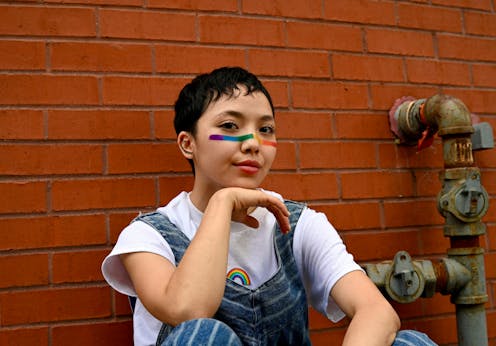
Including pronouns in introductions, your email signature or your social media bio may seem like a minor detail. Pronouns are just small words we use in place of names all the time. But, like names, pronouns have personal significance. They say something about who we are.
Trans, nonbinary and gender-diverse people face many issues more pressing than pronouns, including health and educational disparities and disproportionately higher rates of abuse, violence and discrimination. Getting pronouns right is a simple thing everyone can do to show respect.
Linguistic shifts towards gender inclusivity are occurring worldwide, and the use of gender-neutral or inclusive pronouns is not a new nor exclusively Western phenomenon.
Chinese, one of the world’s oldest languages and spoken by more than one billion people, illustrates how languages adapt to reflect shifting understanding of gender. Its pronoun system may be on the cusp of significant change.
Developing pronouns
In my newly published research, I’ve explored what is happening with Chinese third-person pronouns.
The modern Chinese pronoun system is fascinating for two reasons.
First, gendered pronouns have only been part of the Chinese language for 100 years: the feminine pronoun 她 (she) was only adopted in the 1920s.
Second, although there are now distinct Chinese characters for “he”, 他, and “she”, 她, these are both pronounced tā in Mandarin. You can have a whole conversation about someone without revealing their gender.
The lack of gender-distinct pronouns in spoken Mandarin has prompted calls for written Chinese to follow suit. Queer Chinese speakers have proposed several gender-inclusive pronouns that would be pronounced tā, just like 他 (he) and 她 (she).

These include the romanised form “TA” and new Chinese characters 「⿰无也」 and 「⿰㐅也」. These new characters might look strange: they are written like this to clarify that they should be read as one Chinese character. Currently, they take up the space of two Chinese characters because they are not yet in Unicode and cannot be typed properly.
Other people hope to see the now-masculine 他 regain its original function as an ungendered pronoun.
What pronouns do queer Chinese speakers use?
To understand how Chinese pronouns are changing, I surveyed more than 100 queer Chinese speakers across 12 countries. I asked survey respondents, a third of whom were nonbinary or otherwise gender-diverse, about their pronoun preferences and perceptions. I also analysed how pronouns are used in a large database of contemporary Chinese texts.
My research found gender-inclusive pronouns accounted for about a quarter of first-choice pronouns, and nearly half of all pronouns used by survey respondents. TA was overwhelmingly preferred by gender-diverse individuals (70%), with the English “they” (20%) the next most popular option.
While cisgender and transgender men almost exclusively used masculine pronouns, cis and trans women showed significant openness to using gender-inclusive pronouns alongside feminine ones. After 她 (she), TA was the second most common pronoun for women (40%) and second most common overall (17%).
Notably, 他 (he) was not used by any women or gender-diverse people, except one who considered it gender-neutral. This suggests reviving its original ungendered usage may be difficult.

TA emerged as the most recognised gender-inclusive pronoun, with nearly all respondents (97%) familiar with it regardless of their age, gender, region or language background. In contrast, fewer than 8% had encountered the new character-based pronouns 「⿰无也」 or「⿰㐅也」 and no one reported using them.
What makes TA so popular?
Survey participants were overwhelmingly positive about TA, with 63% expressing favourable views. As one respondent explained:
The look and feel is good, it suits people’s everyday pronunciation habits, and doesn’t create issues with having to specify someone’s gender.
TA functions similarly to English singular “they”. It works in two ways: as a gender-neutral pronoun when gender is unknown (like saying “someone left their umbrella”), and as a gender-inclusive pronoun specifically including gender-diverse people.
Many survey respondents called TA “respectful” and “inclusive” but also simply “convenient”.
However, some respondents were concerned TA is “untraditional” and “pollutes the Chinese language”.
Practical considerations for using emerging Chinese pronouns also extend to the technical challenges of typing new Chinese characters. Before a new character can be typed on computers or phones, it needs to be officially encoded in Unicode, the global standard for digital text.
My research shows this requirement is strongly influencing which emerging Chinese pronouns can gain traction.
While some survey respondents hoped to see a gender-inclusive Chinese character adopted, they weren’t optimistic about 「⿰无也」or 「⿰㐅也」 becoming mainstream.
As one noted:
「⿰无也」is good, but it’s hard to type and it takes a long time to explain.
User-friendly and easily understandable
TA is currently the most popular emerging Chinese gender-inclusive pronoun, crucially because it mimics how people use tā in spoken Mandarin.
It is already part of people’s vocabulary, and already used (at least as a gender-neutral pronoun) by mainstream Chinese media and on online platforms.
This 2023 TEDxSuzhouWomen talk is titled ‘We are all gender misfits’ (你我ta都是"性别酷儿)Unlike other recently proposed pronouns, TA is versatile, user-friendly and easily understandable for queer and non-queer Chinese speakers alike. This makes TA a strong contender for widespread adoption into contemporary Chinese.
Like the introduction of a Chinese feminine pronoun 她 (she) in the 1920s, the emergence of TA as a gender-inclusive pronoun in the 2020s is about recognising a wider spectrum of identities.
Pronouns are not a political statement, just a personal statement. When you use someone’s correct pronouns, you’re saying, “I see you, and I respect who you are”. That’s something worth talking about, in any language.
Authors: Janet Davey, PhD Candidate, Australian Centre on China in the World, Australian National University


















