

Indonesia has sent Australia's recycling home – it's time to clean up our act
- Written by Trevor Thornton, Lecturer, School of Life and Environmental Sciences, Deakin University
Indonesia has returned a container load of recyclables back to Australia, because the material did not meet stringent import requirements.
It is the latest Southeast Asian country to refuse Australia’s recycling waste. In January 2018, China stopped buying our recyclables until contamination was reduced significantly.
To achieve this, Australia needed to reduce contamination in commercial and household recycling, and improve our sorting facilities so they can identify and remove the types of materials causing concern.
Read more: Here's what happens to our plastic recycling when it goes offshore
This should have been a wake-up call that we need to improve our recycling industry and take urgent steps to reduce our reliance on overseas destinations for our recyclables. But did we? Clearly, the answer is no.
Dealing with difficult waste
In July the Philippines turned away 69 containers (about 1,500 tonnes), of materials incorrectly labelled as plastic and containing unacceptable contaminants. Malaysia has also threatened to send recyclables back to the originating country if the loads contain contaminants.
Looking at photos of the material rejected by Indonesia, it is clearly a typical load of baled recyclables that could have come from any sorting facility in Australia. It contains recyclables, but also contamination like used nappies, clothing, food scraps, paper and cardboard in the plastic recycling, metals and plastic in the paper recycling and some containers that once had motor oil or detergents in them.
While I personally suspect it’s slightly over the top to call this “hazardous” material, as some news reports have – the same loads are shipped to some facilities in Australia – it is a moot point. Indonesia can set whatever rules they deem necessary to protect the health of their communities and environment.
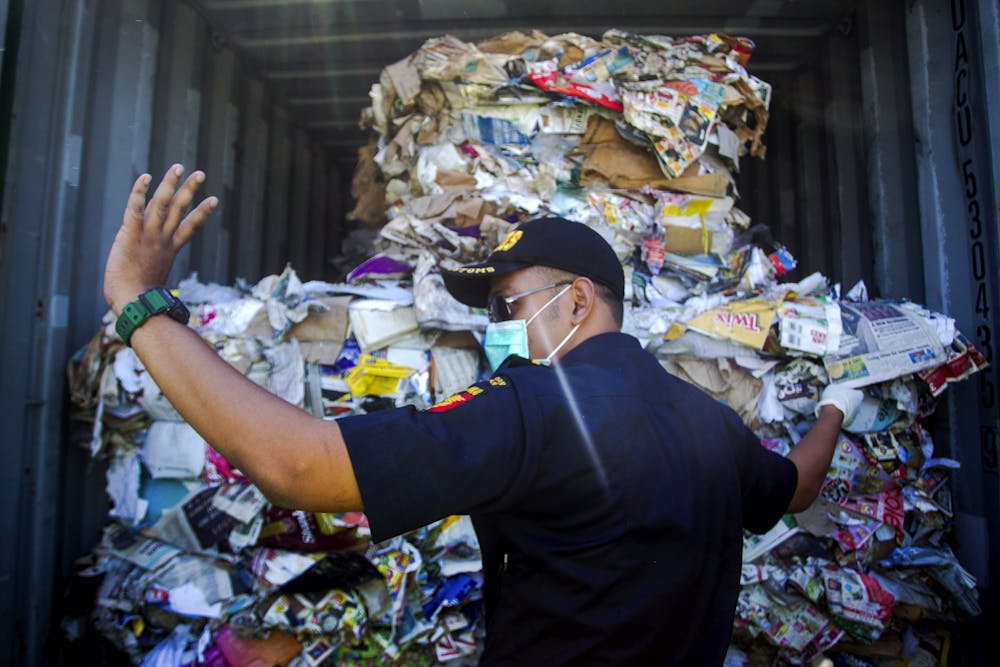 Indonesia is not the only country to turn back contaminated waste.
FULLY HANDOKO/EPA/AAP
Indonesia is not the only country to turn back contaminated waste.
FULLY HANDOKO/EPA/AAP
This continues after strong warnings that unless we provide clean recyclables, we will not have access to these overseas markets.
So what is contamination?
Recycling is basically divided into “streams”. Mostly these streams contain one or two types of materials. For example, we have a cardboard stream, plastic stream or in some instances commingled stream which contains plastic, aluminium, steel and glass containers.
“Contamination” refers to materials that are not wanted in that stream because they interfere with the proper treatment of a given load. Plastic in a load of cardboard and paper is contamination; so are clothes in a plastic load. It does not necessarily need to be toxic chemicals or other things that come to mind when we think of “contamination”.
However, containers used for detergents, disinfectants, and the broad range of household chemicals do contain residues. While some of these fluids and powders do get removed (often while materials are being baled), some residues remain and this can also cause issues for those wishing to use the recyclables as their raw materials.
Read more: Recycling: why you can't just throw anything in the collection bin
So it is no wonder Australian businesses are reluctant to use what we currently sort and send out as their raw materials. If the recyclables materials contain contaminants at a high level, then the business who could have used them would have to expend resources to clean up the loads. Apart from that cost, they then have to dispose of the unwanted materials to landfill.
Additionally, due to some uncertainty in the quality of the recyclables, manufacturers are concerned whether their products will be of the required standard and if not, will that affect the customer base. Remember, when recycled paper was first on the market there was some concern about inferior “whitness” and this affected sales. (Ironically, now most business use recycled paper this situation is somewhat reversed.)
How can we fix it?
Ultimately, the issue is not how we can get other countries to accept our waste. Australia needs to improve our capacity and willingness to use recycled materials ourselves.
We have seen progress recently with Australian companies using recycled materials in new and innovative ways. Plastics used in road construction or in building materials is just one example.
But unless our recycling is better sorted, it won’t be used by domestic companies. Even products made with recycled material need to be clean, safe and reliable.
Read more: Why you're almost certainly wasting time rinsing your recycling
So what can we do about it? Of course, the obvious first step is to invest more into recycling facilities so they can sort more efficiently. However, we all need to take responsibility for what we put into the recycling at home or work. Many contaminants can easily be avoided with a little more care, so familiarise yourself with what can be recycled by your home council.
Finally, recycling is not a panacea. We need to seriously reduce the amount of waste we create, as individuals and a society. Without this, the problem will only continue to grow.
Read more: We can't recycle our way to 'zero waste'
Authors: Trevor Thornton, Lecturer, School of Life and Environmental Sciences, Deakin University

















