

‘Politically weakened’ or ‘muddling through’ – Luxon and Hipkins ranked on their mid-term prospects
- Written by: Grant Duncan, Teaching Fellow in Politics and International Relations, University of Auckland, Waipapa Taumata Rau
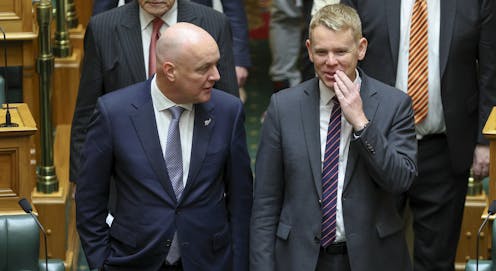
We’re roughly half way through this parliamentary term, and it looks as though the 2026 election could deliver “Christopher vs Chris: the sequel”.
Neither leader is currently riding high, though. National’s Christopher Luxon and Labour’s Chris Hipkins are both scoring in the low 20s in the most recent preferred prime minister polls.
Most voters, it seems, are ambivalent or unimpressed with them. And Luxon has been the subject of media speculation about a possible leadership change.
But it pays to be cautious, especially this far from an election. Leadership is a complex mix of individual ability, career stage and political context.
We can think of political leaders having a “stock” of leadership “capital” that fluctuates over time. They build up credit or authority, but they have to spend it. Former supporters can become bored, disappointed or disillusioned.
Any assessment of a leader will involve some subjective judgements. But the Leadership Capital Index (LCI) was developed by three British and European political scientists as a framework for scoring leadership on a range of sliding measures.
As this example using former British prime minister Tony Blair shows, the LCI accounts for a leader’s skills, support and reputation based on their performance, polling and prospects over time.
I applied the LCI to Hipkins and Luxon. Ideally, this would be conducted by a panel, and more than once over a career. But readers are welcome to examine and comment below on my assessments – a virtual panel, if you like. You can see more detail about my reasoning here.
The LCI’s ten factors are a mixture of the objective and subjective, adding up to an overall ranking of a leader’s political capital on a five-point scale:
depleted – “lame duck”
low – “politically weakened”
medium – “muddling through”
high – “momentum”
exceptional – “political weather maker”.
Neither Luxon nor Hipkins performed very well: Luxon came out on the low-capital range looking “politically weakened”, while Hipkins was “muddling through” on medium capital.
Leadership capital changes over time, and the LCI takes account of that. This assessment relates to mid-March 2025.
The Leadership Capital Index
1. Political/policy vision: (1. Completely absent. 2. Unclear/inconsistent. 3. Moderately clear/consistent. 4. Clear/consistent. 5. Very clear/consistent.)
I’ve given both leaders 4 out of 5 here. Both have presented clear and consistent political and policy visions. Readers who disagree will see I take some relevant issues into account in the items below.
2. Communication performance: (1. Very poor. 2. Poor. 3. Average. 4. Good. 5. Very good.)
Luxon has been struggling here. His failure to give broadcaster Mike Hosking a straight answer about a cabinet sacking didn’t help, and he has been criticised for his corporate speaking style. Hipkins has performed better as a communicator (regardless of your views on his values). I’ve given Luxon 2/5 and Hipkins 4/5.
3. Personal poll rating relative to the most recent election: (1. Very low (–15% or less), 2. Low (–5 to –15%), 3. Moderate (–5% to 5%), 4. High (5-15%), 5. Very High (15% or more).)
This is an objective numerical measure based on preferred prime minister polls just before the 2023 election compared with the most recent ones. Both Luxon and Hipkins score 3/5.
4. Longevity (time in office as prime minister): (1. less than 1 year. 2. 1-2 years. 3. 2-3 years. 4. 3-4 years. 5. More than 4.)
At March 2025, Luxon gets 2/5 and Hipkins gets 1/5. If we included time in office as party leaders, the numbers would be higher.
5. Selection margin for party leadership: (1. Very small (less than 1%). 2. Small (1-5%). 3. Moderate (5-10%). 4. Large (10-15%). 5. Very large (more than 15%).)
Both leaders were elected as party leader by their respective caucuses. These votes are private, but it’s known Hipkins’ selection was unanimous. I believe Luxon also won by a large margin (greater than 15%). So they both get 5/5.
6. Party polling relative to most recent election result: (1. –10% or lower. 2. –10% to –2.5%. 3. –2.5% to +2.5%. 4. +2.5% to 10%. 5. More than 10%.)
In early March, Labour was polling in the low 30s, up from an election result of 26.9%. So Hipkins gets 4/5. National was also polling in the low 30s, down from 38.1%. So Luxon gets 2/5.
7. Levels of public trust: (1. 0-20%. 2. 20-40%. 3. 40-60%. 4. 60-80%. 5. 80-100%.)
Going back to a “trust” poll in early 2023 and a similar one in May that year, Luxon scored a lower trust level (37%) than Hipkins (53%). So Luxon gets 2/5 and Hipkins gets 3/5.
8. Likelihood of credible leadership challenge within next 6 months: (1. Very high. 2. High. 3. Moderate. 4. Low. 5. Very low.)
This relies on predictions, but Luxon is in greater danger than Hipkins. National’s polling is down, with some predicting a leadership change (although others acknowledge this could carry more costs than benefits). Hipkins lost the 2023 election but seems secure as Labour leader. Luxon gets 3/5 (moderate risk) and Hipkins gets 4/5 (low risk).
9. Perceived ability to shape party’s policy platform: (1. Very low. 2. Low. 3. Moderate. 4. High. 5. Very high.)
This is subjective but not about liking or disliking the policies. Both leaders perform moderately well here on 3/5. Luxon has put his own managerial style on policymaking, notably with quarterly targets. When Jacinda Ardern resigned as prime minister, Hipkins lit a “policy bonfire” to begin afresh. But he is taking time to announce new ones. We’d expect to see improvements for both leaders closer to the election.
10. Perceived parliamentary effectiveness: (1. Very low. 2. Low. 3. Moderate. 4. High. 5. Very high.)
Hipkins has an advantage, given his greater parliamentary experience. Luxon hasn’t dealt decisively with two attention-grabbing coalition partners, especially over ACT’s Treaty Principles Bill. Hipkins gets 4/5, Luxon 2/5.
Final scores – now have your say
The results add up to a ranking on the leadership capital index. Out of a possible 50, Luxon scores 28 and Hipkins 35. Neither is a great score; both careers look stalled.
On the index, this defines Luxon as “politically weakened”. This could improve through better communication, sounder leadership of an ambitious team, and greater control over coalition dynamics.
But Luxon’s leadership capital has never been particularly high. He didn’t enjoy a post-election “honeymoon” and may have peaked early – and low. More low polls may see National remove him, but there is also still time for his policies to pay off.
The index has Hipkins “muddling through”. He needs to connect with voters, boost his reputation as a future leader (rather than election loser) and sharpen Labour’s policy platform.
Hipkins’ leadership capital might have peaked in early 2023 when he became prime minister. Labour party polls are up a bit since the election, but his own preferred prime minister polling has stayed relatively low.
Finally, neither leader has performed well compared with their predecessors John Key and Jacinda Ardern at their heights. But political fortunes can be unpredictable, and crises can even boost them, so the future remains unwritten.
Is this assessment fair or unfair? Readers are welcome to critique my analysis and offer alternative ratings in the (moderated) comments section below.
Authors: Grant Duncan, Teaching Fellow in Politics and International Relations, University of Auckland, Waipapa Taumata Rau


















