

Laws governing space are 50 years old. New ones are needed to prevent it becoming a ‘wild west’
- Written by: Yucong Wang, Lecturer, School of Law and Justice, University of Newcastle
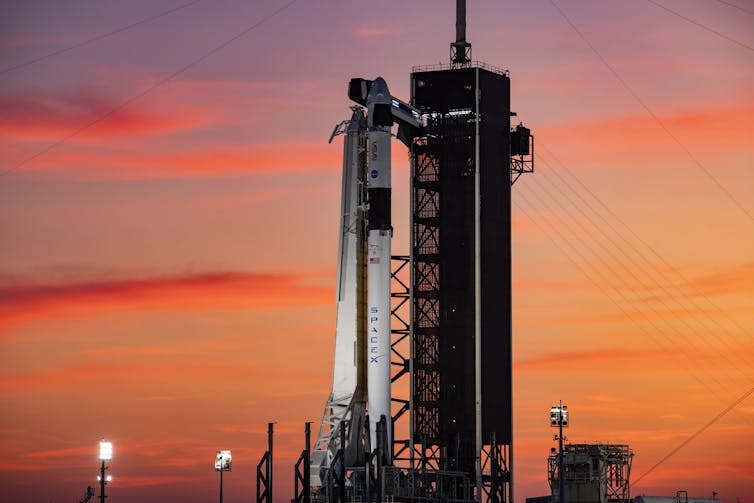
In the first few months of 2025, there’s been a flurry of private venture space missions. Some have been successful, such as American company Firefly Aerospace landing its spacecraft Blue Ghost Mission 1 on the Moon. This was the first successful lunar landing of a privately owned spacecraft.
But there have also been several recent failures. None have been more spectacular than the repeated explosions of tech billionaire Elon Musk’s SpaceX Starship rockets in January and March.
In theory, there are a range of international laws governing these activities. However, most were established roughly half a century ago, before space was within reach of private companies eager to explore it and exploit its untapped resources.
With this development, there is an urgent need to update laws governing what happens in space, in order to prevent it becoming a kind of “wild west” where tech billionaires and the companies they own can do as they please with little to no accountability, consequence or regard for the public good.
Laws as old as the Cold War
Space activities are mainly governed by United Nations treaties. These include the 1967 Outer Space Treaty, the 1972 Liability Convention, and the 1979 Moon Agreement.
But these agreements were created during the Cold War, when space exploration was shaped by military sensitivities and mainly conducted by nation states.
Yet private companies are now major players in space. They can bring the allure of space to the masses, for a pretty penny. For example, most of the roughly 11,000 active satellites orbiting Earth are privately owned.
NASA now relies on partnerships with companies to combine expertise and save costs. The European Space Agency does the same, as do many of the 77 countries with space programs
Elon Musk has expertly tapped into this trend, securing US$22.6 billion in United States government funding for SpaceX.
Private spacecraft journeys may combine commercial and national goals. For example, the Blue Ghost Mission 1 was contracted by NASA through its Commercial Lunar Payloads initiative. It carried a suite of NASA science and technology instruments.
Just days later, another company put a spacecraft on the Moon. Yet the Intuitive Machines Athena spacecraft landed awkwardly. It toppled over and was soon declared dead. It too was carrying expensive NASA cargo.
National space agencies will continue to rely on company partners in more ambitious ventures. But what happens when things go wrong? How can private companies be held accountable if they damage the property of others, or cause environmental harm on celestial bodies?
Space traffic
There is an increasing risk of collisions among satellites, spacecrafts and space debris. And while there are some mechanisms for collision warnings, there is no global approach to assess the risk of collisions.
The 1972 Liability Convention provides guidance about addressing liability after satellite collisions. However, it only directly applies to states, not private companies.
If a private company’s spacecraft causes damage, the affected party can only initiate a claim via diplomatic channels against the launching state, not the company itself. The claims pathway can be complex, slow and subject to diplomatic negotiations.
Also, some satellite operators purchase insurance to cover damage from collisions, wisely bypassing the convention. Insurance creates an efficient private mechanism to address damages, avoiding the need to involve states or navigate the diplomatic processes required under the Convention.
But space insurance is incredibly expensive, so most satellites are not insured.
The Outer Space Treaty says countries must avoid contamination of space. But it does not specifically address the problem of accumulated space debris.
The long-term sustainablity of space activities, including the build up of debris, was not the pressing issue for the treaty’s drafters. Moreover, the treaty’s language is vague, requiring states to act with “due regard” for others’ interests and conduct “appropriate” consultation before undertaking potentially harmful activities. However, it does not define what these terms mean.
Who owns the resources in space?
The prospect that humans will be able to collect and sell mineral resources from astronomical objects is edging closer to reality. Initial focus is on the Moon. But who owns the resources on the Moon?
There is no internationally agreed-upon property rights regime beyond Earth. The US is trying to achieve private ownership of space resources through its 2020 “Artemis Accords”.
This effort is a big boost to the privatisation of space. But it contrasts with the “common heritage of mankind” concept – the cornerstone of the 1979 Moon Agreement.
So far 53 countries have signed the Artemis Accords. But only 17 countries are parties to the Moon Agreement. Without clear rules applicable to all space players, lunar exploration and mining by private entities may run into trouble.
There are many worrying scenarios. A private spacecraft might crash into a country’s lunar accommodation facility due to a lack of “rules of the road” on the Moon. Lunar traffic and mining might cause damage to the Moon’s surface.
Can private entities be held accountable for this damage? The current space law regime does not address such hypothetical problems that may become real in coming years.

Safe and sustainable space exploration
Space law must evolve to ensure safe and sustainable commercial space travel and lunar exploration. This can only be achieved by building international consensus on new rules for space missions.
This requires many challenging discussions.
What types of damage to the Moon should be remediated, and by who? What is the most suitable avenue for affected entities to apply for compensation? What rules should be in place to manage the increased traffic volume in outer space? How can countries be incentivised to strengthen their oversight of their private entity partners in joint missions?
Perhaps the easiest issue to solve is which side of future lunar highways to drive on. With the US and China leading the way at the moment, it would be on the right side.
Authors: Yucong Wang, Lecturer, School of Law and Justice, University of Newcastle


















