

As the rescued astronauts return, space law is still in orbit over who’s responsible when missions go wrong
- Written by: Anna Marie Brennan, Senior Lecturer in Law, University of Waikato
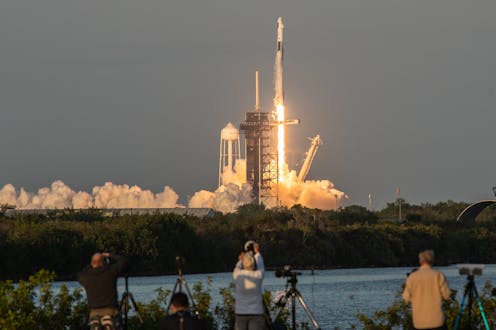
Now back on Earth thanks to Space X’s Dragon capsule, astronauts Suni Williams and Butch Wilmore will be breathing fresh air again after a gruelling nine months onboard the International Space Station.
Stranded in June 2024 after their experimental Boeing Starliner spacecraft malfunctioned and was deemed too risky to carry passengers back to Earth, their stay was further extended last week when the recovery mission was postponed due to launchpad problems.
A successful rescue mission will be a relief to NASA, which had the unprecedented task of figuring out how to get the astronauts home. But the crisis has also raised difficult questions about space missions and what happens if they don’t go to plan.
This is complicated by civilians now going into space, including actor William Shatner and business tycoons Jeff Bezos and Richard Branson. Later this year, pop star Katy Perry and talk show host Gayle King will blast off on board Blue Origin’s NS-31 Mission.
Corporations such as SpaceX, Blue Origin, Rocket Lab and Virgin Galactic are increasingly at the forefront of the new space race, but they operate in a legal vacuum as well as an atmospheric one.
With the law not keeping pace with this rapid rise in commercial space exploration and exploitation, just who has a duty to rescue so-called space tourists and astronauts is unclear. Urgent legal reform is needed.
Privatisation of space
International space law contains a special duty for countries to rescue astronauts, regardless of their nationality.
According to the United Nations Agreement on the Rescue of Astronauts, all member countries of the treaty, not just the country that launched the mission, have a duty to take “all necessary steps” to assist spacecraft crew in distress.
This includes missions still in space as well as spacecraft that crash land in another state’s territory or at sea. The state conducting the rescue mission must safely return the astronauts to Earth – and to the country they originally launched from.
But it’s not clear whether private space companies will have a similar duty. Some experts worry space tourists may have no real legal protection.
Space law dates from the 20th century, when the 1967 Outer Space Treaty was adopted. But the original space race involved superpowers, and the possibility of corporations one day crossing the “final frontier” wasn’t even considered.
So, if space tourists become stranded like Williams and Wilmore have been, there’s a possibility – in law at least – they could be left to fend for themselves.
Who is an ‘astronaut’?
Space policy experts are now calling on the international community to adopt a broad interpretation of the term “astronaut” to ensure anyone has a right to be rescued regardless of their legal status.
They’re also calling for new rules to determine who is responsible for rescuing private citizens if they get into trouble. Despite the several treaties and conventions regulating space activity, none address space tourism.
Currently, space tourism involves lower atmosphere travel, but SpaceX’s Elon Musk has talked about sending tourists to Mars. However realistic that is, space law is struggling to keep up with such ambitions.
With the rise of private space missions, there is now a strong argument for the companies involved being required to shoulder or share the associated costs and responsibilities.
Described by the UN Office of Outer Space Affairs as “envoys of humankind”, astronauts undergo years of arduous training before taking part in space missions. They are acutely aware of the risks of space travel – but have embraced it.
The same can’t be said for civilians. Space tourism is still in its early days, but the companies promoting it will need to act responsibly and sustainably. This means making their customers aware of the dangers and implementing rescue procedures and protocols.
Without proper regulatory oversight, however, space tourism companies could require prospective customers to sign legal agreements waiving their right to rescue if they are in danger.
The challenge for space law now is to find a workable compromise between human safety and corporate profit motives.
Authors: Anna Marie Brennan, Senior Lecturer in Law, University of Waikato


















