

Southern elephant seals are adaptable – but they struggle when faced with both rapid climate change and human impacts
- Written by: Nic Rawlence, Associate Professor in Ancient DNA, University of Otago
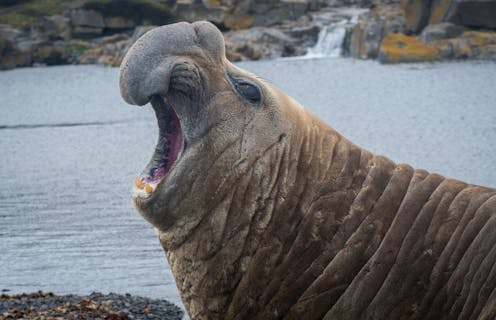
Southern elephant seals (Mirounga leonina) are an iconic species of the Southern Ocean. But with rapid environmental changes in their ocean home, the seals’ population range has been shifting.
Once spread across vast areas of the southern hemisphere, these apex predators are facing challenges from both climate shifts and human activities.
Our new research examines ancient and modern DNA, archaeological records and ecological data.
It reveals how these large marine mammals have adapted – and sometimes failed to adapt – to such pressures since the height of the last Ice Age thousands of years ago.
A dynamic evolutionary history
Today, the largest southern elephant seal populations are found on subantarctic islands, including South Georgia, Macquarie Island and the Falkland Islands. These colonies act as global strongholds for the species.
Yet in the past, until just a few hundred years ago, many smaller populations existed on the Victoria Land Coast in Antarctica and closer to temperate zones, on mainland Australia and New Zealand.
Our study focused on the Australasian lineage of southern elephant seals, drawing on samples from these ancient colonies. By analysing their genetic makeup, we pieced together a timeline of their biological heritage, including population expansions and contractions.
This has crucial implications for understanding the resilience of elephant seals in the face of climate change.
From genetic clues in subfossil and archaeological remains, some thousands of years old, we found evidence of repeated population cycles. Expanding sea ice during cold glacial periods forced the seals northward, only for them to recolonise the Southern Ocean as sea ice retreated during warm interglacials.
This history was particularly dynamic after the height of the last Ice Age 21,000 years ago. The planet started warming then, which led to dramatic ecological shifts.
Elephant seals likely expanded from ice-free refuges in temperate regions such as Tasmania and New Zealand into newly available subantarctic and Antarctic coastlines.
However, this range expansion wasn’t permanent. As the current warm interglacial (the Holocene) progressed, new challenges arose: Indigenous hunting and, later, extensive European industrial sealing.
For Indigenous communities in New Zealand and Australia, elephant seals were a part of their diet.
We know this from seal remains in middens (rubbish dumps) and material culture, including necklaces made from elephant seal teeth which have been found in early Māori archaeological sites.
Archaeological remains from coastal sites in New Zealand and Tasmania indicate significant hunting and reliance on seals by Indigenous populations. Along with human-driven environmental changes, this led to local extinctions.
Impacts of humans and climate change
Genetically, the seals from these ancient Australasian and Antarctic colonies were distinct but related. They formed a unique lineage in the Pacific that included Macquarie Island. This genetic diversity likely resulted from periods of isolation in separate refuges at the height of the last Ice Age.
However, with modern climate shifts and human exploitation, much of this genetic diversity has been lost. The colonies that once thrived on the Victoria Land Coast in Antarctica are now extinct.
Meanwhile, Macquarie Island is home to a significant breeding colony facing its own challenges. Changes in Antarctic sea ice are increasing the distance between breeding grounds on the island and feeding grounds at sea. This has affected the colony’s stability in recent decades.
One of the most striking outcomes of our research is how quickly these large, long-lived animals can respond to environmental pressures. Seals adapted to a shifting climate by expanding their range in response to new habitats and retracting when conditions became unsuitable.
This ability to move and adapt, however, was limited when confronted by the dual pressures of rapid climate change and human exploitation, which reduced their numbers and genetic diversity drastically over a short period.
Can the Southern Ocean ecosystem adapt?
As human-driven climate change continues, the Southern Ocean is expected to continue warming. This will cause further habitat loss for species that depend on sea ice and are affected by shifts in the availability of prey.
The elephant seals’ history offers a window into how marine mammals may respond to these changes. But it also serves as a warning: human impacts, coupled with environmental pressures, can lead to swift, sometimes irreversible declines.
Our research underscores the importance of conserving the genetic diversity and habitats of southern elephant seals. These seals are not just a testament to adaptability in a changing world; they are reminders of the vulnerability of even the most resilient species.
Protecting their remaining strongholds and minimising human impacts on their food sources and breeding grounds will be crucial if we hope to avoid further contractions in their population.
The story of the southern elephant seal is one of survival, adaptation and loss. As we face our own climate challenges, we must consider the lessons embedded in their genetic and ecological history.
It’s a reminder that while nature often adapts to change and can weather some ecosystem threats, human-driven impacts can push even the most adaptable species beyond the point of recovery.
Authors: Nic Rawlence, Associate Professor in Ancient DNA, University of Otago



















