

Antarctic bases are hotbeds of stress and violence. Space stations could face the same challenges
- Written by: Rebecca Kaiser, PhD Candidate, School of Social Sciences, University of Tasmania
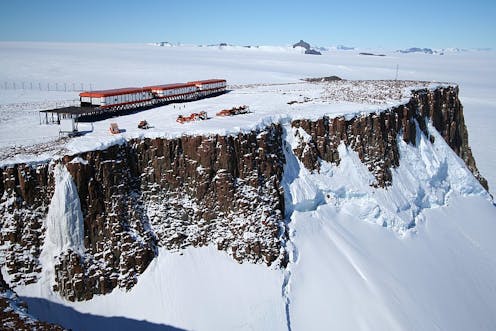
Earlier this week, reports emerged that a scientist at South Africa’s SANAE IV Antarctic research base had accused a colleague of physical assault.
We research Antarctic governance and crime in isolated, confined and extreme environments such as Antarctic and space stations. Rebecca specifically investigates how station cultures evolve in isolation and what factors significantly influence conflict – and what can be done to improve safety in these environments.
What happened on SANAE IV?
SANAE IV is located on the edge of a steep cliff in Vesleskarvet in east Antarctica. The alleged assault stemmed from a dispute over a task the team leader wanted the team to do. In an email published by the South African Sunday Times, the alleged victim said the alleged attacker had also:
threatened to kill [name withheld], creating an environment of fear and intimidation. I remain deeply concerned about my own safety, constantly wondering if I might become the next victim.
Psychologists are now in touch with the research team. They aren’t due to leave the extremely isolated and remote base until December.
This latest incident fits within a broader pattern of crime and misconduct in Antarctica. Research stations on the icy continent are often portrayed as hubs of scientific cooperation. But history has shown they can also become pressure cookers of psychological strain and violence.
Multiple cases of misconduct
There have been multiple cases of misconduct in Antarctica over the years.
In 1959, a scientist at Russia’s Vostok Station allegedly attacked his colleague with an ice axe after losing a game of chess. In 2018, another Russian research station became the site of a stabbing. The alleged cause? Spoiled book endings.
In 1984, the leader of Argentina’s Almirante Brown Station set fire to the facility after being ordered to stay through the winter. This resulted in the station’s evacuation.
The 2000 death of an astrophysicist at the Amundsen-Scott South Pole Station was a suspected murder.
And recent investigations into sexual harassment at multiple Antarctic stations highlight ongoing safety concerns.
Drivers of conflict
Research suggests several psychological and social factors contribute to conflict in remote locations such as Antarctica. These include prolonged isolation, extreme environmental conditions, and the necessity of constant close contact.
In combination, these factors can amplify even minor frustrations. And over time, the lack of external social support, the monotony of daily routines, and the psychological weight of confinement can lead to heightened emotional responses and conflict.
Without structured outlets for stress relief and effective de-escalation mechanisms (such as gyms, libraries, or quiet spaces where mediation between people can happen), tensions can reach breaking points.
Power dynamics also play a crucial role. With limited external oversight, leadership structures and informal hierarchies take on an outsized influence. Those in positions of authority have significant control over how disputes are resolved. This has the potential to exacerbate tensions rather than reducing them.
The process for reporting and responding to incidents in these kinds of environments also remains inconsistent. There’s a lack of policing, and traditional justice systems are also largely absent. Many stations rely on administrative action and internal conflict resolution mechanisms, rather than legal enforcement.
But these mechanisms can be biased or inadequate. In turn, this can leave victims of harassment or violence with few options. It can also lead to more conflict.
Read more: Antarctic stations are plagued by sexual harassment – it's time for things to change

From Antarctica to space
As Antarctica and space become more accessible for research and commercial ventures, proactive approaches to crime and conflict prevention in these remote and extreme environments is vital.
The psychological and social challenges observed in Antarctic stations provide a valuable model for understanding potential conflicts in long-duration space missions. Lessons learned from incidents in Antarctica can inform astronaut selection, training, and onboard conflict resolution strategies.
A key area requiring refinement is psychological screening for personnel.
Current screening methods may not fully account for how individuals will react to the social shift that takes place in a remote environment. This includes the altering of attitudes, personal priorities and tolerances.
More advanced stress tolerance assessments and social adaptability training could improve candidate selection. It could also reduce the likelihood of conflicts escalating to violence.
It’s also vital that we gain a better understanding of the unique conflict dynamics that evolve in these equally unique environments.
Research can help. So too can thorough investigations of incidents, such as the one that allegedly occurred at SANAE IV.
This knowledge can be used to recognise early signs of potential conflicts. It can also be integrated into case study-based training modules for expeditioners prior to their deployment. These training modules should include role-playing scenarios, crisis intervention techniques, and integrating the lived experiences of past expeditioners.
This would better equip personnel to navigate interpersonal challenges.
Going to extremes
The recent alleged events at SANAE IV are indicative of a broader pattern of human behaviour in extreme environments.
If we are to successfully expand scientific exploration and habitation in these settings, we must acknowledge the realities of human conflict and develop strategies to ensure the safety and wellbeing of those who live and work in these challenging conditions.
Studying crime and conflict in environments such as Antarctica is not just about understanding the past. It’s about safeguarding the future of exploration – whether on Earth’s harshest frontier or in the depths of space.
Authors: Rebecca Kaiser, PhD Candidate, School of Social Sciences, University of Tasmania


















