

We combed through old botanical surveys to track how plants on Australia’s islands are changing
- Written by: David Coleman, Post-doctoral Researcher in Plant Ecology, Macquarie University
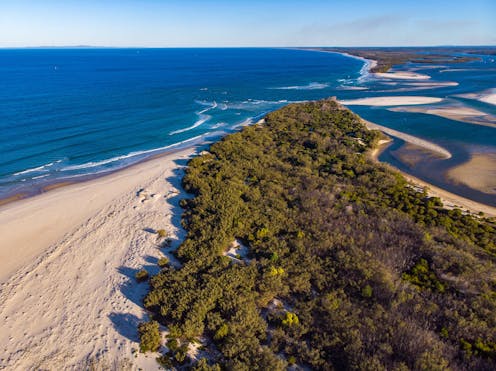
More than 8,000 continental islands sit just off the coast of Australia, many of them uninhabited and unspoiled. For thousands of species, these patches of habitat offer refuge from the threats they face on the mainland.
Coastal islands are also a valuable resource for ecologists studying how communities of plants colonise new habitats and change over time.
Now, we have created a new publicly available database known as A-Islands, which draws on decades of plant surveys (where botanists visit a particular location and record the plants found there).
This unique collection of surveys draws on data about more than 6,500 plant species from over 850 islands. Some vast islands stretched for kilometres, while others were as small as a tiny apartment.
Our new research, published in the Journal of Vegetation Science, provides new insights into how Australia’s coastal islands have changed over time, and can help with plant monitoring and conservation efforts as the climate warms.
Scaling steep cliffs, jumping from helicopters
We built A-Islands by painstakingly digitising plant surveys from old books and records, and speaking with botanists and organisations all over Australia.
A-Islands is made up of 1,350 island botanical surveys dating back to the 1940s, from over 135 different sources. We are still adding more.
The stories of how the data was collected were fascinating. In some cases, people camped on islands for weeks, making sure they’d recorded every living organism they could.
Some scaled steep cliffs from small boats or even jumped from helicopters to access remote islands, and record the plants they found there.
Australia’s islands punch above their weight
As we collated the surveys, we realised Australia’s coastal islands were punching above their weight for species diversity.
Despite making up less than 1% of Australia’s land area, at least 25% of Australia’s plant species inhabit these coastal islands.
These islands’ climates are almost as diverse, spanning coral atolls in tropical north Queensland to the cold and windswept rocky isles off the southern tip of Tasmania.
While some species of plants have colonised hundreds of Australian islands, most inhabit just a few isles.
These plant communities are the backbone of island ecosystems and provide havens for many endangered animals.

A rare resource for scientists
Many of the islands featured in A-Islands have been surveyed more than once over the last 100 years.
Most data in the ecological sciences tends to provide a snapshot in time of the species that might be at a location.
In contrast, A-Islands can tell us how the plant communities have changed over decades.
This is surprisingly rare in ecological studies but essential if scientists are to predict vegetation changes in the future as the climate changes.
A new idea
Many people think of plant communities as static and unchanging.
However, A-Islands shows that on these small coastal islands, mainland species are migrating to the island, persisting for a time, and then going extinct and being replaced by other species.
This concept of species constantly changing at a particular location is called species turnover. In theory, the types of species in an island community will change over time but the number of species remains, on average, the same over the long term.
The data in A-Islands not only confirms this has happened at an unprecedented number of archipelagos, but also suggests a new idea: some types of species “turnover” faster than others.
Species like grasses and small herbs tend to come and go from islands more frequently than longer lived taller species.
Islands can be climate refuges
Data sets such as A-Islands will become even more essential as the climate changes. Islands are at the forefront of biodiversity loss, and over half of the known global plant extinctions have occurred on islands.
Uncovering these underlying trends in species community change will be crucial for predicting how plant communities everywhere respond to climate change over the coming centuries.
The Future of Ecological Research - Interview with Prof Dr Mark Westoby from Macquarie University.These islands will be important climate refuges, buffered from the hottest temperatures by the surrounding ocean and protected from mainland pressures. They will be vital plant habitats in the future.
The A-Islands dataset forms a crucial baseline for defining what species have inhabited our pristine island environments over time.
It can also help scientists work out where to prioritise surveys they’ll need to do as the climate changes.
Authors: David Coleman, Post-doctoral Researcher in Plant Ecology, Macquarie University


















