

The search for missing plane MH370 is back on. An underwater robotics expert explains what’s involved
- Written by: Stefan B. Williams, Professor of Marine Robotics, Australian Centre for Robotics, University of Sydney
More than 11 years after the disappearance of Malaysia Airlines flight MH370, the Malaysian government has approved a new search for the missing debris of the aircraft.
Malaysia announced the push for a renewed search last year, ten years after the tragedy that claimed the lives of 239 people.
Seabed exploration firm Ocean Infinity, which conducted an unsuccessful search in 2018, prepared a new proposal to which Malaysia’s government agreed in principle in December last year.
Now, the company has returned to the southern Indian Ocean 1,500 kilometres west of Perth – with a suite of new high-tech tools.
A search area the size of Sydney
Ocean Infinity is involved in projects surveying for offshore oil and gas reserves, and for suitable locations for offshore renewable energy projects.
But it has also proved it is capable of locating underwater wreckage in the past. For example, in 2018, the company found a missing Argentinian navy submarine nearly 1,000 metres underwater in the Atlantic Ocean. And last October, it found the wreck of a US Navy ship that had been underwater for 78 years.
The new search area for MH370 is roughly the size of metropolitan Sydney. It was identified in collaboration with experts based on refined analysis of information received after the aircraft disappeared. This information included weather, satellite data and the location of debris attributed to the aircraft which washed up along the coast of Africa and islands in the Indian Ocean.
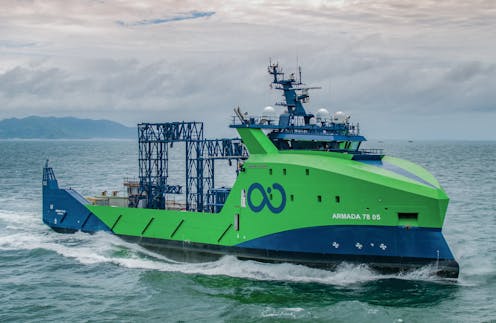
For this search, Ocean Infinity will be using a new 78 metre offshore support vessel, the Armada 7806. It was built by Norwegian shipbuilder Vard in 2023.

Advanced sonar technology
The Armada 7806 is equipped with a fleet of autonomous underwater vehicles manufactured by the Norwegian firm Kongsberg.
These 6.2m long vehicles are capable of operating independently of the support vessel at depths of up to 6,000m for up to 100 hours at a time. They are equipped with advanced sonar technology, including sidescan, synthetic aperture, multibeam and sub-bottom profiling sonar.
Sonar systems are essential for underwater mapping and object detection surveys. They use acoustic pulses to look for echoes from the seafloor.
Sidescan sonar captures high-resolution images of the seafloor by sending out pulses of sound and detecting objects that reflect the sound pulses back.
Synthetic aperture sonar is a technique for combining the results from multiple “pings” to effectively make the scanner bigger and more powerful, seeing further, and producing more detailed images.
Multibeam sonar, in contrast, maps the seafloor topography by emitting multiple sonar beams in a fan-shaped pattern below the platform.
Finally, sub-bottom profiling sonar operates at lower frequencies and penetrates the seabed to reveal underlying geological structures. This is useful for archaeological studies, sediment analysis and identifying buried objects.
Together, these sonar technologies provide complementary data for underwater exploration, search and recovery, and geological assessments.
Camera systems and lights on the vehicles may be used to confirm potential targets. Once a target of interest is detected using sonar, the vehicles would be programmed with missions designed to operate significantly closer to the seafloor. This would allow them to capture imagery of the search area with which to identify the targets.
Such a search would only be conducted once a target of interest is identified, as the area covered by each image is significantly smaller than that covered by sonar, therefore requiring much denser survey tracks.
Significant advancements in robotics
Since its previous search in 2018, Ocean Infinity has made significant advancements in its marine robotics and data analytics capabilities. It has demonstrated its capacity to simultaneously deploy multiple vehicles at depths of up to 6,000m.
This significantly increases the coverage area, as each vehicle covers its own patch of seafloor. This will allow for a more efficient and comprehensive survey of the designated search zone.
The data being collected by the vehicles will be downloaded once the vehicles are brought back onboard, and stitched together to provide detailed maps of the search areas.
Difficult conditions, above and below the surface
Conditions in the search region are expected to be difficult. Weather on the surface will likely provide challenges for the support vessel and the crew. Underwater vehicles will have to contend with complex conditions on the seafloor, including steep slopes and rough terrain.
The operation is expected to take up to 18 months. Weather conditions are most likely to be favourable between January and April.
If Ocean Infinity succeeds in finding the wreckage of MH370, the Malaysian government will pay it US$70 million.
The next steps would be trying to retrieve the plane’s black boxes, which would enable investigators to piece together what happened in the final moments before the plane plunged into the ocean. The Armada 7806 is likely to have remotely operated vehicles onboard equipped with cameras and manipulator systems, which may be used to verify the wreck site and in any future salvage operations.
If Ocean Infinity fails, it will receive no payment. And the investigation into the location of the plane will essentially be back to square one.
Authors: Stefan B. Williams, Professor of Marine Robotics, Australian Centre for Robotics, University of Sydney


















