

how rethinking flood management can benefit people and nature
- Written by: Christina McCabe, PhD Candidate in Interdisciplinary Ecology, University of Canterbury
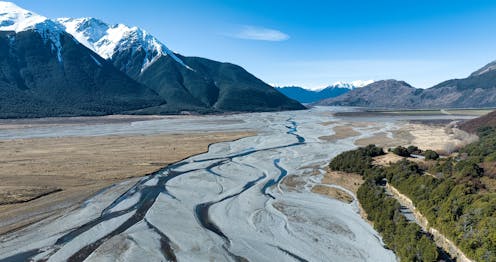
When we think about flood management, higher stop banks, stronger levees and concrete barriers usually come to mind. But what if the best solution – for people and nature – isn’t to confine rivers, but to give them more space?
This alternative is increasingly being considered as an approach to mitigating flood risk. But allowing rivers room to move also delivers ecological benefits far beyond flood risk reduction. It supports biodiversity, improves water quality and stores carbon.
As climate change increases the frequency and intensity of extreme floods, rethinking our approach to managing floodplain rivers has never been more urgent.
Climate change, floods and river confinement
Climate change is amplifying flood risks worldwide, and Aotearoa New Zealand is no exception. Large floods are expected to become much more frequent and severe, threatening communities, infrastructure and ecosystems.
Many of these risks are made worse by past management decisions that have artificially confined rivers within narrow channels, cutting them off from their natural floodplains.
Floodplain river systems have historically been dynamic, shifting across landscapes over time. But extensive stop banks, modification of river channels and land development have restricted this natural variability.
Strangling rivers in this way transfers and heightens flood risks downstream by forcing water through confined channels at greater speeds. It also degrades ecosystems that rely on the natural ebb and flow of river processes.
Giving rivers space to roam
The idea of allowing rivers to reclaim space on their floodplains is not new.
In the Netherlands, the Room for the River programme was a response to flooding in 1995 that led to large-scale evacuations of people and cattle. In England, predictions that economic risks associated with flooding will increase 20-fold within this century ignited the Making Space for Water strategy.
However, these initiatives typically remain focused on flood protection, overlooking opportunities to maximise ecological benefits. Our new research shows that well-designed approaches can deliver ecological gains alongside flood protection.
This is crucial because floodplain river systems are among the most valuable ecosystems. They provide about a quarter of all land-based ecosystem services such as water retention and pollutant filtration, as well as educational, recreational and cultural benefits.
Managing rivers for variability
A fundamental shift in river management involves acknowledging and accommodating natural variability. Floodplain rivers are not static: they change across landscapes and through time, responding to seasonal flows, sediment movement and ecological processes.
Our research synthesises the ecological processes that are enabled when floodplain rivers have room to move.
Rivers that are not unnaturally confined are typically more physically complex. For instance, along with the main river channel, they might have smaller side channels, or areas where the water pools and slows, springs popping up from below ground to re-join the surface waters, or ponds on the floodplain.
A diverse range of habitats supports a rich variety of plant and animal life. Even exposed gravel, made available in rivers that flow freely, provides critical nesting sites for endangered birds.
Biodiversity is not one-dimensional. Instead, it exists and operates at multiple scales, from a small floodplain pond to a whole river catchment or wider. In a dynamic, ever-changing riverscape, we might find the genetic composition of a species varying in different parts of the river, or the same species of fish varying in their body size, depending on the habitat conditions.
These examples of natural biological variability enable species and ecosystems to be resilient in the face of uncertain future conditions.
At a larger scale, the type and number of species that live in different floodplain river habitats also varies. This diversity of biological communities produces variation in the functions ecosystems perform across the river, such as the uptake of nutrients or processing of organic matter. This can even help to diversify food webs.
These variations mean not all species or groups of species in the river will be vulnerable to the same disturbances – such as droughts or floods – at the same time. This is because plants and animals in rivers have evolved to take advantage of long-term rhythms of floods and droughts in different ways.
For instance, the cottonwood poplars of the southwest United States time their seed release with the highly predictable rhythms of snowmelt-driven spring floods in that part of the world. In Aotearoa New Zealand, whitebait fish species typically deposit their eggs during high autumn flows, which then get transported to sea as larvae during high winter flows.
Some animals need multiple habitats within the river for different stages of life. Other creatures travel from afar to use river floodplains for only a short time. The latter includes the banded dotterel (Charadrius bicinctus), endemic to Aotearoa New Zealand. This bird travels as far as 1,700km to nest on braided-river gravels each spring. Banded dotterels are in decline, and they rely on habitats provided by rivers that have space to roam.
A call for more sustainable river management
As climate change accelerates, we must rethink how we manage our waterways. Reinforcing levees and deepening channels may seem like logical responses to increased flood risk, but these approaches often exacerbate long-term vulnerabilities and transfer risk elsewhere.
We call for practitioners to broaden the scope of values included in river management policy and programmes to include ecological variability.
Nature-based solutions are approaches that seek to benefit both people and nature. By working with nature rather than against it, we can create landscapes that are more resilient, adaptive, and supportive of both people and biodiversity.
It’s time to embrace a new paradigm for river management – one that sees rivers not as threats to be controlled, but as lifelines to be protected and restored.
Authors: Christina McCabe, PhD Candidate in Interdisciplinary Ecology, University of Canterbury


















