

Ningaloo and the Great Barrier Reef are bleaching in unison for the first time
- Written by: Zoe Richards, Senior Research Fellow in Marine Biology, Curtin University
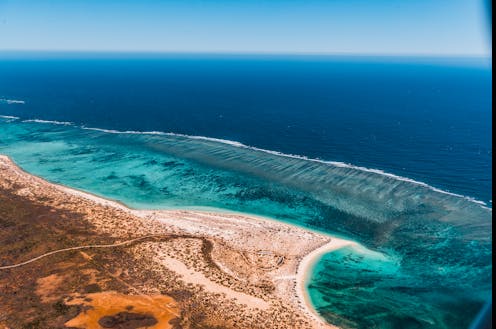
This summer, an intense marine heatwave struck off northwestern Australia, driving sea surface temperatures up to 4°C above the summer average. The large mass of warm water has slowly moved south from the Kimberley region and through the Pilbara, leaving a wave of underwater destruction behind. Now Ningaloo Reef is bleaching in earnest.
The Great Barrier Reef is bleaching too in the waters from Cape York down to Townsville.
This appears to be the first time these two World Heritage-listed reefs have bleached in unison. Bleaching may also hit the World Heritage reef at Shark Bay in Western Australia.
How bad is it? I have just returned from Ningaloo Reef, where I saw widespread bleaching and the first signs of coral mortality. Up to 90% of the coral found in shallow areas of the northern lagoon had bleached. Bleaching doesn’t automatically mean death, but it severely weakens the coral and jeopardises survival.
At Ningaloo and further south, the heatwave is still unfolding. In coming months, we can expect to see some coral mortality, while other corals will survive the bleaching in poor health only to succumb to disease or other threats such as Drupella (coral-eating snails). Other corals may survive but struggle to reproduce, but some particularly hardy corals with the right combination of genes for surviving this event are expected to live on.
Why is this happening? No surprises here: our greenhouse gas emissions trap more heat in the atmosphere. Over 90% of the heat pours into the oceans, pushing surface and deep water temperatures higher for longer periods of time.

How bad has the heat been?
Coral can tolerate brief periods of higher temperatures. But in response to prolonged heat stress, coral polyps expel their symbiotic zooxanthellae algae. They appear to do this to avoid further tissue damage from toxic reactive oxygen molecules which build up as the coral begins to stress. But these microalgae supply sugary food to the coral polyps in exchange for a home. Without these nutrients, the coral can starve.
Heat stress is tracked using a measure called “degree heating weeks” (DHW) – essentially, how much above-average heat has built up in an area over the previous three months. Bleaching can begin at four DWH, while eight DHW can kill some corals.
At Ningaloo, the heat has been off the charts – levels of up to 16 DHW have been recorded, the highest on record for this location.
On the Great Barrier Reef, bleaching is underway in the northernmost section. This is the sixth bleaching event on the Great Barrier Reef this decade. Early data suggests there is severe heat in places, ranging from six to 13 DHW in intensity and alerts remain for more heat and bleaching to come.
Bleaching is usually worst for corals growing in shallow water, such as the calm lagoons created by fringing or barrier reefs. Lagoons often have clear waters with high light penetration and limited flushing of water.
Ningaloo in hot water
Over ten days, we recorded the health and type of every coral we saw at 21 sites along Ningaloo Reef, from Coral Bay to the northern tip of North West Cape and into Exmouth Gulf.
The worst affected area that we observed was a 30 km stretch at the northern end of the North West Cape, the peninsula along which Ningaloo Reef runs. Here, we saw mass bleaching – up to 90% of corals partly or fully bleaching and some corals were already dying.
Fast-growing corals from the Acroporid and Pocilloporid families were hard hit, as often seen in other bleaching events. But we also saw slower-growing and normally hardy corals bleaching, such Lobophyllia, Favites and Goniastrea.
Even the massive Porites corals in the lagoons were suffering. These giant boulder-like corals are the old growth and sentinels of the reef. Many of these ordinarily resilient corals are hundreds of years old and have survived past smaller bleaching events. But this time, they too are severely suffering.
Not even ocean-facing corals exposed to more water flow were safe. We found 30 to 50% of the corals on the reef slope were bleached to some degree. Coral diseases such as white band disease were already affecting many flat plate corals. These diseases often follow marine heatwaves, as they take advantage of coral’s weakened immune systems and the disruption of the symbiotic relationship between coral polyps and their algae.

The timing is especially bad for Ningaloo’s corals, which usually spawn around five days after the March full moon, which fell on March 19 this year. By contrast, corals on the Great Barrier Reef tend to spawn between October and December.
For the reef to recover quickly, it needs yearly influxes of new coral recruits. But if corals are struggling to survive, there is a risk they will not be fit enough to reproduce. Corals take three to six years to become reproductively viable and if bleaching impedes reproduction, it could greatly reduce the number of larvae available to replenish the reef. In addition to that, if immature corals bleach and die, there’s a risk several generations of corals could be lost before reaching maturity.
Fortunately we did observe healthy and reproductive corals along the outer rim of the lagoon at Coral Bay, and locals have recently reported seeing spawning near Coral Bay. This suggests some coral were indeed healthy enough to spawn.
What will happen next?
As the southern hemisphere heads towards winter, the oceans will begin to cool off. That doesn’t mean the threat is over – oceans are only getting hotter.
If we continue on our current path, simultaneous east and west coast bleaching events could become the new normal – and that would be devastating for our reefs, marine biodiversity, the blue economy and the wellbeing of Australians.
Authors: Zoe Richards, Senior Research Fellow in Marine Biology, Curtin University


















