

Podcasting was once a rebel medium for diverse voices. Now it’s slowly being consumed by big media
- Written by: Corey Martin, Lecturer/Podcast Producer, Swinburne University of Technology
Podcasting was once the underdog of the media world: a platform where anyone with a microphone and an idea could share their voice.
With low barriers to entry and freedom from institutional gatekeeping, it promised to amplify marginalised voices and allow underrepresented groups to tell their own stories, on their own terms.
Today, however, this promise seems increasingly strained as corporate interests tighten their grip on the industry. As money flows in, the podcasting space is beginning to resemble the rest of the digital media world – driven by advertising revenues and political polarisation.
The promise of podcasting
Six years ago, audio scholars Martin Spinelli and Lance Dann described podcasting as a “revolutionary” medium for its ability to inspire empathy through innovative forms of audio.
Podcasting was heralded as a format that broke through the barriers of traditional media by offering new ways to engage with underrepresented voices and ideas. Media and cultural studies pointed to the direct-to-ear delivery – free from the biases of visual culture – as a uniquely intimate way to consume content.
Globally, the industry boomed as a result of pandemic lockdowns, with the number of podcasts on Spotify skyrocketing from 450,000 in 2019, to 1.5 million in 2020.
Listenership has also surged in Australia. According to a 2024 report by Edison Research, we’ve seen a 20% increase in listenership from 2022 to 2024 – with 48% of the those aged 12 and above having listened to a podcast within the past month.
From open space to rat race
In his 2024 book Podcasting in a Platform Age, podcast researcher John Sullivan warns the podcasting space is being increasingly dominated by a handful of powerful media companies that dictate what and who gets visibility.
Larger podcasts with higher production budgets, celebrity hosts and backing from major networks are attracting larger audiences, with independent creators struggling to get a foot in the door.
At the time of writing, of the top 50 most popular podcasts in Australia, more than half (52%) come from overseas, and primarily the United States.
Of the 24 Australian-made podcasts on the list, 80% are backed by a media organisation, with most (64%) connected to major networks such as LiSTNR, which is owned by Southern Cross Austereo. Only 12% of the Australian podcasts on the list come from truly independent creators without any corporate funding or major production support.
Why does it matter that large-network ownership is on the rise? To understand this, it helps to first understand how ads keep podcast networks in business – and how this can impact content decisions.
Deepening ideological divides
Advertisers follow the crowds. In a podcasting context, this means they’re more likely to funnel their dollars into large networks, further bolstering their resources.
At the same time, networks want to drive as many ears to their ad sponsors as possible. To do this, they focus on producing content they know will get the most engagement.
The result is a vicious cycle in which attention and advertising power feed each other, making it even harder for independent voices to break through. Over time, this feedback loop can lead to less content diversity and more polarisation.

It’s here that we’re seeing an increase of politicians using podcasts to push their views and cultivate ideological loyalty.
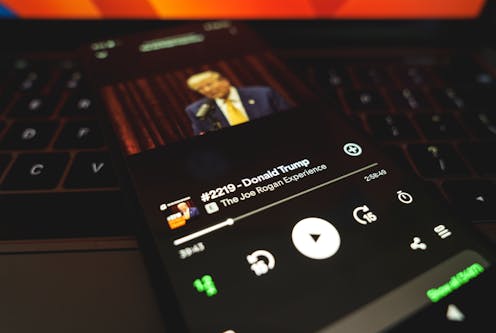
In the lead-up to the 2024 US election, Kamala Harris appeared on Call Her Daddy (the second most popular Spotify podcast in 2024), while Donald Trump was on The Joe Rogan Experience (the most popular). Both interviews were later fact-checked and found to contain false or misleading claims.
Trump’s interview in particular was flagged by CNN for having 32 false claims. Nonetheless, analysts and researchers pointed to it as a driver behind his success with young male voters.
The political podcasting trend is also playing out in Australia ahead of the next federal election.
Late last year, Opposition Leader Peter Dutton appeared on the podcast Diving Deep With Sam Fricker. This was followed by an appearance on Straight Talk, hosted by businessman Mark Bouris, in January.
More recently, Prime Minister Anthony Albanese and Greens leader Adam Bandt separately appeared on It’s A Lot with Abbie Chatfield.
Diversity in the podcasting space
According to 2022 Pew Research Centre data, 55% of Americans said their major reason for listening to podcasts was “to learn”, while 29% said they wanted to stay up-to-date with current affairs. But information-hungry listeners may be getting shortchanged, as podcasts are less likely to be fact-checked against the same editorial standards that govern traditional media.
As platform researcher Michael Bossetta notes, although large platforms such as Spotify have the potential to create a more informed world, they are more likely to push content that keeps users hooked (that is, content they already enjoy and/or agree with).
Recommender algorithms also have a role to play. One 2020 study found that while Spotify’s personalised suggestions increased user engagement by 28.90%, they also reduced the individual-level diversity of podcast streams by 11.51%.
But platforms do have the power to do better. They could, for instance, use their algorithms to prioritise content diversity. This would help ease the “engagement-diversity trade-off”, in which personalisation increases engagement, but limits the diversity of content consumed by an individual.
That said, it’s unlikely platforms will voluntarily change the way they operate. If meaningful reforms are to happen, they will more likely have to come from government regulations or through independent governing bodies.
In the meantime, listeners aren’t powerless. While we can’t stop algorithms from pushing certain content to the top of our feeds, we can disrupt them by actively seeking out independent voices and diverse stories.
Authors: Corey Martin, Lecturer/Podcast Producer, Swinburne University of Technology


















