

our research shows how Australia can stop buying weapons for the wars of the past
- Written by: Pi-Shen Seet, Professor of Entrepreneurship and Innovation, Edith Cowan University
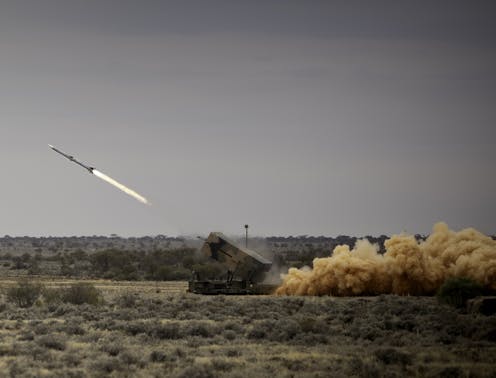
Australia’s defence spending is on the rise. The future defence budget has already been increased to 2.4% of GDP. There is pressure from the new Trump administration in the United States to raise this further to at least 3%.
The Albanese government has brought forward A$1 billion in defence spending for the 2025 federal budget. The Coalition in turn has promised to spend even more if elected.
However, it is unclear whether the money will be spent wisely. Our recent research found that current defence planning may leave the Australian Defence Force (ADF) poorly prepared for future conflicts.
To keep up, Australia must develop capabilities for contemporary “grey zone” operations (coercive statecraft activities that blur the line between peace and war, or fall short of war), as well as future 21st-century conflicts. Priority areas are cyber, information and space technologies.
Positive signs and missteps
In the past two years, we have seen a slew of announcements about the current and future capabilities of the ADF.
Some have been positive. A new Defence Space Command has been set up. The 2023 Defence Strategic Review and 2024 Defence Industry Development Strategy were both promising.
There have also been missteps. The MRH90 helicopters have been stood down. A $7 billion military satellite project was cancelled. And the Collins class submarines face ongoing problems.
Defence experts have complained of “a lack of clear purpose and intent, a lack of direct connection between strategic objectives and industry policy, and a continuing project-by-project approach”.
The ADF acknowledges the need for advanced technological capabilities. However, in practice it is still too focused on platforms and hardware suited more for the conflicts of the past.
The current context and challenges
Several Defence reviews over the past 50 years have found that the ADF procurement and acquisition system lacks the agility and resources to adapt to changes in the strategic environment.
Defence spending as a share of GDP has been declining in Australia since the end of the Vietnam War. Notably, the ADF has focused on reducing costs, lowering errors in defence procurement, outsourcing to industry, and speeding up acquisition.
Read more: FactCheck: is Defence spending down to 1938 levels?
Despite the recent plans to increase defence budgets, critics argue the strategy is too little, too late. It delays the acquisition of most new capabilities to beyond five years from now.
On October 30 2024, Defence Industry Minister Pat Conroy announced a major acquisition of missiles, other guided weapons and explosive ordnance. Many of these acquisitions were simply plugging existing gaps, and would not be ready until at least 2029.
Many of the acquisitions (such as missiles, 155mm ammunition and submarines) did not quite align with the government’s Defence Innovation, Science and Technology Strategy (DISTS) launched the previous month.
The hard task of planning ahead
Making plans for defence procurement is a difficult task. The strategic environment changes quickly, and technology can move even faster. As a result, planned acquisitions may be irrelevant by the time they arrive.
However, there are ways to get better at forecasting. These include horizon scanning, to spot potentially important developments early, and systemic design for a big-picture approach. These approaches can also be combined with AI-supported analysis tools including scientometrics (which analyses the amount of research in different areas and how it is all linked) and natural language processing.
We used these tools in recent research funded by the Australian Defence Department to explore the impact of emerging technologies on ADF capabilities.
Scanning the horizon
In our first project, we conducted a comprehensive horizon scan of emerging technologies, focusing on cyber, internet of things (or networked smart devices), AI, and autonomous systems.
We used scientometric research methods, which provide a bird’s-eye view of research into disruptive and converging technologies.
This was supplemented by a survey asking industry professionals and experts to evaluate emerging technologies. In particular, we asked about their potential impact, likelihood of deployment or utilisation, extensiveness of use, and novelty of use in future conflicts.
The survey data was analysed using a qualitative, machine-driven, AI-based, data analysis tool. We used it for text mining, thematic and content analyses.
We found the likelihood of deployment and utilisation of cyber technologies in conflict is very high in the near term, reflecting the growing challenges in this area. Similarly, AI technologies were also singled out for their immediate potential and urgency.
We concluded that to maintain a competitive edge, the ADF must invest significantly in these priority areas, particularly cyber, network communications, AI and smart sensors.
Designing better systems
Our second project was a systemic design study evaluating Australia’s opportunities and barriers for achieving a technological advantage in light of regional military technological advancement.
The study highlighted ten specific technologies or trends as potential force multipliers for the ADF. We found three areas with immediate potential and urgency: cybersecurity of critical infrastructure, optimisation and other algorithmic technologies, followed by space technologies.
These findings were reinforced in further research supported by the Army Research Scheme. It found the ADF’s capabilities for operating effectively in the “grey zone” will be strongly facilitated by ensuring it is maintaining its technological edge in the integration of its cyber capabilities and information operations.
A widespread challenge
The ADF is not alone in these challenges. For example, successive UK governments have also identified persistent challenges in defence acquisition. These have included issues with budgetary planning due to limited competition, significant barriers to entry for new enterprises, and the constantly evolving geopolitical landscape.
However, this should not be an excuse. Instead, in line with the Defence Innovation, Science and Technology Strategy, and as our research has found, it should serve as a catalyst for action.
The ADF should focus on fostering emerging technologies and enabling the development of disruptive military capabilities to deliver asymmetric advantage for the ADF. As Australia’s Chief Defence Scientist notes, this will help get emerging technologies into the hands of our war fighters faster.
The authors would like to acknowledge the following people from Edith Cowan University who contributed to the research: Helen Cripps, Jalleh Sharafizad, Stephanie Meek, Summer O'Brien, David Suter and Tony Marceddo.
Authors: Pi-Shen Seet, Professor of Entrepreneurship and Innovation, Edith Cowan University


















