

Alone Australia is back. An expert explains what happens to your body and mind when you’re starving
- Written by: Therese O'Sullivan, Associate Professor in Nutrition and Dietetics, Edith Cowan University
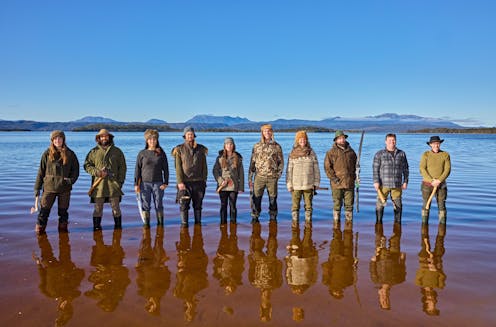
Alone Australia is back this week for a third season on SBS. And its ten contestants are learning what it means to be really hungry.
They’ve been dropped alone into separate areas of the Tasmanian wilderness to film their experiences of the elements, isolation and hunger. The person who lasts the longest wins the A$250,000 prize.
The contestants are trying various methods to find food. But not everyone’s had success in fishing, trapping and foraging. And the effects on their bodies and minds are already evident.
Here’s what happens when hunger and starvation kick in.
Shelter, water, food
After shelter and water, food is a main concern for long-term survival – not just for Alone Australia contestants.
Many of us are familiar with the feeling of hunger – discomfort caused by a lack of food. Hunger is a complex process that involves regulation of blood glucose levels and release of hormones that control appetite and how full you feel. For instance, when we are hungry, the stomach produces the hormone ghrelin, telling us it’s time to eat.
Starvation is a much more serious state. It’s a long period without enough food that results in severe disruption to how the body normally works.
A healthy person may be able to survive without food for around one to two months. However, the length of time is likely to be affected by many factors including age, sex, fitness, health, sleep and access to clean drinking water.
Last year’s winner of Alone Australia made it to 64 days, much of it without enough food.
But even successful survivalists can struggle to find and eat enough food to meet their requirements. One previous contestant lost as much as 11 kilograms over eight days.
Hunger is already an issue for contestants, most of whom are struggling to find food.What happens if you don’t have enough food?
A lack of food doesn’t just affect your body size. It also affects the way your body functions. People can experience extreme tiredness, have trouble remembering recent events, and feel colder due to a drop in body temperature.
Prolonged starvation can also have psychological impacts and affect the way you think, reason and make decisions.
We have some clues from a study that would be unethical to reproduce today.
The Minnesota Starvation Experiment started in 1944 to examine the effects of starvation on the body. The idea was to replicate the degree of starvation experienced in areas of Europe during world war two.
Thirty-six healthy young men who were conscientious objectors to war service volunteered to undergo a six-month semi-starvation phase where their calorie intake was halved, followed by a three-month rehabilitation.
Data showed they lost an average of one-quarter of their body weight (including a reduced heart mass).
But other impacts included depression, fatigue and irritability. One participant said:
little things that wouldn’t bother me before or after would really make me upset.
Participants had difficulty concentrating, and their attitudes towards food changed dramatically. They had constant thoughts about food, hoarded food and even started collecting cookbooks. Many of these attitudes and behaviours lasted even after rehabilitation back to a normal diet.
Yes, feeling ‘hangry’ is real
Most Australians will be fortunate to never experience the same levels of starvation as in the Minnesota experiment or in Alone Australia.
But even skipping a meal can have an impact on our wellbeing. We become “hangry” – when hunger leads us to be irritable or angry.
A study of 64 participants from Europe tracked their hunger and emotions over 21 days. The more hungry the participants were, the more hangry they felt and the more unpleasant feelings they reported (for example, feeling depressed or stressed versus feeling relaxed or excited).
When people are hungry, they are also more likely to have intrusive, mind-wandering thoughts.
In a complex reading and comprehension task, the minds of people who hadn’t eaten for five hours wandered more than the minds of people who had eaten recently. Those who were hungry also performed worse on the task.
So in Alone Australia, it’s easy to see how hunger can lead people to lose focus on what they’re doing, and their minds wandering. Rather than focusing on the best spot to go fishing, contestants’ minds can wander to feelings of self-doubt.

Hunger also affects decision making
Feeling hungry also affects how you make rational decisions, but there’s conflicting evidence.
Hungry people are more likely to make impulsive decisions about food. In Alone Australia, this might result in a decision to eat fish raw rather than cooking it first, a more hazardous choice due to an increased risk of infection from parasites.
However, hungry people can show better judgement when making complex decisions with uncertain outcomes – like a gambling task. So being mildly hungry (in this study, overnight fasting) might sharpen your survival instincts. In Alone Australia, hungrier contestants may make better decisions around where to place hunting traps.
But hunger’s effect on decision making is likely to depend on the context. It may make people more impulsive in some situations, but more strategic and willing to take risks in others.
For the contestants in Alone Australia, some risk taking will be required to secure an ongoing food supply. This will be crucial to successfully surviving in the Tasmanian wilderness.
Authors: Therese O'Sullivan, Associate Professor in Nutrition and Dietetics, Edith Cowan University


















