

We need to protect the heritage of the Apollo missions
- Written by Alice Gorman, Senior Lecturer in Archaeology and Space Studies, Flinders University
It’s 50 years since the two Apollo 11 astronauts – Neil Armstrong and Buzz Aldrin – spent 22 hours collecting samples, deploying experiments and sometimes just playing in the Sea of Tranquillity on the Moon.
In doing so, they created an archaeological site unique in human history.
Now, with what’s been called the New Space Race and plans to return to the Moon, the Apollo 11 and other lunar sites are under threat. We need to protect this heritage for future generations.
Read more: How big is the Moon? Let me compare ...
Apollo 11’s archaeological site
The archaeological site of Tranquillity Base consists of the hardware left behind, as well as the marks made in the lunar surface by the astronauts and instruments.
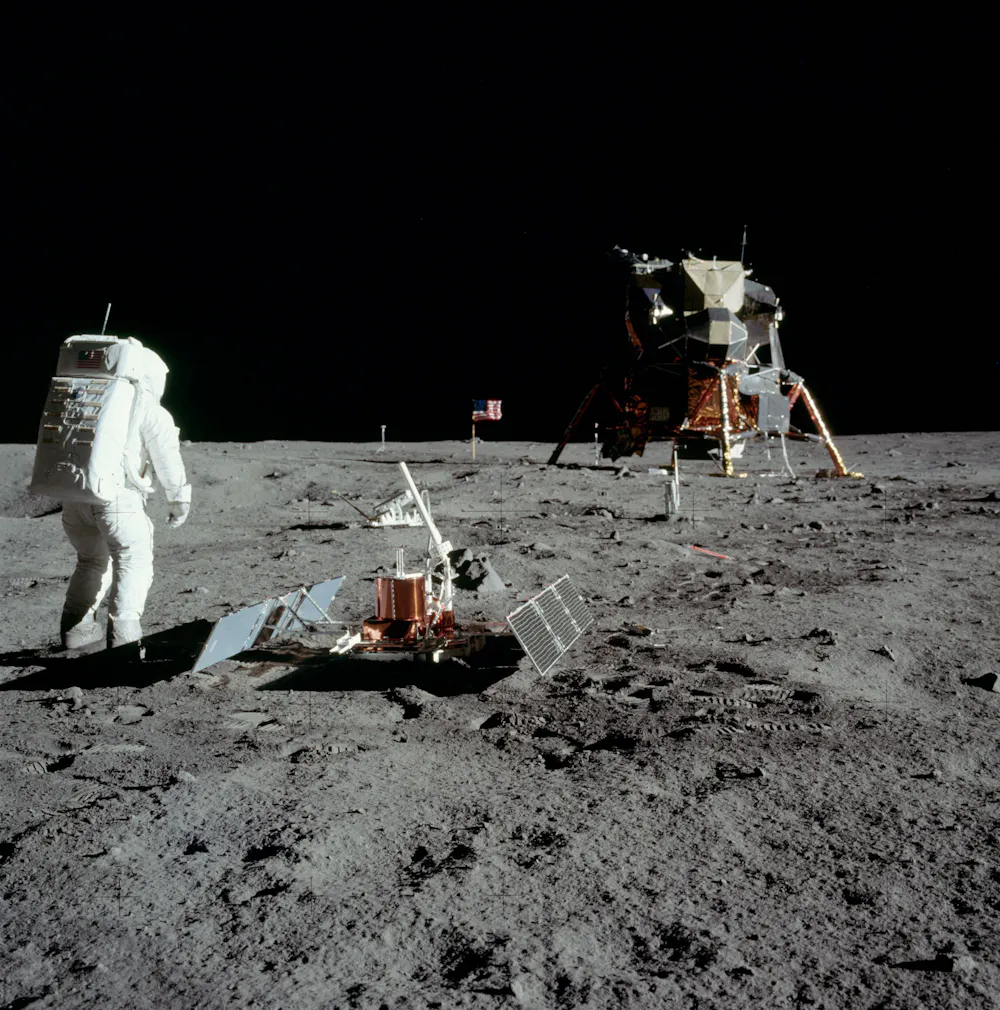 Apollo 11 astronaut Buzz Aldrin with the seismic experiment and other equipment left on the Moon.
NASA
Apollo 11 astronaut Buzz Aldrin with the seismic experiment and other equipment left on the Moon.
NASA
The hardware component includes the landing module, the famous flag (no longer standing), experiment packages, cameras, antennas, commemorative objects, space boots and many other discarded objects – more than 106 in total.
Around these objects are the first human footprints on the Moon as well as the tracks the astronauts made walking around, and the places where they dug out samples of rock and dust to take back to Earth for scientific analysis.
The artefacts, traces and the landscape constitute an archaeological site. The relationships between them can be used by archaeologists to study human behaviour in this environment so different to Earth, with one-sixth terrestrial gravity and no atmosphere.
Assessing the heritage value
Not only this, but the site has heritage value for people on Earth. To assess this, we can look at a number of categories of cultural significance. Those in the Burra Charter are widely used across the world for heritage assessment.
Historic: There is no doubt that, as the first place where humans set foot on another celestial body, this is a very important place in global history. It also represents the ideologies of the Cold War (1947-1992) between the US and the USSR.
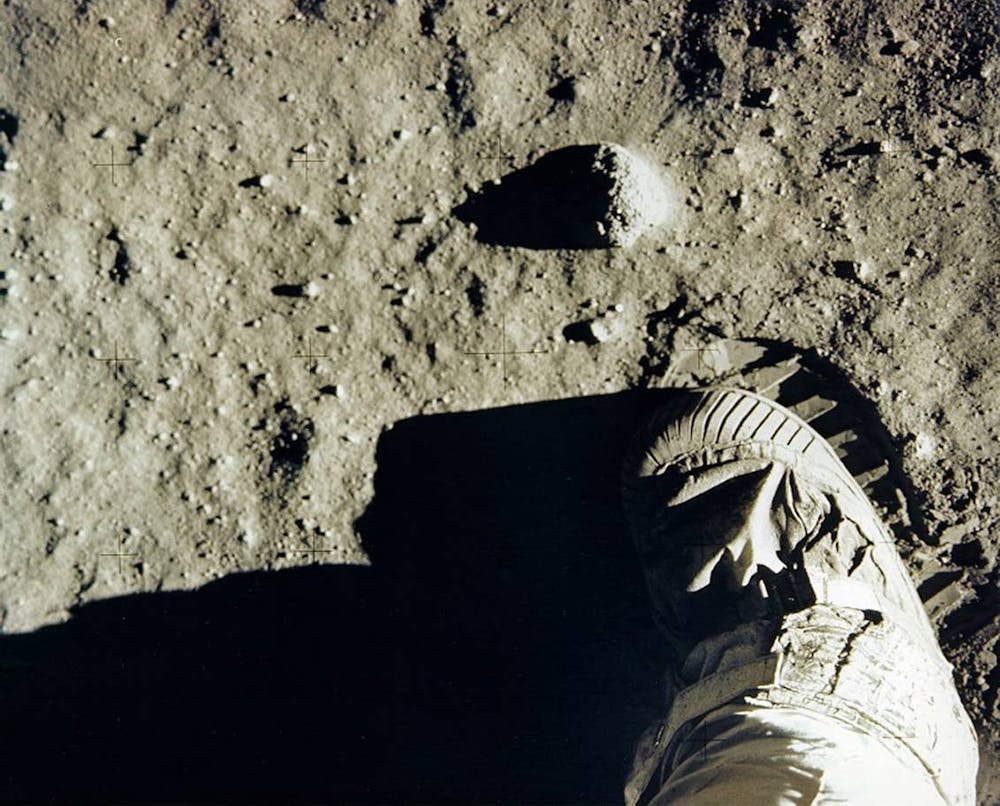 Buzz Aldrin leaves a footprint on the first Moon landing.
NASA
Buzz Aldrin leaves a footprint on the first Moon landing.
NASA
Scientific: What can we learn from the site? More particularly, what questions would we no longer be able to answer if Tranquillity Base was damaged or destroyed?
This is not just about archaeological research into human behaviour on the Moon. Apollo 11 has been exposed to the harsh lunar environment for 50 years. The surfaces of the hardware are accidental experiments in themseves: they carry the record of 50 years of micrometeorite and cosmic ray bombardment. Finding out how well the materials have survived can also provide information about how to design future missions.
Aesthetic: This type of cultural significance is about how we experience a place. While we can’t assess it in person, there are films and photographs that give us a feeling for the place. This includes the light, shadows and colours of the lunar surface from the perspective of the human senses. The aesthetic qualities have inspired many artists and musicians, including astronaut Alan Bean who devoted his post-Apollo 12 life to painting the Moon.
 Astronaut Alan Bean deploys some experiments during his Apollo 12 mission on the Moon.
NASA
Astronaut Alan Bean deploys some experiments during his Apollo 12 mission on the Moon.
NASA
Social: This is about the value that contemporary communities place on the site. For the 600 million-plus people who watched the television broadcast of the landing, it was a life-changing moment representing the ingenuity of human technology and visions of a space-age future.
But the mission did not mean the same for everyone. Some African-Americans protested against Apollo 11, seeing it as a waste of resources when there was such great economic and social disparity between white and black communities in the US. For them, it was a sign of human failure rather than a triumph.
The larger the community that has an interest in a heritage place, the higher its level of social significance. It could be argued that Apollo 11 has outstanding universal significance, like places on the World Heritage List (unfortunately the World Heritage Convention cannot be applied to space).
What are the threats?
In the past few years we have seen an increase in proposed missions to return to the Moon. Some have stated their intention to revisit the Apollo sites, by human crew or robot – and this could lead to the removal of material, for souvenirs or science.
But the sites are both fragile and unprotected. The two primary risks to their survival are uncontrolled looting, and damage from abrasive and sticky lunar dust.
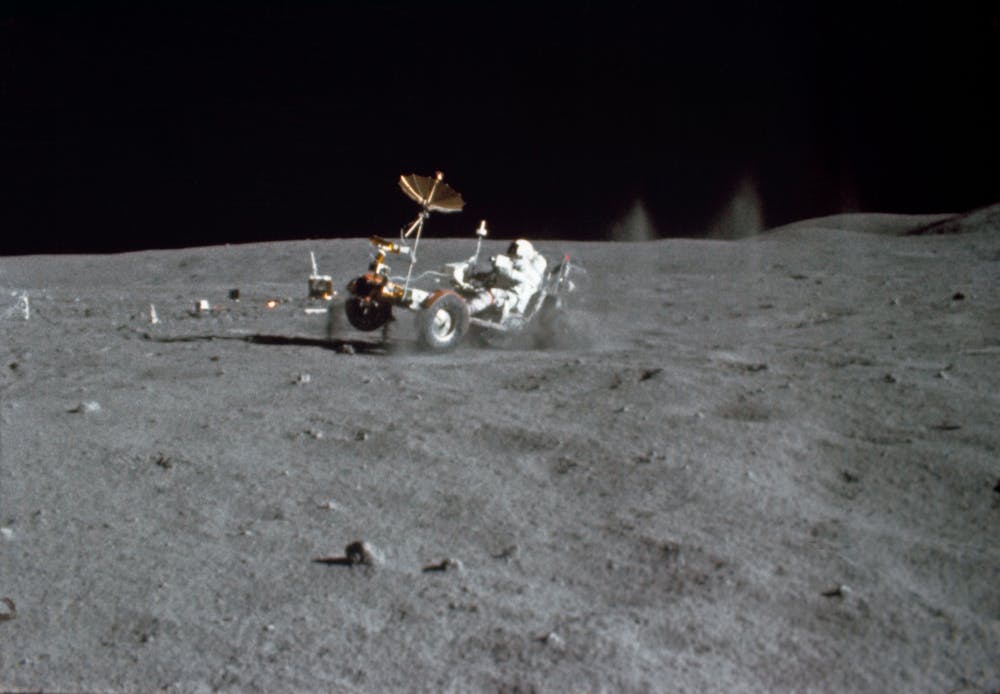 Look at the dust thrown up by the Lunar Roving Vehicle driven by astronaut John W. Young during the Apollo 16 mission. Both dust and rover are still on the Moon.
NASA
Look at the dust thrown up by the Lunar Roving Vehicle driven by astronaut John W. Young during the Apollo 16 mission. Both dust and rover are still on the Moon.
NASA
Removing material from the sites damages the integrity of the artefacts and the relationships between them. A casual visit could erase the original footprints and astronaut traverses. The corrosive dust disturbed by surface activities could wear away the materials.
Dust was a problem for all the crewed lunar missions. Apollo 16 commander John Young said: “Dust is the number one concern in returning to the Moon.”
The dust can be stirred up by plumes from landing or ascending vehicles, driving vehicles, walking on the surface, or, in the next phase of lunar settlement, by construction and industrial activities, such as mining.
Attempts at protection
The Outer Space Treaty of 1967 forbids making territorial claims in space. Applying any national heritage legislation to a place on the Moon could be interpreted as a territorial claim.
The US states of California and New Mexico have placed the Apollo 11 artefacts left on the Moon on a heritage list. They can do this because, under the treaty, the US legally owns the artefacts. But this does not protect the site itself.
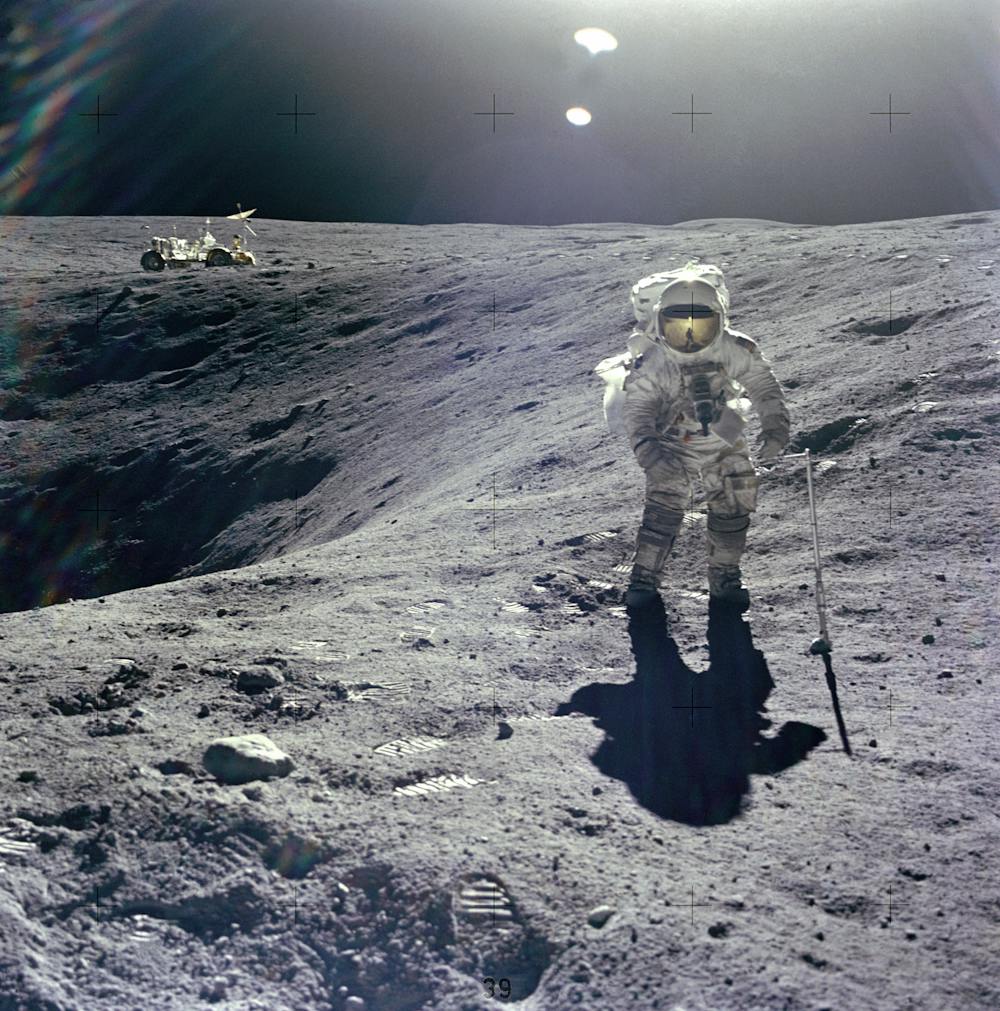 Note the footprints on this image of astronaut Charles M. Duke junior on the Apollo 16 mission.
NASA
Note the footprints on this image of astronaut Charles M. Duke junior on the Apollo 16 mission.
NASA
NASA has established a set of heritage guidelines for its sites on the Moon. The guidelines propose buffer zones around these areas, inside which no-one should enter. They make recommendations for approaching the sites to minimise dust disturbance.
In May 2019, a bill called the One Small Step to Protect Human Heritage in Space Act was introduced to the US Congress. Its purpose is:
To require any Federal agency that issues licences to conduct activities in outer space to include in the requirements for such licences an agreement relating to the preservation and protection of the Apollo 11 landing site, and for other purposes.
But the bill applies only to Apollo 11 and does not have similar requirements for the five other Apollo landing sites. It also applies only to US missions. It’s a step in the right direction, but there is still much more to be done.
 The plaque left on the lunar module base during the Apollo 11 mission.
NASA
The plaque left on the lunar module base during the Apollo 11 mission.
NASA
Only in the last decade has the idea of space archaeology gained legitimacy. Until recently, there was no urgency to establish an international framework to manage the cultural values of lunar heritage.
Read more: Why the Moon is such a cratered place
Now we’re in a new situation. On Earth, it’s common for industrial or urban activities that disturb the environment to be subject to an environmental impact assessment, which includes heritage.
Even when there are no laws to force companies to pay attention to heritage, many consider it important to seek a Social Licence to Operate – support from stakeholder communities to continue their activities.
Everyone on Earth is a stakeholder in the heritage of the Moon. Fifty years from now, what will remain of the Apollo 11 and other sites? What new meanings will people draw from it?
Authors: Alice Gorman, Senior Lecturer in Archaeology and Space Studies, Flinders University
Read more http://theconversation.com/we-need-to-protect-the-heritage-of-the-apollo-missions-117007


















