5 things you didn’t know about our underground fungi
- Written by: Adam Frew, Lecturer in Mycorrhizal Ecology, Hawkesbury Institute for the Environment, Western Sydney University
If you’re walking outdoors, chances are something remarkable is happening under your feet. Vast fungal networks are silently working to keep ecosystems alive.
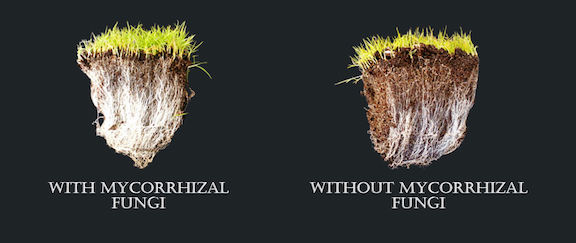
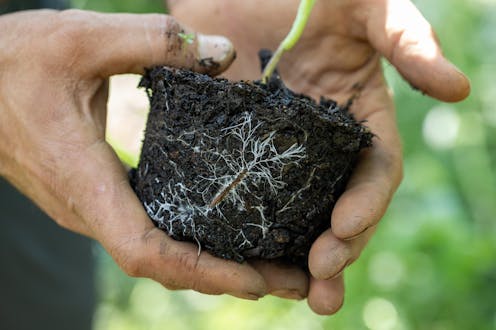
These fungi aren’t what you might picture. They are not mushrooms, or brightly coloured growths on tree trunks. Arbuscular mycorrhizal (AM) fungi look like spools of thread wrapped around plant roots.
What makes these fungi remarkable is the deal they struck almost half a billion years ago with another kingdom of life – plants.
AM fungi make threads of hyphae thinner than spider silk and weave them through plant roots. Then, they begin to trade, offering plants water and phosphorus, a vital plant nutrient in soils. In return, plants offer carbon-rich sugars and fats from photosynthesis. Fungi can’t photosynthesise, but plants can.
This symbiotic relationship can help plants survive periods of drought and live in nutrient poor soils. More than 80% of all plant families rely on these fungi, while AM fungi cannot live without plants.
Without these fungi, many of Australia’s plants — and the soil they grow in — would be in real trouble. Our continent is ancient, dry, and nutrient-poor. But while we monitor the fate of plants and animals in response to human impact and climate change, we haven’t been tracking the fungi who support it all. We don’t even know how many species there are, let alone if we’re losing them.
To help fill this gap, I have developed the first dedicated database recording species and distributions of AM fungi in Australia – AusAMF.
The underground economy of roots and filaments
AM fungi deserve to be better known. These essential companions to most of the world’s plants maintain plant diversity, suppress invasive species, store carbon, cycle nutrients and prevent soil erosion.
Here are five remarkable things about AM fungi:
1. They’re older than roots
Incredibly, this fungus-plant symbiosis emerged before plants evolved roots some 360–420 million years ago.
AM fungi have been around for 475 million years, partnering with very early land plants such as the ancestors of today’s liverworts – which have no roots. This ancient alliance actually helped plants colonise land.

2. They can boost native plants and reject invasives
AM fungi do more than transport nutrients, carbon and water. They shape entire plant communities. Some plants benefit more than others, influencing competition and species co-existence. By giving some species a competitive edge, AM fungi allow some plants to survive which might otherwise be lost.
When AM fungal diversity declines, it can lead to a loss of native plants and open the door to invasive plant species.
But with the right management — such as reducing pesticides or reintroducing locally adapted fungi — AM fungi can boost plant nutrition and ecosystem restoration. They can help native vegetation recover and stop invasive species from gaining a foothold.
3. They run an invisible underground economy
The fungi-plant trade is more organised than you might think.
In some instances, plants reward the fungi giving them the most phosphorus with more carbon, while the fungi prioritise plants offering them the most carbon – a bit like a marketplace. Some plants have figured out how to cheat the fungi, taking resources without giving anything in return.
This high-magnification video shows water and nutrients flowing inside the hyphae of the AM fungus Rhizophagus irregularis. Source: Oyarte Galvez et al. (2025) Nature4. They boost plant defences against pests and disease
Fungi don’t just help plants grow, they help them fight. As AM fungi colonise a plant’s roots, they boost its defences against threats such as diseases and plant-eating insects by strengthening and speeding up chemical responses. My research shows the size of this fungal-defence boost for plants can depend on what AM fungi are present.
And if one plant is attacked, it puts out chemical signals which can move through the fungal network and let other plants know to ready their defences.
5. They take in vast amounts of carbon
Plants take carbon from the atmosphere and store it in their leaves, roots and wood. But AM fungi store carbon from plants too.
Because mycorrhizal fungi are found wherever there are plants, their underground networks are vast – and so is their carbon impact. Recent research estimates the annual figure is more than a third of global fossil fuel carbon emissions.
Vitally important, all but unknown
If AM fungi vanished, many plant species would likely follow suit. Others would become more vulnerable to drought, disease, and pests. Soil would erode more easily, and nutrient and carbon flows would shift dramatically.
Are they in trouble? We don’t know. AM fungi are out of sight, out of mind. No federal or state government agency seem to be tracking them. Our current National Soil Action Plan doesn’t mention fungi at all, despite their importance to soil health.
Other than Antarctica, Australia is the least sampled continent for soil AM fungi, with just 32 sites in global databases. Europe, by comparison, has data from more than 1,200 sites.

That’s where I hope the AusAMF database will help. I partnered with landholders and research networks to gather soil samples. So far, the database has data from 610 locations, with about 400 more on the way.
But this is still scratching the surface. AM fungal communities can differ between neighbouring fields or habitats, depending on land management methods and types of vegetation. Virtually all current records are a single snapshot in time — we lack the long-term monitoring needed to track seasonal or annual changes.
It would be a mistake to remain in the dark about AM fungi. The more we learn, the more we see their importance, not only in supporting biodiversity, but in helping our crops and ecosystems cope with a changing world. If they are in decline, we need to know – and set about protecting them.
Authors: Adam Frew, Lecturer in Mycorrhizal Ecology, Hawkesbury Institute for the Environment, Western Sydney University