

New research reveals chemical secrets of Earth’s crust 4.5 billion years ago
- Written by: Simon Turner, Professor, School of Natural Sciences, Macquarie University
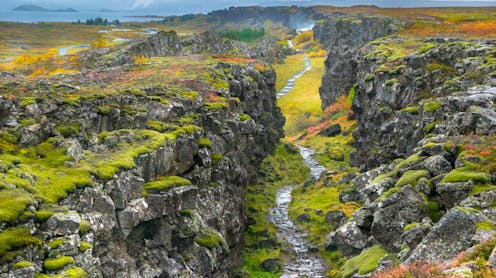
Earth is the only known planet which has plate tectonics today. The constant movement of these giant slabs of rock over the planet’s magma creates continents – and may have even helped create life.
In a new paper published in Nature today, colleagues and I reveal secrets of Earth’s crust 4.5 billion years ago. In the process, we also provide a new way to approach one of the biggest enduring scientific mysteries: when did plate tectonics begin?
Intimately connected to the development of life
Earth is roughly 4.5 billion years old. Some scientists argue that in its early form, the planet lacked plate tectonics and may have instead been characterised by a stagnant crust (imagine a fixed lid) – similar to the one on Mars.
Others say it may have been characterised by episodic, stop-start tectonics. The latter might have been triggered by major meteorite impacts that were common early on, but declined in number over time.
Plate tectonics is intimately linked to the composition of the oceans and atmosphere because the constant movement of the plates also moves carbon and other elements around. It’s also closely linked to how heat is released from Earth’s interior.
Because of this, plate tectonics is also thought to be intimately connected to the development of life on Earth.

A distinctive chemical fingerprint
The movement of tectonic plates produces volcanic activity at their boundaries. But at island arcs, such as the so-called Ring of Fire which encircles the Pacific Ocean, this volcanism has a distinctive chemical fingerprint nearly identical to that of today’s average continental crust. For example, there is a depletion of the element niobium relative to the rare earth elements.
Because of this, scientists have long thought that the key to determining when plate tectonics began is to find the first appearance of this fingerprint in ancient rocks.
Unfortunately, the actions of plate tectonics also compress, melt and reprocess the rocks of the Earth’s crust. As a result, ancient rocks are very rare and there are probably none now remaining from the Hadean eon (4.5–4 billion years ago).
Interestingly, despite much effort over many decades, the results of such attempts to determine the timing of the onset of plate tectonics have resulted in age estimates ranging from 800 million to 4.5 billion years.
Such a large range suggests a major problem in the approach.
A new approach
Beginning in early 2024, the research team I led tried a new approach. The team was made up of four other researchers from the University of Oxford, Curtin University, the University of Technology Queensland and the University of Lyon.
We used mathematical models to simulate the period of time when Earth’s core was still forming and its surface comprised an ocean of bubbling, molten rock. Specifically, we investigated the degree of melting of Earth’s early mantle – and the behaviour of chemical elements during this process.
Our results showed Earth’s earliest crust – known as the protocrust – that formed during the Hadean eon, would have a chemical composition identical to that of the modern average continental crust.
For example, niobium becomes extracted into metal and removed into Earth’s core, whereas the rare earth elements rise to the surface in the magmas that crystallise to form the crust.

The chemical fingerprint was always there
This discovery has major implications for how we think about Earth’s earliest history. It means the distinctive chemical fingerprint of the continental crust was always there – and only recycled at island arcs ever since.
It follows that this signature cannot be used to determine when plate tectonics began, explaining why previous studies could not reach any consensus.
Although major meteorite impacts would have led to melting and reprocessing of the earliest crust, such processes would only have recycled the continental chemical fingerprint, not created it.
Some of these early large impacts may have also initiated periodic subduction – the downward and sideways movement – of tectonic plates that eventually fell into the continuous, self-sustaining pattern we observe today. However, our study shows that determining when this transition occurred is more complex than long thought and will require new research methods.
Further modelling of the geodynamics of Earth’s early crust is needed to better understand when it became unstable and started to subduct. So too is a reappraisal of the implications of this for the evolution of the Earth and the ultimate development of life.
This work also gives us a new way to think about how continents and life might form on other rocky planets.
Authors: Simon Turner, Professor, School of Natural Sciences, Macquarie University


















