

NZ considers changes to copyright law as part of promise to help end global 'book famine'
- Written by: Lida Ayoubi, Lecturer, Auckland University of Technology
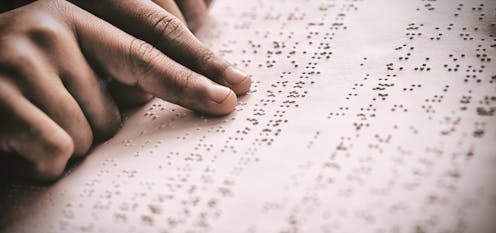
The New Zealand parliament seems closer to adopting a bill to amend copyright legislation to make it easier for visually impaired people to access published works.
An estimated 90% of all written works published worldwide are not available in formats accessible to people with a print disability. This barrier affects an estimated 168,000 New Zealanders.
The 2013 Marrakesh Treaty, which New Zealand joined in 2017, would help end the “global book famine” by allowing access to more written works in formats such as Braille, large print or audio. Bringing the treaty into effect in New Zealand requires changes to the Copyright Act 1994, and the amendment bill is due to go through its final reading this week.
Read more: Australia's copyright reform could bring millions of books and other reads to the blind
Copyright law and the right to read
Currently, creating accessible formats from existing works is only possible with the permission of the copyright owner or if there are exceptions limiting the copyright owner’s rights. Combined with a lack of infrastructure and the high cost of producing accessible works, this has created a global “book famine” for visually impaired people.
This affects not only those who read for leisure but also students and researchers, especially in developing and least developed countries. This lack of access to books and other copyright material is a hurdle to the realisation of several human rights, including the right to education, access to information, the right to participate in culture and to enjoy scientific progress, as well as the rights to health and employment. This is reflected in the Marrakesh Treaty’s focus on human rights and equality for the visually impaired.
The treaty’s provisions are designed to address problems such as long waits for authorisation or accessible format copies from a copyright owner, unreasonable restrictions imposed on accessible formats, and barriers to cross-border exchange of available accessible works that often result in duplication of production efforts.
Access to copyright works and higher education
Australian research found that when universities provided their visually impaired students with access to essential or prescribed texts, students generally obtained readings late. For instance, only 50% of print disabled first-year students had access to prescribed textbooks before the semester started.
Some universities reported far more substantial delays. In such cases, students would receive their essential readings only very late in the semester or after the semester is over. The reasons for delays vary, with some students not notifying the university that they require assistance. Additionally, reading lists are often not finalised until the first week of semester and publishers fail to respond to requests to provide accessible texts in a timely manner.
Publishers generally require students to buy a print copy of the work before they will provide access to an electronic version. Some are willing to provide download links, while others, particularly in the United States, often prefer to mail disc copies. Sometimes works are only available as preprint versions, which require a considerable amount of editing before they can be provided to students. This is a drain on university resources.
Consequently, not all students who would benefit from accessible formats currently obtain them. This means their chances of demonstrating their full potential are often compromised.
Read more: It's designers who can make gaming more accessible for people living with disabilities
New Zealand’s Marrakesh Treaty implementation bill
The bill is part of a broader review of New Zealand’s copyright legislation to ensure “the copyright regime keeps pace with technological and market developments” since its last significant amendment in 2008. It expands the reach of section 69 of the Copyright Act 1994 that addresses the reproduction and distribution of accessible works.
One of the main changes is to broaden the scope of current exceptions and improve access for visually impaired New Zealanders. The bill also introduces measures to facilitate international sharing of accessible works. These changes help realise visually impaired people’s “right to read”.
A contentious issue for the implementation of the treaty in New Zealand and elsewhere is the so called “commercial availability test”. The test is currently a requirement in New Zealand for an “authorised entity” to make reasonable efforts to obtain an accessible copy at an ordinary commercial price. By far the cheapest, fastest and most convenient means of obtaining accessible format works is if they are available for sale through the normal channels.
But in the absence of easily available accessible copies, the test creates uncertainty and imposes an administrative burden on institutions that provide the visually impaired with accessible copies. This is why after hearing submissions on the bill, a select committee recommended the removal of the test.
The proposed changes to copyright legislation would allow people with a print disability to make accessible format copies or to receive those made by an authorised entity in New Zealand or elsewhere, without infringing copyright. While broadening the scope of the current exceptions, the bill has checks and balances in place that protect reproduced accessible formats, contrary to a misconception of allowing free-riding on copyright works.
This is of significance to university students as some may self-declare disabilities while others are reluctant to disclose an impairment. Universities emphasise that they provide a safe place for disclosure, but speedy provision of services remains an issue.
The increase in the availability of electronic texts has helped to meet needs, but it is not keeping pace with student demand and expectation. As part of an increasingly technology savvy student population, students with impairments now request electronic versions of texts and use technology to adapt them to their needs. Students no longer want enlarged or scanned material as this is much harder to manipulate. The amendments in the bill would enable them to create their own accessible formats, or source them without having to identify as print disabled.
Overall, the proposed law change is a positive step towards improving access to copyright works for visually impaired New Zealanders. It also helps New Zealand maintain its good global citizen status by allowing an exchange of accessible works with other Marrakesh Treaty members.
Authors: Lida Ayoubi, Lecturer, Auckland University of Technology


















