

Modern Australian
Times Advertising

New satellite data shows NZ’s major cities are sinking – meaning rising seas will affect them sooner

  • Written by Jesse Kearse, Postdoctoral Researcher, Geophysics, Kyoto University
New satellite data shows NZ’s major cities are sinking – meaning rising seas will affect them sooner

Rising seas are already affecting coastal communities in Aotearoa New Zealand. On a global average, the sea level is now 18 centimetres higher than it was in 1900, and the annual rate of increase has been accelerating to currently 4.4 millimetres per year.

This may not seem much, but it is already amplifying the impact of storm and tidal surges. Over the coming decades and centuries, this will pose increasingly serious problems for all coastal communities.

But this is not the end of our troubles. Some parts of New Zealand’s coastline are also sinking. In many New Zealand cities, shorelines are steadily subsiding, with growing impacts on coastal infrastructure.

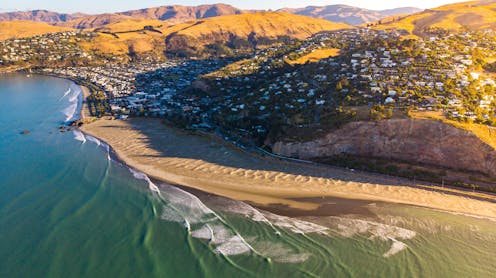
Our new research reveals where and how fast this is happening. We found the coastlines near all major cities in New Zealand are sinking a few millimetres each year, with some of the fastest rates in coastal suburbs of Christchurch, where the land is still adjusting to the impact of the 2011 earthquake.

Relative increase in sea level

Sea-level rise is happening globally because the ocean is expanding as it continues to warm and glaciers and polar ice sheets are melting.

Meanwhile, land subsidence operates on regional or local scales, but it can potentially double or triple the effects of sea-level rise in certain places. This dual effect of rising seas and sinking land is know as relative sea-level rise and it gives coastal communities a more accurate projection of what they need to prepare for.

To understand which parts of the coast are most at risk requires detailed and precise measurements of land subsidence. The key to this is to observe Earth from space.

We have used a technique known as interferometric synthetic aperture radar (InSAR). This involves the repeat acquisition of satellite radar images of the Earth’s surface, tied to very accurate global navigation satellite system measurements of ground stations.

This builds on earlier work by the NZSeaRise project, which measured vertical land movement for every two kilometres of New Zealand’s coastline. Our study uses a significantly higher resolution (every ten metres in most places) and more recent datasets, highlighting previously missed parts of urban coastlines.

Urban hotspots

For instance, in Christchurch the previous NZSeaRise dataset showed very little subsidence at Southshore and New Brighton. The big differences in the new data are not due to the increase in spatial resolution, but because the rate of vertical land movement is very different from the time prior to the 2011 earthquake.

Localised subsidence in these Christchurch suburbs is up to 8mm per year, among the fastest rates of urban subsidence we observed. These areas sit upon natural coastal sand dunes above the source area of the earthquake and the Earth’s crust is still responding to that sudden change in stress.

A map of subsidence in Christchurch. Circles dotted around the coastline show NZSeaRise estimates (2003-2011), blue circles show results of this study (2018-2021).
This map shows vertical land movement (VLM) in Christchurch, highlighting areas that are sinking. The circles around the coastline show NZSeaRise estimates (2003-2011) and continous blue shading highlights new results (2018-2021). Jesse Kearse, CC BY-SA

We have tracked vertical movement of the land with millimetre-scale precision for five major cities in New Zealand. The InSAR technique works particularly well in urban areas because the smooth surface of pavements, roads and buildings better reflects the satellite radar beam back into space where it is picked up by the orbiting satellite.

This means the estimates of relative sea-level rise for these cities are close to or above 7mm per year. If sustained, this amounts to around 70cm of sea-level rise per century – enough to seriously threaten most sea defences.

Our new satellite measurements provide a detailed picture of urban subsidence, even within single suburbs. It can vary by as much as 10mm per year between parts of a city, as this map of Dunedin and the Otago Harbour shows.

A map of urban land subsidence in Otago Harbour and Dunedin city. The darker blue colours show where land is sinking at a rate of 4mm per year or more.
This map shows vertical land movement (VLM) in Dunedin. The darker blue colours highlight parts of the city where land is sinking at a rate of 4mm per year or more. Jesse Kearse, CC BY-SA

We found hotspots of very rapidly sinking regions. They tend to match areas of land that have been modified, particularly along the waterfront. During the 20th century, many acres of land were reclaimed from the ocean, and this new land is still compacting, creating an unstable base for the overlying infrastructure.

One example of this is in Porirua Harbour, where a section of reclaimed land near the mouth of Porirua Stream is sinking at 3–5mm per year. This is more than double the average rate for Porirua’s coast.

Two maps showing the outline of reclaimed land in Porirua Harbour and the level of subsidence.
Rapidly sinking regions often match areas of land that have been modified or reclaimed, such as along the waterfront of Porirua Harbour. Jesse Kearse, from http://retrolens.nz, licensed by Land Information NZ, CC BY-SA

Paradoxically, perhaps, it is only by looking back on our planet from outer space that we can begin to see with sufficient detail what is happening to the land in our own backyard.

The good news is that we can use the results to identify coastlines that are particularly vulnerable to sea-level rise and plan accordingly for any future development. Our new measurements are just the first step in what must become a major effort to watch the ups and downs of our coastlines and urban areas.

Authors: Jesse Kearse, Postdoctoral Researcher, Geophysics, Kyoto University

Read more https://theconversation.com/new-satellite-data-shows-nzs-major-cities-are-sinking-meaning-rising-seas-will-affect-them-sooner-252881

Winter Sanitation Gaps in Parramatta Kitchens: A Hidden Pest Risk

Winter brings a host of changes to our homes, from the chill in the air to the cozy warmth indoors. However, this season also introduces sanitation ch...

When to Seek Advice from Employment Lawyers in Melbourne

Australian employment law is detailed and, at times, complex, with rights and obligations that aren't always obvious to employees or employers witho...

7 Benefits of Professional Gutter Cleaning for Australian Homeowners

Gutters aren't exactly glamorous. They sit up there on the edge of your roof, doing their job quietly - until they stop working. Clogged, overflowing ...

Pipe Floats Strengthening Pipeline Performance In Demanding Environments

Pipelines often travel through environments that are anything but predictable, water currents shift, terrain changes, and materials keep moving unde...

Why Ceiling Fans Are Essential For Comfort, Efficiency, And Modern Living

Creating a comfortable indoor environment is not just about temperature; it is about how air moves, how a room feels, and how efficiently energy is ...

Why Duct Cleaning In Melbourne Is A Smart Investment For Healthier Living Spaces

Behind your walls, ceilings, and vents lies a network quietly working every day to keep your home comfortable. Yet over time, this system can become...

Disability Service Providers Supporting Inclusive And Independent Living

Finding the right support system can feel like assembling a puzzle where every piece must fit just right. For individuals and families navigating di...

A Beginner's Guide to Owning a Caravan in Australia

Owning a caravan opens up a style of travel that's hard to match for freedom and flexibility. However, for those just starting out, the process of c...

Preparing Your Air Conditioner for Summer: What Most Homeowners Overlook

As temperatures rise, many homeowners switch on their air conditioning for the first time in months — only to find it’s not performing the way i...

What Actually Adds Value to Properties in Newcastle

Newcastle has seen steady growth over the past few years, with more buyers looking beyond Sydney for lifestyle, space, and long-term value. As dema...

What is Design and Build in Construction?

Imagine you’re about to start a new construction project, maybe it’s a custom home or a commercial building. You’ve got the idea, the land, an...

Commercial roof leak detection: why early action protects your building

Water ingress is one of the most disruptive and costly issues facing commercial properties. For property managers and facilities teams, even a minor...

Custom Photo Frames: Turning Everyday Moments into Lasting Displays

Photos capture moments, but how you display them determines how they’re experienced every day. A meaningful photograph deserves more than a generi...

Managed IT Services: A Smarter, More Predictable Way to Run Your Business Technology

If you’ve ever had your systems go down in the middle of a busy day, you’ll know how quickly things can unravel. Phones stop ringing, emails sto...

Landscaping Geelong — Coastal Elegance Meets Practical Design

A Landscape Shaped by Location Geelong occupies a unique position within Victoria’s broader landscape. It carries the energy of a growing city, y...

Electric Adjustable Beds: A Simpler Way To Sleep Better

Sleep should feel natural. It should come easily, without discomfort, without constant repositioning, and without waking up feeling sore. But for ma...

Healthy Snacking Sorted: Premium Beef Jerky

In today's fast-paced world, finding a snack that's both satisfying and genuinely good for you can feel like a mission. Many readily available optio...

What to Know Before Getting Dental Implants: A Guide for First-Time Patients

Dental implants Perth patients often look for a long-term solution for missing teeth without the hassle of dentures or bridges. If you are thinking ...

















