Looking inward: why Trump’s tariffs highlight the need for NZ to build local capacity
- Written by Rod McNaughton, Professor of Entrepreneurship, University of Auckland, Waipapa Taumata Rau
When retail executives start swearing during earnings calls, something is clearly amiss. That’s what happened recently when the CEO of United States-based luxury furniture retailer Restoration Hardware saw his company’s share price plunge by more than 25% in after-market trading.
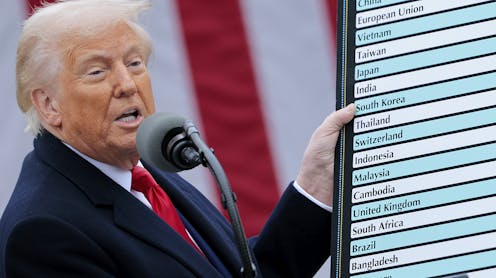
The cause? Donald Trump had just declared “Liberation Day”, announcing sweeping new tariffs on nearly all imports. For companies like Restoration Hardware – which rely on suppliers in China and Vietnam, and now face tariffs of over 50% – the impact was immediate: higher costs, disrupted supply chains and enormous uncertainty.
New Zealand exporters were spared the worst, with exports facing only the 10% baseline tariff under the new regime. But the lesson is clear. In today’s world, the real threat isn’t always direct exposure, it’s volatility.
Trump’s tariffs sparked a nosedive in share markets and reignited concerns about the reliability of global trade. And while tariffs may rise and fall, uncertainty seems here to stay. This is why an idea first developed by journalist and author Jane Jacobs in the 1980s deserves renewed attention.
In Cities and the Wealth of Nations, Jacobs argued that sustainable economic growth isn’t driven by national policy or protectionism but by what she called “import replacement”: where cities and regions develop the capacity to produce goods they once imported.
The concept is often confused with import substitution, where governments impose tariffs or subsidies to protect domestic industries. But Jacobs’ model is different. It’s not about shielding firms from competition. It’s about growing new capabilities from the ground up.
A smarter response to volatility
Import replacement happens when entrepreneurs identify goods currently sourced from elsewhere and start producing them locally, not because tariffs artificially advantage them but because they’ve found a better way to meet local needs. Over time, this drives specialisation, innovation, and eventually new exports.
Jacobs believed this bottom-up process was the real engine of economic resilience. And she was right. In an era marked by pandemics, war, climate volatility and policy shocks, the ability to adapt quickly and locally is more valuable than ever.
New Zealand saw this first-hand during COVID-19. When global supply chains stalled, we found ourselves unable to access essentials from PPE to packaging, diagnostic swabs to digital hardware. Some firms responded with ingenuity. Others waited. In many cases, local capacity simply wasn’t there.
That experience revealed an uncomfortable truth: trade agreements alone don’t secure economic sovereignty. It depends on the capability to make, adapt and substitute when the system falters.
Some entrepreneurs are already seizing the moment. In the US, for example, founder of activewear brand XX-XY Apparel, Jennifer Sey, argues that trade disruption creates space for ethical, transparent supply chains closer to home. For her, localisation is not just risk management, it’s a business opportunity.
But rebuilding domestic capacity isn’t easy. It takes capital, skilled workers and time. And tariff-based incentives can vanish as quickly as they appear. That’s why the kind of import replacement Jacobs envisioned wasn’t a reactive policy tool but a long-term development strategy.
What import replacement could look like
The same logic applies to New Zealand. We are heavily dependent on imported goods in critical sectors like machinery, pharmaceuticals, digital infrastructure, fertilisers and food processing. If any of those supply chains is disrupted, we’re not just inconvenienced, we’re exposed.
To reduce that vulnerability, we need to think strategically. That might mean developing domestic capacity to manufacture essential health products, or supporting entrepreneurs working on substitutes for imported fertilisers or packaging materials.
It could mean encouraging research institutions to develop substitutes for materials we currently source offshore.
Universities and other research organisations can play a vital role. By collaborating with startups and small or medium-sized businesses, they can accelerate innovation. From prototype to production, tertiary institutions can help translate research into real-world resilience.
Public procurement could also be better leveraged. Government contracts could reward suppliers who help reduce import dependency and build options into our domestic supply chains.
Crucially, we need to map our vulnerabilities. Which imports are critical to key sectors? Where are we reliant on a single country or supplier? What could we produce regionally, if not nationally, with the right insight and capability?
Resilience is not retreat
This is not an argument against trade. New Zealand’s economy depends on it. But if we’ve learned anything from COVID and now from “Liberation Day”, it’s that openness without options is a liability.
Tariffs may make headlines. But they won’t build the necessary capabilities in the US or globally for the next crisis. That kind of economic resilience comes from the patient work of entrepreneurs in building, substituting, learning and adapting, at speed and close to home.
Jacobs reminded us that economies don’t grow stronger by walling themselves off. They grow stronger when they learn to make what they once had to import and, in doing so, discover what the world might want next.
Authors: Rod McNaughton, Professor of Entrepreneurship, University of Auckland, Waipapa Taumata Rau