

Our ancestors didn’t eat 3 meals a day. So why do we?
- Written by: Rob Richardson, Senior Lecturer in Culinary Arts & Gastronomy, Auckland University of Technology
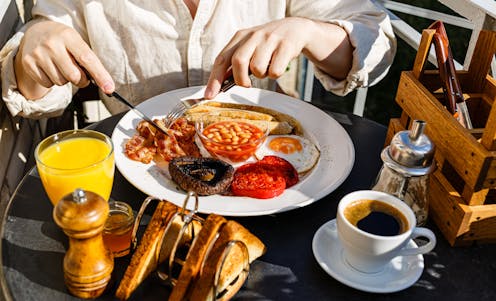
Pop quiz: name the world’s most famous trio? If you’re a foodie, then your answer might have been breakfast, lunch and dinner. It’s an almost universally accepted trinity – particularly in the Western world.
But how did it come about?
The first meals
Early humans were nomadic. Forming small communities, they would travel with the seasons, following local food sources.
While we can only guess what daily mealtimes rhythms looked like, evidence dating back 30,000 years from the South Moravia region, Czech Republic, shows people visited specific settlements time and again. They gathered around hearths, cooking and sharing food: the first signs of human “commensality”, the practice of eating together.
One of the best-preserved hunter-gatherer sites we’ve found is Ohalo II – located on the shores of the modern-day Sea of Galilee (also called Lake Tiberias or Lake Kinneret) in Israel, and dating back some 23,000 years.
In addition to several small dwellings with hearths, it provides evidence of diverse food sources, including more than 140 types of seeds and nuts, and various birds, fish and mammals.
The development of agricultural knowledge some 12,000 years ago gave rise to permanent settlements. The earliest were in the Levant region (across modern-day Iraq, southwestern Iran and eastern Turkey), in an area called the “Fertile Crescent”.

Permanent agriculture led to the production of a surplus of food. The ability to stay in one place with food on-hand meant the time it took to cook no longer mattered as much.
It quickly became common to eat one light meal early in the day, followed by a larger hearth-prepared meal later on. The specific timings would have varied between groups.
Eating together as a rule
The communal nature of foraging and hunting, and later farming, meant humans almost always ate their meals in the company of others. In the ancient city-state of Sparta, in the 4th century BCE, these practices were codified as common main meals called syssitia (meaning “eating together”).
These meals were consumed at the end of the day in communal dining halls. Food was served by young boys to tables of 15 or so men who lived together and fought in the same military division. The men gradually shared generational knowledge with the young boys, who themselves would join the tables by age 20.
In the 5th century BCE, Greek historian Herodotus wrote about how syssitia evolved from a Spartan military practice to having deep political meaning in society. Similarly, Plato wrote common meals were an integral component of civil society, and that missing a meal without good reason was a civic offence.
By dining in full view of the rest of society, citizens were compelled to maintain self-discipline. Mealtime was also an opportunity for social linkage, and important discussions ranging from business deals to politics.
The eating habits of Spartan women are missing in the texts, although it is implied they ate at home.
Bunches of lunches
Counter to the tough Spartan way of life, the Romans enjoyed their main meal, cena, earlier in the day, followed by a lighter meal just before bed.

The northern European tribes tended towards two larger meals per day, as more sustenance is required in colder climes. To the Vikings, these meals were known as dagmal and nattmal, or day meal and night meal. Nattmal was the cooked evening meal, while dagmal usually consisted of leftover nattmal with the addition of bread and beer or mead.
In Australia, evidence suggests Aboriginal peoples tended toward a daily single meal, which aligns with the predominant method of cookery: slow-cooking with hot coals or rocks in an earth oven. This underground oven, used by Aboriginal and also Torres Strait Islander communities, was referred to as a kup murri or kap mauri by some groups.
This is similar to other Indigenous preparations throughout the Pacific, such as the New Zealand Māori hāngī, Hawaiian imu, Fijian lovo, and even the Mayan píib.
The once-daily meal would have been supplemented with snacks throughout the day.
Three’s the magic number
The timing of meals was heavily influenced by class structure, local climate and people’s daily activities. Practicality also played a part. Without reliable lighting, meals had to be prepared and eaten before dark. In settled parts of Northern Europe, this could be as early as 3pm.
So how did we go from one or two main meals, to three? The answer may lie with the British Royal Navy.
Since its inception in the 16th century, the navy served three regular meals to align with the shipboard routine. This included a simple breakfast of ship’s biscuits, lunch as the main meal, and dinner as more of a light supper.
Some sources suggest the term “square meal” may have come from the square wooden trays meals were served in.
 Initially, sailors recieved a daily gallon of beer with meals. This was later changed to watered-down rum, the infamous ‘grog’, which is being handed out in this 1940 photo taken aboard HMS King George V.
Imperial War Museums, CC BY-NC
Initially, sailors recieved a daily gallon of beer with meals. This was later changed to watered-down rum, the infamous ‘grog’, which is being handed out in this 1940 photo taken aboard HMS King George V.
Imperial War Museums, CC BY-NC
The Industrial Revolution, which started around 1760, arguably also played a role in formalising the concept of three specific mealtimes across the Western world.
The cadence of breakfast, lunch and dinner matched the routine of the longer, standardised workdays. Workers ate breakfast and dinner at home, before and after work, while lunch was eaten with coworkers at a set time.
With minimal breaks, and no time for snacking, three substantial meals became necessary.
The fall of the holy trinity
Today, many factors impact the time and frequency of our meals, from long work commutes to juggling hobbies and social obligations.
 The ways in which we eat and share food continue to evolve alongside our societies and cultures.
Shutterstock
The ways in which we eat and share food continue to evolve alongside our societies and cultures.
Shutterstock
The COVID pandemic also impacted how and what we eat, leading us to eat larger amounts of higher calorie foods. The rapid growth of delivery services also means a meal is no more than a few minutes away from most people.
All of this has resulted in mealtimes becoming less rigid, with social meals such as brunch, elevenses and afternoon teas expanding how we connect over food. And mealtimes will continue to evolve as our schedules become ever more complicated.
Authors: Rob Richardson, Senior Lecturer in Culinary Arts & Gastronomy, Auckland University of Technology
Read more https://theconversation.com/our-ancestors-didnt-eat-3-meals-a-day-so-why-do-we-250773



















_-_Napoli_MAN_120029_-_01.jpg)