

Sorry gamers, Nintendo’s hefty Switch 2 price tag signals the new normal – and it might still go up
- Written by: Ben Egliston, Senior Lecturer in Digital Cultures, Australian Research Council DECRA Fellow, University of Sydney
Last week, Nintendo announced the June 5 release of its long anticipated Switch 2. But the biggest talking point wasn’t the console’s launch titles or features. At US$449 in the United States, and A$699 in Australia, many were struck by the steep cost.
However, this price doesn’t seem quite as high once you compare it to the broader history of hardware pricing. And it may still go up.
History of Nintendo pricing
The original NES (Nintendo Entertainment System) console cost US$179 when it was released in 1985. That’s US$525, or A$590, adjusted for 2025 inflation.
But other consoles have been even pricier. The PlayStation 3 launched in North America in 2006 at around US$499 (US$782 today). When it launched in Australia the next year, it retailed at A$999 (upwards of A$1500 today).
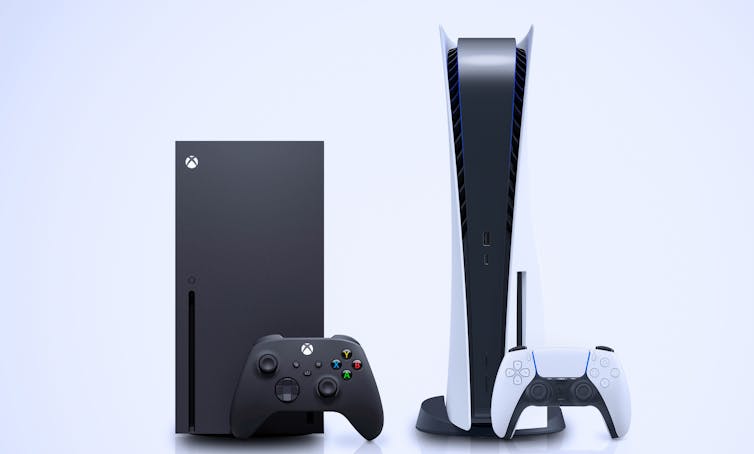
Nintendo’s main competitors are Sony (Xbox) and Microsoft (PlayStation). Both are subsidised by their broader media and technology businesses, which means they can afford to make higher-cost consoles, and even take losses on console sales.

Compared to Nintendo, Sony and Microsoft depend more heavily on licensing third-party content and offering subscription services, such as Xbox Game Pass, to drive recurring revenue.
Nintendo’s business model, by contrast, revolves around selling both its consoles and original “first-party” titles.
Nintendo also takes a different approach to console development, by prioritising lower-spec, lower-cost hardware aimed at a broader and often more casual audience. The company has typically made profits on both its hardware and software (particularly its first-party games).
Our research suggests many players appreciate this strategy. Rather than competing directly with Sony and Microsoft on technical performance, they felt Nintendo focused on delivering fun and accessible experiences through affordable technology.
Still, the current economic conditions make the Switch 2’s price hard to swallow. With the rising cost of living and stagnant wages, even historically “normal” prices can feel out of reach.
The tariff question
Why is Nintendo increasing the price of Switch 2 – especially given the enormous commercial success of the original 2017 Switch at its lower price point of US$299 and A$469?
The Switch 2 release was announced on the same day the Trump administration unveiled plans for sweeping new tariffs, including a proposed minimum 10% tariff on all imports (and higher on Vietnam, China and Cambodia, where Nintendo manufactures its consoles).
Doug Bowser, president at Nintendo of America, has claimed tariffs “weren’t factored into the pricing” of the Switch 2.
But it’s hard to imagine a scenario in which Nintendo simply absorbs those costs. The company has historically maintained positive margins on hardware. It is also famously conservative when it comes to its pricing strategy.
Not just tariffs — and not just Nintendo
The Switch 2’s price tag is a window into broader shifts in the business of games. Games are more popular than ever. And apart from a small dip in 2022, they’re making more money than ever.
But they’re also more expensive to make. Reports claim Call of Duty: Black Ops Cold War had a combined development and marketing budget of around US$700 million.
Low interest rates, particularly during the pandemic, meant rising production costs could be offset by cheap money from big publishing, technology, and entertainment conglomerates investing in videogame companies.
Venture capital firms and tech giants alike piled in. The result was huge growth for the industry, as well as some blockbuster mergers.

But the era of near-zero interest rates is no more – and the flow of money that once covered soaring development costs is slowing down.
Gaming companies have responded with mass layoffs, further exacerbated by exuberance (largely from management) for artificial intelligence to increase efficiency. Beyond this, they are turning to more aggressive monetisation strategies.
Games such as Fortnite and Call of Duty don’t just make money from sales. They keep players inside their ecosystems, spending money over time.
Research has shown developers are increasingly designing games for ongoing user monestisation, whether through micro-transactions, battle passes, extra downloadable content, subscriptions or in-game advertising.
Read more: 'Literally just child gambling': what kids say about Roblox, lootboxes and money in online games
What happens next?
Between tariffs, inflation and rising game development costs, the US$450 Switch 2 (and its US$80/A$110 games) may just be the beginning. In the short term, we’re likely to see higher prices for both consoles and games.
The effects of US tariffs on Switch 2 pricing in Australia remain unclear. However, the Australian dollar’s recent roller coaster ride, partly driven by uncertainty over US tariffs, could mean further price hikes to offset increased import costs.
We saw Sony adjust prices for the PS5 mid-generation in response to production costs. There’s no reason to assume the Switch 2 price will remain static.
In the longer term, we’re entering a market where the line between “freemium” and “premium” continues to blur. Premium games now often come with built-in expectations of ongoing monetisation, moving away from one-off sales.
Platform holders such as Nintendo remained notable exceptions, favouring upfront pricing and self-contained experiences. Although they, too, may gradually shift away from this.
Authors: Ben Egliston, Senior Lecturer in Digital Cultures, Australian Research Council DECRA Fellow, University of Sydney


















