

How common are errors in IVF labs? Can they be prevented?
- Written by: Karin Hammarberg, Adjunct Senior Research Fellow, Global and Women's Health, School of Public Health & Preventive Medicine, Monash University
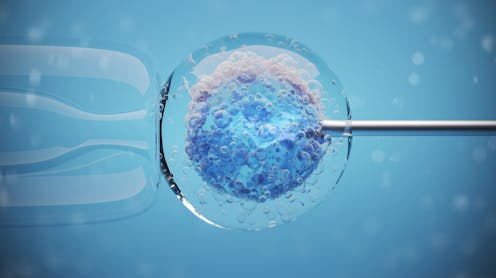
The news of a woman unknowingly giving birth to another patient’s baby after an embryo mix-up at a Brisbane IVF lab has made headlines in Australia and around the world. The distress this incident will have caused to everyone involved is undoubtedly significant.
A report released by Monash IVF, the company which operates the Brisbane clinic, states it “adheres to strict laboratory safety measures (including multi-step identification processes) to safeguard and protect the embryos in its care”.
It also says the company’s own initial investigation concluded the incident was “the result of human error”.
An independent investigation will follow which presumably will shed light on how human error could occur when multi-step identification processes are in place.
On a broader level, this incident raises questions about how common IVF errors are and to what extent they’re preventable.
The booming IVF industry
Because people have children later in life than they used to, some struggle to conceive and turn to assisted reproductive technologies. These include in-vitro fertilisation (IVF) and intracytoplasmic sperm injection (ICSI) which both involve handling of sperm and eggs (gametes) in the laboratory to form embryos. If there’s more than one embryo available after a treatment cycle, they can be frozen and stored for later use.
Increasingly, assisted reproductive technologies are also being used by single women, same-sex couples, and women who freeze their eggs to preserve their fertility.
For these reasons, the fertility industry is booming. In 2022 there were more than 100,000 assisted reproductive treatment cycles performed in Australian fertility clinics, up more than 25% on the number of cycles performed in 2017.
Regulation of the IVF industry
In Australia, the IVF industry is more regulated than in many other parts of the world.
To operate, clinics must be licensed by the Reproductive Technology Accreditation Committee and adhere to its code of practice.
In relation to storage and accurate identification of embryos, the code states clinics must provide evidence of the implementation and review of:
Policies and procedures to identify when, how and by whom the identification, matching, and verification are recorded for gametes, embryos and patients at all stages of the treatment process including digital and manual record-keeping.
The code further states clinics must report serious adverse events to the Reproductive Technology Accreditation Committee. The list of what’s considered a serious adverse event includes any incident that “arises from a gamete or embryo identification mix up”.
Clinics must also adhere to the National Health and Medical Research Council’s ethical guidelines on the use of reproductive technology in clinical practice and research.
Lastly, states and territories have laws that regulate aspects of the IVF industry such as requirements to report adverse events and other data to state authorities.
In the United Kingdom, the Human Fertilisation and Embryology Authority regulates the IVF industry and requires clinics to report adverse incidents. These are reported as grade A, B or C, where A is the most serious and involves “severe harm to one person, or major harm to many”. Data on adverse incidents is reported in a publicly available annual report.
In the United States, however, the IVF industry is largely unregulated, and clinics don’t have to report adverse incidents. However, the American Society for Reproductive Medicine states clinics should have rigorous procedures to prevent the loss, damage, or misdirection of gametes and embryos and have an ethical obligation to disclose errors to all impacted patients.
How common are IVF errors?
There’s no global data on IVF errors so it’s not possible to know how common they are. But we learn about some of the more serious incidents when they’re reported in the media.
While the recent embryo mix-up is the first known incident of this nature in Australia’s 40-year IVF history, we have seen reports of other errors in Australian clinics. These include the alleged use of the wrong donor sperm, embryos being destroyed due to contamination, and inaccurate genetic testing which resulted in the destruction of potentially viable embryos.
In the UK, the Human Fertilisation and Embryology Authority’s most recent report states there was one Grade A incident in 2023–24. This was the first Grade A incident reported since 2019–20 when there were two.
In the US, some notable errors include storage tank malfunctions in two clinics which destroyed thousands of eggs and embryos.
Lawsuits have also been filed for embryo mix-ups. In a 2023 case, a woman from Georgia delivered a Black baby even though she and her sperm donor are both white. The biological parents subsequently demanded custody of the child. Despite wanting to raise him the woman who had given birth gave up the five-month-old boy to avoid a legal fight she couldn’t win, she said.
In the US, some argue most errors go unreported because reporting is not mandated and due to the absence of meaningful regulation.
Are IVF errors preventable?
Despite Australia’s stringent regulation and oversight of the IVF industry, an incident with far-reaching psychological and potentially legal consequences has occurred.
Until the independent investigation reveals how “human error” caused this mix-up, it’s not possible to say what additional measures Monash IVF should take to ensure this never happens again.
An IVF laboratory is a high-pressure environment, and any investigation should look at whether staffing levels are adequate. Staff training is also relevant, and it’s essential all junior lab staff have adequate supervision.
Finally, perhaps Australia should adopt the UK’s model and make data about adverse events reported to the Reproductive Technology Accreditation Committee available to the public in an annual report. To reassure the public, this report could include what measures clinics take to avoid the errors happening again.
Authors: Karin Hammarberg, Adjunct Senior Research Fellow, Global and Women's Health, School of Public Health & Preventive Medicine, Monash University
Read more https://theconversation.com/how-common-are-errors-in-ivf-labs-can-they-be-prevented-254382


















