

Owners are officially no longer responsible for tourism accidents on their land – but they never really were
- Written by: Chris Peace, Lecturer in Occupational Health and Safety, Te Herenga Waka — Victoria University of Wellington
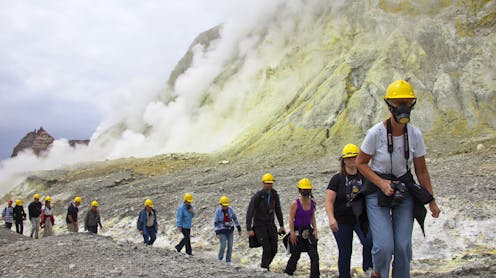
Newly announced reforms to the Health and Safety at Work Act mean landowners will no longer be responsible for tourism-related injuries on their properties. But it’s not clear this has ever really been a problem.
Workplace Safety Minister Brooke van Velden says there was an “inadvertent climate of fear” affecting councils, farmers and landowners who allowed access to their land for hunting, fishing, mountain biking and horse trekking. The fear was that they would be held responsible if someone was hurt or killed on their land.
The reforms targeting landowners are part of wider changes to the Health and Safety at Work Act, which was passed in 2015. Under section 37 of the act, a person who controls a workplace is responsible for ensuring that
the workplace, the means of entering and exiting the workplace, and anything arising from the workplace are without risks to the health and safety of any person.
But we found just one instance of landowners being taken to court for adventure activities going wrong on their properties. This was the case against Whakaari Management Ltd, the owners of Whakaari/White Island after the 2019 eruption that claimed 22 lives and injured 25 others.
In 2024, Whakaari Management was found guilty of failing to protect visitors to the island, but that decision was overturned in February this year.
Responsibilities under the law
Under the current rules, responsibility for something going wrong rests with the “person conducting a business or undertaking”.
A farmer, for example, is conducting business because they own or have control of their land. This does not apply if they are renting out the land but not involved in the activity’s management or control.
In the Whakaari Management Ltd appeal the judge wrote:
To be caught by [section] 37, a [a person conducting a business or undertaking] must in fact be exercising active control or management of the workplace in a practical sense. Owning it is not enough. Making money from it is not enough. Merely being able to manage or control a workplace, but not doing so, is not enough.
Active control might include an agreement between the landowner and the activity operator to monitor conditions.
While the Whakaari case is the only one we found where a landowner has been prosecuted under the current rules, there have been a number of court cases involving adventure activity companies.
The key difference between successful and unsuccessful cases seems to be whether the business owners had the ability to influence or change what went wrong.
For example, in cases where customers of diving businesses drowned, the courts have decided the businesses did not have control of the workplace, including the sea, a lake or river.
In one case the judge wrote the business
does not and cannot control flow or conditions nor can it control who uses or goes through the rapid […] It cannot give directions in relation to it, nor exercise any authority over it.
A business owner operating a kayaking business did have control of the operational conditions and should have had a safe system of work, including checking the weather forecast.
Similar failings were found after a school trip resulted in drownings and after the poor condition of tour buses and uncontrolled driving during a sand-surfing trip resulted in deaths.
Making adventure activities relatively safe
Even under the Adventure Activities Regulations – industry specific rule passed in 2010 and updated since – the responsibility for safety in the tourism industry fell on tourism operators, not landowners.
And, from a safety perspective, the rules have been relatively successful. In the past 35 years, there have been about 52 deaths in adventure activities due to natural hazards (including the Whakaari/White Island tragedy). During the same period more than 30,000 workers died at or because of work.
But this relative safety in adventure activities has come at a cost for small businesses. Under the 2010 regulations, the average cost of mandatory audits has been around NZ$5,000 – a cost borne by the small adventure activity businesses.
If the government wants to further improve the safety of the outdoor tourism industry, then it needs to focus on making it easier and cheaper for businesses to comply with the regulations, rather than focusing on protecting landowners from a risk they never really faced.
Authors: Chris Peace, Lecturer in Occupational Health and Safety, Te Herenga Waka — Victoria University of Wellington


















