

Yoko Ono, ‘the first female punk rocker’, is an artist of benevolent magic
- Written by Christine Feldman-Barrett, Senior Lecturer in Cultural Sociology, Griffith University
In 1945, when Yoko Ono was 12, her home city of Tokyo was firebombed. With her mother and siblings, she fled to the safety of a farming village in Nagano Prefecture. Food was scarce. During this time, Ono, as the eldest child, often had to help find provisions for her family. At one point, while she and her brother Keisuke were lying down looking up at the sky, she asked him to create a dream menu: if access was no obstacle, what foods would he choose?
Her prompt, fired by her imagination, inspired hope for better days ahead. Her brother believes this was her first work of conceptual art.
This is difficult to argue with, given so much of Ono’s art has recurring motifs of hope and joyful human interaction. David Sheff’s Yoko is the latest offering in a new generation of books revisiting Ono and her legacy within popular culture. It creates a portrait of an artist – now 92 – who has championed the power of positivity, no matter the adverse conditions.
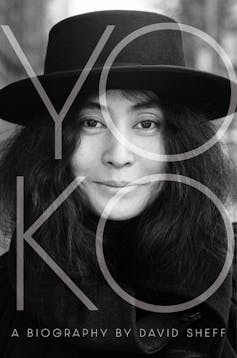
Review: Yoko: A Biography – David Sheff (Simon & Schuster)
Ono’s career as a conceptual artist was well underway by the time she met John Lennon in 1966, when he visited her about-to-be-staged solo exhibition in London. Nonetheless, when the Beatles broke up in 1970, a misogynistic narrative swiftly blamed her for playing a substantial role in the band’s demise.

Journalists and fans accused Ono of being a “homewrecker” (Lennon was still married when they became a couple), but the conceptual artist’s even greater sin seemed to be that she was not a blonde, leggy model typical of rock-star girlfriends.
It is little wonder that, a few years later, some of her songwriting would call upon the image of the witch – a historical figure especially symbolic of women’s misrepresentation within society. Ono’s reclamation, through songs like Woman of Salem (1973) and Yes, I’m a Witch (1974) – also the title of her 2007 album – is fitting.
The 1968 release of the Lennon–Ono album Two Virgins, which featured experimental music and had the couple pose nude for its cover, prompted a moral panic. As Sheff writes,
people went from attacking Yoko as a homewrecker to accusing her of destroying Lennon as an artist. Talk of John being under Yoko’s spell percolated; she was forcing him to do outrageous – nutty, abhorrent – things.
Few would deny Ono – as artist, musician and woman – has experienced her own set of witch trials. Some still blame her for the Beatles’ breakup, see her conceptual art as nonsensical garbage, or believe her own musical output is nothing more than a screaming banshee’s wail.
Correctives to such unforgiving and tired narratives are necessary. This is why David Sheff’s biography is so important.
Biographer and ‘good friend’
Sheff admits from the outset that his position as biographer is paired with that of a longtime friend. But he also assures readers he did his “best to strip the varnish away” to reveal a more authentic Ono. That close proximity to his subject makes for a compelling account.
The journalist met Lennon and Ono in September 1980, spending several weeks with them to write a magazine profile. They were happy with the resulting article. The day after he spoke with them about it, Lennon was killed. Sheff became good friends with Ono and got to know their son Sean, becoming one of those who helped her survive “the season of glass” following Lennon’s murder.
In 2002, she and Sean “helped save the life” of Sheff’s son, during a period of homelessness and drug addiction. Ono later granted Sheff permission to title the memoir about his son “Beautiful Boy”, after Lennon’s song.

He interviews scores of family members, friends and colleagues, while drawing upon his own experiences with Ono. In a telling passage, which speaks to Ono’s interest in creative visualisation, Sheff explains that she:
believed that the words she used – in everything from song titles to conversation – would influence the future. She wanted to fill her brain with positive thoughts, not negative ones.
Some have refused to believe this benevolent Yoko Ono exists.
Privilege and emotional poverty
Ono was born on February 18 1933 in Tokyo, to one of Japan’s wealthiest families. Her father was a bank executive while her mother’s family, the Yasudas, were responsible for what later became Fuji Bank. Despite her privileged upbringing, which also saw her family move between Japan and the United States, she felt her parents were emotionally distant. As she grew older, she received mixed messages about what they saw as her purpose in life: was it marriage or a career?
 Lennon and Ono, 1971.
Michel Lipchitz/AAP
Lennon and Ono, 1971.
Michel Lipchitz/AAP
Ono was the first woman to be accepted to study philosophy at the elite Gakushuin University in the fall of 1952, but soon left for the US to study at the women’s liberal arts college Sarah Lawrence, outside New York. There, she focused on composing music and writing poems and stories, while also investigating the city’s art scene – and met and married her first husband, composer Toshi Ichiyanagi, in 1956. Soon after, she was mixing with visual artists and composers like John Cage, who was both. By 1960, she was hosting art and music events at a loft she rented in New York’s bohemian downtown. Performing and exhibiting her own work soon followed.
Before she met and married Lennon, Ono was married a second time, in 1963, to Anthony Cox. Cox was an American painter, sculptor and film producer who rescued her from a mental hospital in Tokyo, where she was placed after a series of suicide attempts that followed a barrage of criticism of her work. “She was trying to connect through her work, but she’d never felt more alone,” Sheff writes.
With Cox, who she was still married to when she met Lennon, she had a daughter, Kyoko, in 1963. A year later – with her husband’s encouragement – a book called Grapefruit, filled with Ono’s “instruction pieces”, was published. Despite the deep despair she had felt, her life had turned around and she was newly motivated to share her art with the world.
Playful positivity
Sheff smartly conveys the first moments Ono and Lennon realised they were on the same wavelength: as artists and as people. In their first meeting, when Lennon visited Ono’s Indica exhibition in London, he climbed a ladder and held up a magnifying glass to the ceiling, where he saw the word yes.
Another piece he noticed was Painting to Hammer a Nail, which comprised a white wooden panel, a hammer on a chain, and a can of nails just beneath. He asked to hammer a nail in, but as the exhibit was not yet open, Ono did not want him to do it. After another moment, she agreed he could, if he paid five shillings to do so. Lennon then offered her an imaginary five shillings to hammer in an equally imaginary nail.
Ono was charmed by the playful response. Lennon was struck with the positivity and humour inherent in Ono’s work: it contradicted his view of avant-garde art as pretentious and overly self-serious.
 When they met, Lennon was struck with the positivity and humour inherent in Ono’s work.
Evan Agostini/Invision/AAP
When they met, Lennon was struck with the positivity and humour inherent in Ono’s work.
Evan Agostini/Invision/AAP
Sheff points out Ono’s work often asks audiences to imagine and create with her. Famously, her “instruction pieces”, which first gained visibility during the 1960s (helped by her book Grapefruit), asked those interacting with the art to do something or think about certain things. Here, the artist and audience were actively working together.
In Self Portrait (1965), a mirror tucked into an envelope meant the portrait in question was not of Ono, but of the person glimpsing their reflection, Sheff writes. Ono did not summon her audience into a world of whimsy for whimsy’s sake, but into a space where artist and audience were co-creating new vantage points from which to admire the world’s everyday wonders.
Mrs Yoko Ono Lennon
By March 1969, Ono was officially Mrs Yoko Ono Lennon. Their marriage was life-changing in myriad ways: both truly felt they had found their perfect match. In 1975, they would welcome a son, Sean. The couple collaborated in art and music, but the union was not beloved by all.
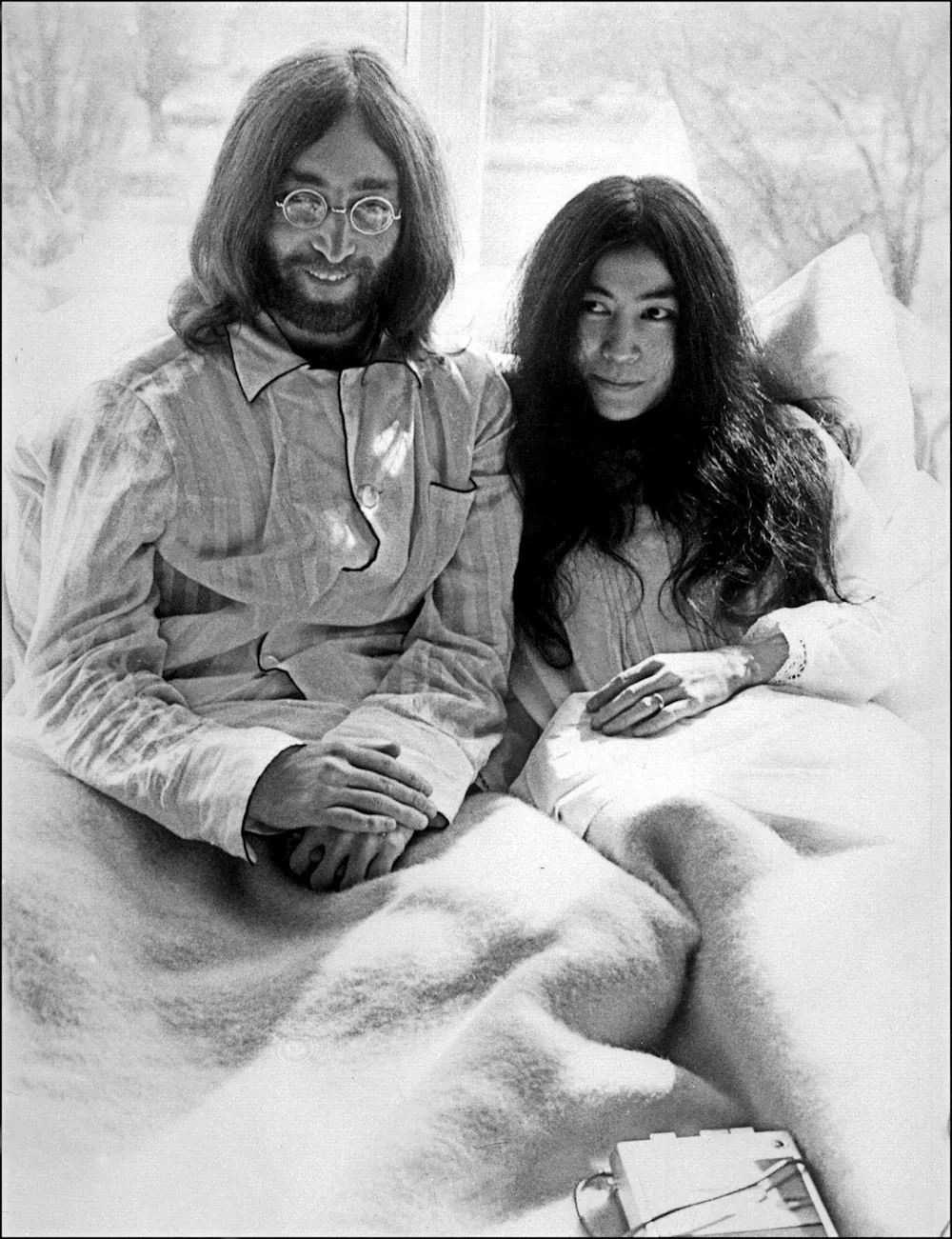 Lennon and Ono truly felt they had found their perfect match.
EPA/AAP
Lennon and Ono truly felt they had found their perfect match.
EPA/AAP
Criticism of Ono ran the gamut from descriptions of her as an oddball interloper in Lennon’s music-making to outright racist remarks because she was Japanese. Sheff shares glimpses that depict just how mean-spirited some of the 1970s media coverage was. But despite the negativity the couple encountered, they enjoyed a loving, meaningful and productive partnership.
Ono’s world changed forever on December 8 1980, when her husband was shot and killed outside their New York home. She was beside him when it happened. Sheff recounts his memories of her unimaginable grief and the resilience she somehow found in the aftermath of Lennon’s murder. Since her husband’s death, she has dedicated a substantial portion of her life to championing Lennon’s legacy, as well as advocating for gun control in the US.
Ono’s own artistic accomplishments and place in the historical record are rightly given full attention throughout the book. Recent retrospective exhibits, including the Tate Modern’s 2024 Yoko Ono: Music of the Mind in London, demonstrate the longstanding cultural impact of her conceptual art. But Sheff also provides welcome insights into her musical career.
‘First female punk rocker’
Ono’s 1974 sold-out tour of Japan is a noteworthy inclusion, as her musical output has received more than its share of negative criticism. Even in 2025, there are memes that assert Ono’s music is unlistenable and among the worst ever created. Anyone familiar with her discography, however, knows most of her work features singing (not screaming). But it has been difficult to pry Ono’s reputation away from her more avant-garde forays into music.
In 2017, Ono was officially credited with co-writing 1971’s Imagine, with her late husband. A more holistic reappraisal of her music has been underway for some time too. Sean Lennon is quoted saying a good number of musicians from his generation always have appreciated and celebrated Ono’s more experimental sounds. As a musician himself, Sean is influenced and inspired by both parents’ work, and he has collaborated with his mother on several occasions.
 Sean Lennon has collaborated with his mother on several occasions.
Koji Sasahara/AAP
Sean Lennon has collaborated with his mother on several occasions.
Koji Sasahara/AAP
Gen-X icon Kurt Cobain cited Ono as “the first female punk rocker”, Sheff writes, placing her in a genre where her so-called “screaming” would be a badge of honour, rather than worthy of derision. As a fellow Gen-Xer, I was delighted when, in the early 1990s, I discovered one of my favourite bands, Redd Kross, had helped create a Yoko Ono tribute band of sorts, the Tater Totz – who Sean mentions while discussing his generation’s appreciation of Ono.
Benevolent magic
 This thoughtful, engaging biography prompts readers to put aside their preconceptions and reimagine Ono. It suggests she is a force of nature who has made a significant impact on our culture – for good, rather than ill. The book’s cover serves as a fitting preview: a black-and-white photo of its smiling subject.
Sheff asserts at the beginning that he is not looking to “depict Yoko as either a saint or a sinner”. Nonetheless, he offers a much-needed antidote for the decades of venomous critiques directed her way. Considering the amount of public ridicule that Ono has faced for a good portion of her 92 years, it is important more people have a better understanding of who she is, separating myth from reality.
Sheff’s Yoko works well towards achieving this goal. The book offers a nuanced portrait of both the woman and the artist, while showcasing Ono’s creative work as a form of benevolent magic.
Authors: Christine Feldman-Barrett, Senior Lecturer in Cultural Sociology, Griffith University
This thoughtful, engaging biography prompts readers to put aside their preconceptions and reimagine Ono. It suggests she is a force of nature who has made a significant impact on our culture – for good, rather than ill. The book’s cover serves as a fitting preview: a black-and-white photo of its smiling subject.
Sheff asserts at the beginning that he is not looking to “depict Yoko as either a saint or a sinner”. Nonetheless, he offers a much-needed antidote for the decades of venomous critiques directed her way. Considering the amount of public ridicule that Ono has faced for a good portion of her 92 years, it is important more people have a better understanding of who she is, separating myth from reality.
Sheff’s Yoko works well towards achieving this goal. The book offers a nuanced portrait of both the woman and the artist, while showcasing Ono’s creative work as a form of benevolent magic.
Authors: Christine Feldman-Barrett, Senior Lecturer in Cultural Sociology, Griffith University 
















