

Google AI


Modern Australian

A secret mathematical rule has shaped the beaks of birds and other dinosaurs for 200 million years

  • Written by: Kathleen Garland, PhD Candidate, School of Biological Sciences, Monash University
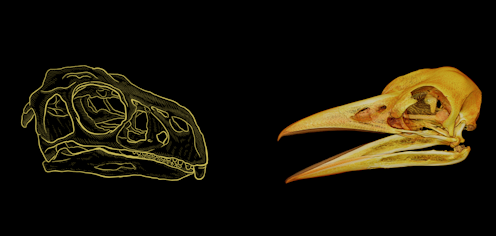
A secret mathematical rule has shaped the beaks of birds and other dinosaurs for 200 million years

Bird beaks come in almost every shape and size – from the straw-like beak of a hummingbird to the slicing, knife-like beak of an eagle.

We have found, however, that this incredible diversity is underpinned by a hidden mathematical rule that governs the growth and shape of beaks in nearly all living birds.

What’s more, this rule even describes beak shape in the long-gone ancestors of birds – the dinosaurs. We are excited to share our findings, now published in the journal iScience.

By studying beaks in light of this mathematical rule, we can understand how the faces of birds and other dinosaurs evolved over 200 million years. We can also find out why, in rare instances, these rules can be broken.

When nature follows the rules

Finding universal rules in biology is rare and difficult – there seem to be few instances where physical laws are so pervasive across all organisms.

But when we do find a rule, it’s a powerful way to explain the patterns we see in nature. Our team previously discovered a new rule of biology that explains the shape and growth of many pointed structures, including teeth, horns, hooves, shells and, of course, beaks.

This simple mathematical rule captures how the width of a pointed structure, like a beak, expands from the tip to the base. We call this rule the “power cascade”.

After this discovery, we were very interested in how the power cascade might explain the shape of bird and other dinosaur beaks.

How snouts and beaks of theropods follow the power cascade rule of growth. Garland et al., iScience 2025

Dinosaurs got their beaks more than once

Most dinosaurs, like Tyrannosaurus rex, have a robust snout with pointed teeth. But some dinosaurs (like the emu-like dinosaur Ornithomimus edmontonicus) did not have any teeth at all and instead had beaks.

In theropods, the group of dinosaurs that T. rex belonged to, beaks evolved at least six times. Each time, the teeth were lost and the snout stretched to a beak shape over millions of years.

But only one of these impeccable dinosaur groups survived the mass extinction event 66 million years ago. These survivors eventually became our modern-day birds.

The early bird catches the rule

To investigate the power cascade rule of growth, we researched 127 species of theropods. We found that 95% of theropod beaks and snouts follow this rule.

Using state-of-the-art evolutionary analyses through computer modelling, we demonstrated that the ancestral theropod most likely had a toothed snout that followed the power cascade rule.

Excitingly, this suggests that the power cascade describes the growth of not just theropod beaks and snouts, but perhaps the snouts of all vertebrates: mammals, reptiles and fish.

An evolutionary tree showing how theropod beaks and snouts follow the power cascade throughout their evolution. Garland et al., iScience 2025

The rule followers and breakers

After surviving the mass extinction, birds underwent a period of incredible change. Birds now live all over the world and their beaks are adapted to each place in very special ways.

We see beak shapes for eating fruit, netting insects, piercing and tearing meat, and even sipping nectar. The majority follow the power cascade growth rule.

All these bird beaks follow the power cascade rule of growth, despite being used for very different purposes. Eastern osprey by Phill Wall (modified, CC BY 2.0), Eurasian hoopoe by Giles Laurent (modified, CC BY-SA 4.0), common ostrich by Diego Delso (modified, CC BY-SA 4.0) and bar-tailed godwit by JJ Harrison (modified, CC BY-SA 4.0).

While rare, a few birds we studied were rule-breakers. One such rule-breaker is the Eurasian spoonbill, whose highly specialised beak shape helps it sift through the mud to capture aquatic life. Perhaps its unique feeding style led to it breaking this common rule.

The beak of a Eurasian spoonbill does not follow the power cascade rule of growth. Eurasian spoonbill by Swardeepak (modified,CC BY-SA 4.0)

We are not upset at all about rule-breakers like the spoonbill. On the contrary, this further highlights how informative the power cascade truly is. Most bird beaks grow according to our rule, and those beaks can cater to most feeding styles.

But occasionally, oddballs like the spoonbill break the power cascade growth rule to catch their special “worms”.

Now that we know that most bird and dinosaur beaks follow the power cascade, the next big step in our research is to study how bird beaks grow from chick to adult.

If the power cascade is truly a foundational growth rule in bird beaks, we may expect to find it hiding in many other forms across the tree of life.

Authors: Kathleen Garland, PhD Candidate, School of Biological Sciences, Monash University

Read more https://theconversation.com/a-secret-mathematical-rule-has-shaped-the-beaks-of-birds-and-other-dinosaurs-for-200-million-years-254481

Pool and Deck Design: How to Plan the Perfect Outdoor Living Space for Your Sydney Home

For many Australians, the backyard is where life happens. Summer barbecues, weekend swims and long evenings outdoors are all part of the lifestyle, ...

Is Solar Pool Heating Worth It? What Sydney Homeowners Should Know

There's nothing quite like a backyard pool on a hot Sydney day. But once autumn rolls in, many pools sit unused for months because the water is simp...

Planning a Luxury House Move: A Week-by-Week Timeline for Prestige Sydney Homes

Selling or buying a prestige home is a major milestone. Whether it's a waterfront residence in Birchgrove, a grand Federation home in Haberfield or ...

Downsizing or Upgrading Your Caravan? Here's How to Sell It Without the Hassle

Selling a caravan can feel like a major task, especially when you are unsure about its value, paperwork, or how to find a buyer. Whether you are dow...

The Best Overseas Adventure Holidays for Australians Who Love the Outdoors

Australia offers no shortage of incredible outdoor experiences, but sometimes the best way to satisfy your sense of adventure is to head overseas. A...

Cape Town Wine Shuttle: Winelands Tasting & Tours

Embark on an unforgettable journey through the picturesque Cape Winelands, where world-class wines and breathtaking scenery await. Our Cape Town Win...

Metal Fabrication: Choosing Metal Fabrication Melbourne Services for Custom Projects

What Modern Metal Fabrication Involves From individual components to complete structures, metal fabrication brings together processes such as desig...

Why Giant Rats Tail Grass Keeps Coming Back After Spraying

Giant Rats Tail Grass (GRT) is one of the most frustrating pasture weeds for farmers and lifestyle property owners. You spray an infested area, see th...

When Custom Cardboard Boxes Make Sense for Your Business

Custom cardboard boxes can be useful when a standard carton does not fit a product, packing method or presentation requirement particularly well. A ...

Full-Height vs. Pop-Top Caravan: Which Is Better for Family Travel across WA?

A pop-top caravan is an excellent choice for travellers who want the comfort of a caravan without committing to a larger, bulkier setup. With a lowe...

Bottle Label Printing: Key Factors for a Professional Finish

Why the Printing Method Matters When businesses need packaging or printed containers developed for a particular application, the right supplier can m...

Virtual Livestock Fencing and GPS Tracking: Improving Visibility Across Cattle Properties

What Virtual Livestock Fencing Means for Modern Cattle Management Managing cattle across extensive properties requires more than knowing where anim...

Sydney Pawnbrokers Explained: How Hocking Your Car Actually Works

Sometimes you need cash, and you need it soon. If you own a car, you may already have a way to get it. That's what people mean when they say they've...

Moving Interstate from the Gold Coast to Brisbane (or Back)? What Removalists Wish You Knew First

Have you talked to anyone who’s done the move? They say the same thing: the drive up the M1 is the easy part. It's everything around it that catches...

Why the Spring School Holidays Are a Great Time to Visit Coffs Harbour

The spring school holidays are a good time to spend a few days on the Coffs Coast. The weather is starting to warm up, there is plenty to do outdoor...

What to Do When an Older Car Is No Longer Worth Keeping in Melbourne

Ever looked at another repair quote and wondered whether your old car is still worth the trouble? It is a common turning point for Melbourne motoris...

Your Baby's First Year: A Local Guide to Feeding, Sleep, and When to Get Extra Support

Ask ten parents in a Brisbane mothers' group how their baby is feeding or sleeping, and expect ten different answers.  Someone's baby sleeps throug...

Kitchen and Laundry Makeover Ideas That Don't Require a Full Renovation

Full kitchen renos are expensive — and most people don't actually need one.  They need the kitchen to stop looking like it's stuck in 2009, or they...

















