

The ocean can look deceptively calm – until it isn’t. Here’s what ‘hazardous surf’ really means
- Written by: Samuel Cornell, PhD Candidate, Beach Safety Research Group, School of Population Health, UNSW Sydney
Over the Easter weekend, seven people drowned along the Australian coast. Most were swept off rock platforms – extremely dangerous locations that are increasingly prevalent in Australia’s coastal fatality data.
The weather was unseasonably warm, the surf at times looking calm and at others foreboding. And yet, despite warnings from Surf Life Saving, emergency services and meteorologists, many still entered the water – often unaware of how deceptively dangerous the conditions could be.
It was a tragic reminder that many people don’t understand ocean conditions and how waves and swells work. Current water safety warnings aren’t doing enough to change behaviour – but with simple improvements and better education around long-period swells, we could save lives.
The difference between waves and swells
Waves on the ocean are caused by wind. Some, called sea waves, are generated by nearby winds. Others, known as swell waves, are created by distant weather systems, such as storms far away, and travel long distances.
Swells can travel thousands of kilometres and may still be present even if the local wind is calm. It’s estimated that up to 75% of wave action across the globe is caused by distant storms, not local winds. This makes the predicting of swells and waves a complex science.
A long-period swell refers to waves that arrive at longer intervals, typically 12 to 20 seconds apart. These swells carry more energy than short-period ones, travel greater distances, and tend to produce sets of larger waves when they hit the coast.

What makes long-period swells so dangerous?
Over Easter, hazardous long-period swells generated by an ex-cyclone offshore were hitting much of the east coast. The Bureau of Meteorology issued warnings, and Surf Life Saving reinforced these messages with media alerts and beach closures.
But the surf didn’t always look threatening – at least not all of the time.
The misleading nature of long-period swells is part of the problem. They create deceptively calm periods, and lulls between these wave sets can last ten or 15 minutes. During that time, people feel safe entering the water, wading out, going onto a rock platform or relaxing near the shoreline.
When the next set arrives, it can be unexpected and forceful – knocking people over, pulling them into the water or creating unexpected currents.
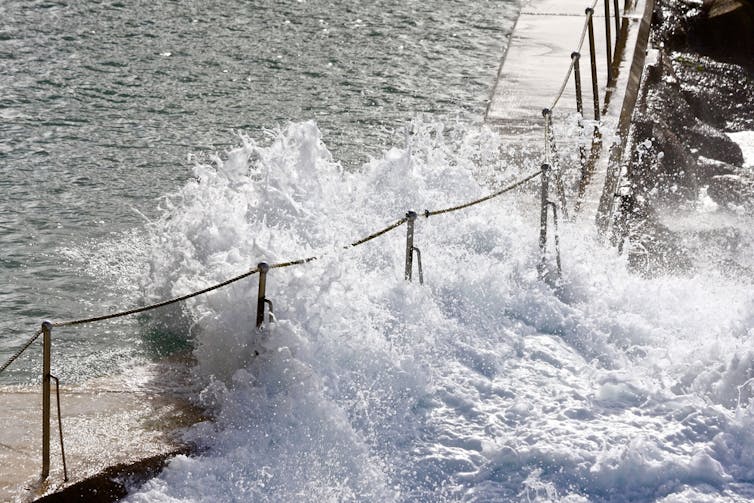
Unlike short-period waves, long-period swells carry momentum that enables them to surge much further up beaches and rock platforms, increasing the chances of sweeping people into the water. When these waves break, they do so with considerable force, and the powerful backwash can drag people into deep water.
The sudden arrival of these waves, without a gradual buildup, makes them especially dangerous in exposed areas like rock shelves or platforms.
Rock platforms are dangerous because of a combination of environmental exposure and low visibility in our approach to coastal safety. They’re often exposed to powerful waves, have uneven, slippery surfaces, and lack easy exit points.
If someone is knocked into the water, there’s usually nothing to hold onto, and climbing back up is almost impossible – especially in heavy clothing or fishing gear.

Why current warnings don’t cut through
Australians may be familiar with fire danger ratings, cyclone warnings and the UV index.
But the way we communicate surf risk – particularly around swell behaviour – is vague and technical. Phrases like “hazardous surf” or “long-period swell” are accurate, but fail to convey what people will actually experience at the shoreline.
Most members of the public don’t know what a 16-second swell interval means, or how it affects where and how waves break. As a result, warnings go unnoticed, or people believe they can assess the risk themselves by looking at the water – which, during a lull, can seem completely harmless.
Social media compounds this problem. Over Easter, videos of huge waves circulated widely, but so did footage of people playing or standing near the water with no apparent concern. The public sees mixed signals – and the science and warnings don’t always cut through.
How to improve coastal hazard communication
If we want to reduce coastal deaths during swell events, we need to bridge the gap between forecasts and real-world understanding.
1. Translate forecasts into direct, behavioural warnings
Instead of just saying “hazardous surf”, add language that explains what that means: “Conditions may appear calm, but large sets of waves will arrive every 10–15 minutes. Stay well back from the waterline”.
2. Use visual risk systems
Just like fire danger ratings, a colour-coded coastal risk index could be introduced for days when swell conditions are particularly hazardous. Simple signage at beaches could indicate the risk level and explain the reason for it.
3. Integrate live updates at key sites
SMS alerts or digital signage at car parks and entry points could provide real-time hazard updates. These should be visual and multilingual to reach a broader audience.
4. Make ocean science public knowledge
Government campaigns, surf clubs and schools should all help explain the basics of swell behaviour – including what long-period swell is, why wave sets arrive and why calm periods aren’t always safe. Just like “swim between the flags” became a known rule, so, too, should basic awareness of wave cycles. Surfers could be champions of this education.
The conditions that contributed to the Easter drownings were forecast, monitored and forewarned. But most people don’t make decisions based on marine forecasts – they make them based on what they see in front of them.
Long-period swell is a classic hidden hazard. It tricks even experienced beach goers, not because the science is unclear, but because the risk isn’t made clear to the public.
Authors: Samuel Cornell, PhD Candidate, Beach Safety Research Group, School of Population Health, UNSW Sydney


















