

Reefs in the ‘middle’ light zone along NZ’s coast are biodiversity hotspots – many are home to protected species
- Written by: James J Bell, Professor of Marine Biology, Te Herenga Waka — Victoria University of Wellington
The latest update on the state of New Zealand’s environment paints a concerning outlook for marine environments, especially amid the increasing push to use the marine estate for economic gain.
But many shallow coastal ecosystems remain largely unexplored. As our latest fieldwork shows, many of these areas are hotspots for protected species, but are largely unprotected from human impacts.
Gardens of the red calcified stylasterid hydrocoral off the coast of Doubtful Sound, Fiordland.Ecosystems in the ‘middle’ light zone
Subtidal rocky reefs have been the focus of scientific research for centuries. During the past eight decades, with the advent of SCUBA diving, they have been studied even more intensively.
However, rocky reefs extend much deeper than most SCUBA divers can typically reach, into what is known as the mesophotic or “middle” light zone.
While seaweeds dominate in the well-lit shallow waters, there is limited light to sustain photosynthesis in the mesophotic zone below around 30 metres. The decline in seaweed creates more space for animals, which leads to the development of communities containing species not found in the shallows.
Deep-water stony corals at around 100 metres off the coast of Northland.Because these ecosystems are no longer affected by surface wave action, they are often dominated by large, fragile three-dimensional species.
We still know very little about the ecology of the species that live in mesophotic ecosystems. Many are likely to be slow growing and long-lived, with some living for hundreds or possibly thousands of years.
Research is ongoing and empirical data still sparse, but observations show many fish are associated with these mesophotic communities. We eat some of them, or they are important within the ocean food web.
Diverse ecosystems and protected species
We shared some of the first high-resolution videos of New Zealand’s mesophotic ecosystems in 2022. Back then, we thought these deep-reef communities were dominated by sponges.
However, we have since deployed a Boxfish remotely operated vehicle more than 200 times around New Zealand and found sponges are not always the most dominant organism.
In fact, mesophotic ecosystems along New Zealand’s coast are very diverse, with regional variation in the types of communities.
Our team found sea squirts dominated communities off Rakiura Stewart Island, anemone stands in the Wellington region, red coral beds along the Fiordland coast and coral “reefs” in Northland.
Asicidian or sea squirt beds at 130 metres off the coast of Rakiura Stewart Island.Importantly, many of these reefs support species protected under the Wildlife Act.
During our most recent trip to Doubtless Bay in Northland, we explored more than 20 locations. At many sites we encountered protected coral species. The term coral is broadly defined in the Wildlife Act – it includes groups such as black corals (order Antipatharia), gorgonian corals (Gorgonacea), stony corals (Scleractinia) and hydrocorals (family Stylasteridae).
Protected black coral and seafans at around 90 metres offshore at Doubtless Bay, Northland.Under the Wildlife Act, it is illegal to deliberately collect or damage these species. If they are brought to the surface accidentally (in fishing gear or by anchors, for example), they must be returned to the sea immediately.
Many of these corals are typically considered deep-sea species, but they are commonly found in New Zealand’s mesophotic ecosystems. Northland’s mesophotic communities have examples from all these groups of corals, as well as other fragile ecosystems dominated by glass sponges.
While glass sponges are not protected, they are thought to be very slow growing, with some species living for thousands of years.
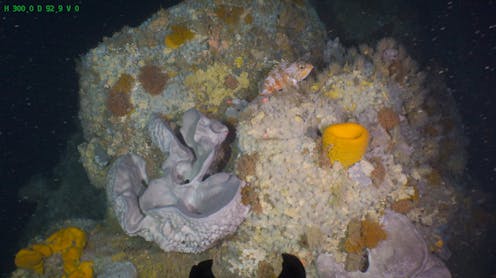
Glass sponge gardens at around 100 metres off the coast of Northland.Current and future impacts
Many mesophotic organisms grow slowly and rely on food carried in the water. This makes them particularly sensitive to activities that disrupt the seafloor, such as fishing and anchoring, and to the effect of higher sediment loads.
Sediment can either smother or clog mesophotic organisms such as corals and sponges. Many of these species show some tolerance to sediment, but prolonged exposure or very high levels can kill them off.
Many of the mesophotic ecosystems we have explored show clear evidence of human impacts, including lost recreational fishing gear and anchor lines.
The government plans to maximise the economic potential of the marine estate and much of this development is focused on coastal areas. Any activities that generate coastal sediment plumes are of particular concern.
Seabed sand mining operations already occur at some sites around the coast of New Zealand. More have been proposed, potentially generating sediment plumes that could reach these mesophotic communities.
Protected black coral in a sponge garden at around 80 metres at the Poor Knights marine reserve in Northland.A fundamental step for effective management of biodiversity is to understand its distribution. Our work over the past five years has characterised a wide range of mesophotic ecosystems, but there are still large areas of the New Zealand coastline that have not been explored. They are likely to contain undescribed communities.
As many regional councils around New Zealand are working through revisions to coastal policy plans, these deeper rocky reefs need to be fully included to protect the species they support.
Authors: James J Bell, Professor of Marine Biology, Te Herenga Waka — Victoria University of Wellington


















