

1 billion years ago, a meteorite struck Scotland and influenced life on Earth
- Written by: Chris Kirkland, Professor of Geochronology, Curtin University
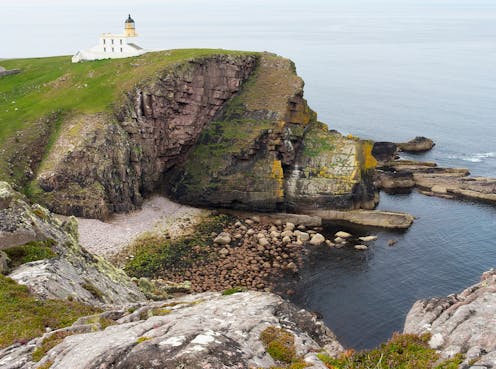
We’ve discovered that a meteorite struck northwest Scotland 1 billion years ago, 200 million years later than previously thought. Our results are published today in the journal Geology.
This impact now aligns with some of Earth’s earliest known, land based, non-marine microbial fossils, and offers new insights into how meteorite strikes may have shaped our planet’s environment and life.
A rocky treasure trove
The Torridonian rocks of northwest Scotland are treasured by geologists as some of the finest archives of the ancient lakes and river systems that existed a billion years ago.
Those water bodies were home to microbial ecosystems consisting of eukaryotes. Eukaryotes are single-celled organisms with complex internal structures that are the ancestors of all plants and animals.
But the Torridonian environments and their associated microbial communities were dramatically disrupted when a meteor slammed into the planet.

The record of this event is preserved in a geological unit known as the Stac Fada Member. It is comprised of unusual layers of rock fragments broken and melted by the impact.
Also, crucially, there are shock-altered minerals that closely resemble those found in famous impact sites such as Chicxulub (Mexico) and Sudbury (Canada).
In the case of the Stac Fada, these minerals were engulfed in high-energy, ground-hugging flows of smashed rock triggered by the impact that spread across the ancient landscape.
What is exciting about our new date for the Stac Fada impact is that it now overlaps in age with microfossils preserved elsewhere in the Torridonian rocks.
This raises some interesting questions. For example, how did the meteorite strike influence the environmental conditions those early non-marine microbial ecosystems relied on?
Finding out the date
Determining when a meteorite struck is no easy task.
We can use minerals to constrain the age, but they have to be the right kind. In this case it means something that wasn’t overly altered by the intense heat, pressure and fluids generated by the impact, yet robust enough to survive the ravages of deep geological time.
Suitable minerals are extremely rare, but we found a few in the Stac Fada rocks. One was reidite, a mineral that only forms under extreme pressure. The other was granular zircon, a uranium-bearing mineral formed by immense impact temperatures.

These minerals are, in effect, tiny stopwatches whose clocks start “ticking” at the time they form. Although these clocks are often damaged during the impact and the ensuing pulse of heat, we used mathematical modelling to determine the most probable time of impact.
Together, these techniques consistently pointed to an event 1 billion years old, not 1.2 billion years old as previously suggested. Given such vast spans of time, a 20% change in age might not seem dramatic.
However, the new age shows the timing of the impact coincides with early non-marine eukaryotic fossils. It also lines up with a major mountain-building event. This means the Torridonian lifeforms had to cope with significant, environment-altering phenomena.
Why this is important for you, me, and life in general
The origin of life is a deeply complex process that likely began with a series of pre-biotic chemical reactions.
While much remains unknown, it is intriguing that two ancient meteorite impacts, the 3.5-billion-year-old North Pole impact in Western Australia and now the 1-billion-year-old Stac Fada deposit in northwest Scotland, occur close in time to major milestones in the fossil record.
The North Pole impact occurs in a sequence of rocks containing stromatolites, some of the oldest-known fossils considered to be indicative of microbial life.
 These rippled layers in the Torridon rocks were built by ancient microbial communities, evidence of some of the earliest life on land.
Tony Prave
These rippled layers in the Torridon rocks were built by ancient microbial communities, evidence of some of the earliest life on land.
Tony Prave
All life requires energy. The earliest forms of life are thought to be associated with volcanic hydrothermal springs. Impacts offer a plausible alternative. The immediate aftermath of a meteorite strike is extreme and hostile, and would ruin your day. But the long-term effects could support key biological processes.
Meteorite strikes fracture rocks, generate long-lived hydrothermal systems and form crater lakes that enable the concentration of important ingredients for life, such as clays, organic molecules and phosphorus. The latter is a key element for all forms of life.
In Scotland, the Stac Fada impact lies within an ancient river and lake environment that housed microbial ecosystems colonising the land. What makes the Stac Fada impact deposits fascinating is that, unlike most other impacts on Earth, they preserve the environments in which those pioneering organisms lived immediately prior to the impact.
Further, the impact deposits were subsequently buried as non-marine microbial habitats became reestablished. So, the Stac Fada rocks provide an opportunity to see how microbial life recovered from impact.
Extraterrestrial visitors in the form of meteorite collisions may not just have scarred Earth’s surface, but shaped its future, turning catastrophic events into natural crater-cradles of life.
Authors: Chris Kirkland, Professor of Geochronology, Curtin University

















