

Did ‘induced atmospheric vibration’ cause blackouts in Europe? An electrical engineer explains the phenomenon
- Written by: Mehdi Seyedmahmoudian, Professor of Electrical Engineering, School of Engineering, Swinburne University of Technology
The lights are mostly back on in Spain, Portugal and southern France after a widespread blackout on Monday.
The blackout caused chaos for tens of millions of people. It shut down traffic lights and ATMs, halted public transport, cut phone service and forced people to eat dinner huddled around candles as night fell. Many people found themselves trapped in trains and elevators.
Spain’s prime minister, Pedro Sánchez, has said the exact cause of the blackout is yet to be determined. In early reporting, Portugal’s grid operator REN was quoted as blaming the event on a rare phenomenon known as “induced atmospheric vibration”. REN has since reportedly refuted this.
But what is this vibration? And how can energy systems be improved to mitigate the risk of widespread blackouts?
How much does weather affect electricity?
Weather is a major cause of disruptions to electricity supply. In fact, in the United States, 83% of reported blackouts between 2000 and 2021 were attributed to weather-related events.
The ways weather can affect the supply of electricity are manifold. For example, cyclones can bring down transmission lines, heatwaves can place too high a demand on the grid, and bushfires can raze substations.
Wind can also cause transmission lines to vibrate. These vibrations are characterised by either high amplitude and low frequency (known as “conductor galloping”), or low amplitude and high frequency (known as “aeolian vibrations”).
These vibrations are a significant problem for grid operators. They can place increased stress on grid infrastructure, potentially leading to blackouts.
To reduce the risk of vibration, grid operators often use wire stabilisers known as “stock bridge dampers”.
What is ‘induced atmospheric vibration’?
Vibrations in power lines can also be caused by extreme changes in temperature or air pressure. And this is one hypothesis about what caused the recent widespread blackout across the Iberian peninsula.
As The Guardian initially reported Portugal’s REN as saying:
Due to extreme temperature variations in the interior of Spain, there were anomalous oscillations in the very high voltage lines (400 kV), a phenomenon known as “induced atmospheric vibration”. These oscillations caused synchronisation failures between the electrical systems, leading to successive disturbances across the interconnected European network.
In fact, “induced atmospheric vibration” is not a commonly used term, but it seems likely the explanation was intended to refer to physical processes climate scientists have known about for quite some time.
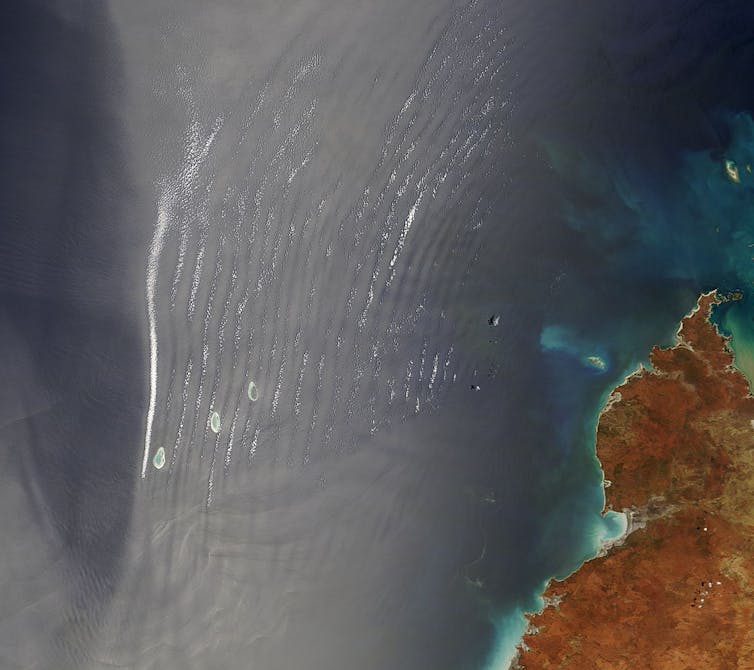
In simple terms, it seems to refer to wavelike movements or oscillations in the atmosphere, caused by sudden changes in temperature or pressure. These can be triggered by extreme heating, large-scale energy releases (such as explosions or bushfires), or intense weather events.
When a part of Earth’s surface heats up very quickly – due to a heatwave, for example – the air above it warms, expands and becomes lighter. That rising warm air creates a pressure imbalance with the surrounding cooler, denser air. The atmosphere responds to this imbalance by generating waves, not unlike ripples spreading across a pond.
These pressure waves can travel through the atmosphere. In some cases, they can interact with power infrastructure — particularly long-distance, high-voltage transmission lines.
These types of atmospheric waves are usually called gravity waves, thermal oscillations or acoustic-gravity waves. While the phrase “induced atmospheric vibration” is not formally established in meteorology, it seems to describe this same family of phenomena.
What’s important is that it’s not just high temperatures alone that causes these effects — it’s how quickly and unevenly the temperature changes across a region. That’s what sets the atmosphere into motion and can cause power lines to vibrate. Again, though, it’s still unclear if this is what was behind the recent blackout in Europe.

More centralised, more vulnerable
Understanding how the atmosphere behaves under these conditions is becoming increasingly important. As our energy systems become more interconnected and more dependent on long-distance transmission, even relatively subtle atmospheric disturbances can have outsized impacts. What might once have seemed like a fringe effect is now a growing factor in grid resilience.
Under growing environmental and electrical stress, centralised energy networks are dangerously vulnerable. The increasing electrification of buildings, the rapid uptake of electric vehicles, and the integration of intermittent renewable energy sources have placed unprecedented pressure on traditional grids that were never designed for this level of complexity, dynamism or centralisation.
Continuing to rely on centralised grid structures without fundamentally rethinking resilience puts entire regions at risk — not just from technical faults, but from environmental volatility.
The way to avoid such catastrophic risks is clear: we must embrace innovative solutions such as community microgrids. These are decentralised, flexible and resilient energy networks that can operate independently when needed.
Strengthening local energy autonomy is key to building a secure, affordable and future-ready electricity system.
The European blackout, regardless of its immediate cause, demonstrates that our electrical grids have become dangerously sensitive. Failure to address these structural weaknesses will have consequences far worse than those experienced during the COVID pandemic.
Authors: Mehdi Seyedmahmoudian, Professor of Electrical Engineering, School of Engineering, Swinburne University of Technology



















.jpg)