

Schools today also teach social and emotional skills. Why is this important? And what’s involved?
- Written by: Kristin R. Laurens, Professor, School of Psychology and Counselling, Queensland University of Technology
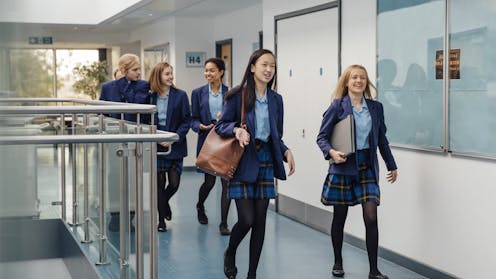
The school curriculum has changed a lot from when many parents and grandparents were at school.
Alongside new approaches to learning maths and increasing attention on technology, there is a compulsory focus on social and emotional skills.
Children start developing these skills by watching and observing others as babies. But they also need to be taught about them more actively – think about parents telling kids to say “thank you” or making sure they take turns when playing with friends.
How do schools teach social and emotional skills? And why is it important? Our new research shows how these lessons can improve students’ wellbeing and lead to better academic results.
What do schools teach about social and emotional skills?
As the Productivity Commission noted in 2023, schools should support students’ social and emotional wellbeing to help them “cope with the various stresses of life”. It also found strong social and emotional skills support students’ ability to engage and learn at school.
Since 2010, social and emotional skills have been a compulsory part of the Australian Curriculum. This involves four key strands for students from the first year of school to Year 10:
self-awareness: understanding your strengths and limitations and having confidence you can achieve goals
self-management: identifying and managing your emotions, thoughts and behaviours in different situations. This includes managing stress and controlling impulses
social awareness: understanding other perspectives, empathising with others from different backgrounds and cultures and understanding social expectations for behaviour
relationship skills: forming and maintaining healthy relationships, communicating and cooperating. This also includes responsible decision-making and understanding morals and consequences.
How are these skills taught?
Teaching these skills can be done in two ways.
The first is by incorporating them into core academic subjects. For example, an English teacher might ask students to discuss the emotions, behaviours and relationships of characters in a novel. Teachers should also model the skills in their interactions with students.
To do this effectively, teachers need specific knowledge of how to teach these skills. Busy schools may not prioritise this professional development for teachers because, unlike academic knowledge, these skills are not assessed.
The second approach is to use a structured program designed to develop these skills. These programs can particularly help teachers with less training in social and emotional teaching.
However, we know these programs are not always available or implemented adequately in schools. For example, in 2015 we surveyed 600 public, Catholic and independent NSW primary schools. Fewer than two-thirds (60%) taught social and emotional skills using formal programs. And of the programs used, one in three (34%) had either never been tested or showed no positive effects on students’ social-emotional skills.
Why is this important?
But research tells us formal programs can work. Our 2025 study looked at the social and emotional skills of 18,600 Year 6 students in NSW government and non-government primary schools. We also used data from their school leaders about the types of social and emotional skills programs they used – or did not use.
We found students who received structured, evidence-based programs (on average, over three to four years) had better social and emotional skills on our self-report survey than those who did not.
Students who received these programs had social and emotional skills that were 7-10 percentile points better than those who did not. That is, in a group of 100 students, they ranked 7-10 places higher.
But it showed there was only a benefit if programs were evidence-based – this means they had been formally tested to check they could be taught effectively by teachers in the classroom.
There are academic benefits as well
In another 2025 study, we followed students as they went to high school. We wanted to see how their social and emotional skills in primary school related to their later academic achievement.
We linked our survey data on NSW Year 6 students’ self-awareness and self-management skills with their NAPLAN reading and numeracy scores in Year 7. We could do this for almost 24,000 students who participated in our survey and in NAPLAN.
We found increases in these skills were linked to increases in NAPLAN scores. Standard gains ranged between 8–20 percentile points.
This fits with other research which shows students with strong self-awareness and self-management are more confident about achieving academic goals and more engaged and focused on their learning. This in turn helps them engage and persevere with challenges, so they achieve more academic learning.
What now?
Our research shows how programs teaching social and emotional skills can give young people fundamental skills to navigate learning and life beyond school. But implementation is patchy and not always based on evidence. School today involves more than reading, maths and facts. This means all schools need resources and access to effective programs to teach social and emotional skills.
Authors: Kristin R. Laurens, Professor, School of Psychology and Counselling, Queensland University of Technology

















