

What are the symptoms of measles? How long does the vaccine last? Experts answer 6 key questions
- Written by: Phoebe Williams, Paediatrician & Infectious Diseases Physician; Senior Lecturer & NHMRC Fellow, Faculty of Medicine, University of Sydney
So far in 2025 (as of May 1), 70 cases of measles have been notified in Australia, with all states and territories except Tasmania and the Australian Capital Territory having recorded at least one case. Most infections have occurred in New South Wales, Victoria and Western Australia.
We’ve already surpassed the total number of cases recorded in all of 2023 (26 cases) and 2024 (57 cases).
Measles outbreaks are currently occurring in every region of the world. Most Australian cases are diagnosed in travellers returning from overseas, including popular holiday destinations in Southeast Asia.
But although Australia eliminated local transmission of measles in 2014, recently we’ve seen measles infections once again in Australians who haven’t been overseas. In other words, the virus has been transmitted in the community.
So with measles health alerts and news reports popping up often, what do you need to know about measles? We’ve collated a list of commonly Googled questions about the virus and the vaccine.
1. What is measles?
Measles is one of the most contagious diseases known to affect humans. In fact, every person with measles can infect 12 to 18 others who are not immune. The measles virus can survive in the air for two hours, so people can inhale the virus even after an infected person has left the room.
Measles predominantly affects children and those with weaker immune systems. Up to four in ten people with measles will need to go to hospital, and up to three in 1,000 people who get measles will die.
In 2023, there were more than 100,000 deaths from measles around the world.
Read more: Travelling overseas? You could be at risk of measles. Here's how to ensure you're protected
2. What are the symptoms of measles?
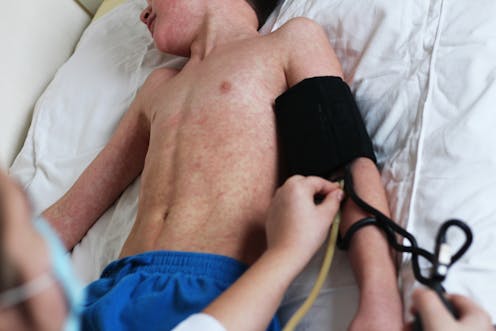
The signs and symptoms of measles usually start 7–14 days after exposure to the virus, and include rash, fever, a runny nose, cough and conjunctivitis. The rash usually starts on the face or neck, and spreads over three days to eventually reach the hands and feet. On darker skin, the rash may be harder to see.
Complications from measles are common, and include ear infections, encephalitis (swelling of the brain), blindness and breathing problems or pneumonia. These complications are more likely in children.
Pregnant women are also at greater risk of serious complications, and measles can also cause preterm labour and stillbirth.
Even in people who recover from measles, a rare (and often fatal) brain condition can occur many years later, called subacute sclerosing panencephalitis.
3. What’s the difference between measles and chickenpox?
Measles and chickenpox are caused by different viruses, although both commonly affect children, and vaccines can prevent both diseases. Chickenpox is caused by the varicella zoster virus, which is also transmitted through the air, and can cause fever, rash and rare (yet serious) complications.
The chickenpox rash is different to the rash seen in measles. It often starts on the chest or back, appearing first as separate red bumps that evolve into fluid-filled blisters, called vesicles. Chickenpox can also appear later in life as shingles.
4. Can you get measles twice?
The simple answer is no. If you contract measles, you should have lifelong immunity afterwards.
In Australia, people born before 1966 would have most likely been infected with measles, because the vaccine wasn’t available to them as children. They are therefore protected from future infection.
Measles infection however can reduce the immune system’s ability to recognise infections it has previously encountered, leaving people vulnerable to many of the infections to which they previously had immunity. Vaccination can protect against this.
5. What is the measles vaccine, and at what age do you get it?
The measles vaccine contains a live but weakened version of the measles virus. In Australia, measles vaccinations are given as part of a combination vaccine that contains the measles virus alongside the mumps and rubella viruses (the MMR vaccine), and the chickenpox virus (MMRV).
Under the national immunisation program, children in Australia receive measles vaccines at 12 months (MMR) and 18 months of age (MMRV). In other countries, the age of vaccination may vary – but at least two doses are always needed for optimal immunity.
Measles vaccines can be given earlier than 12 months, from as early as six months, to protect infants who may be at higher risk of exposure to the virus (such as those travelling overseas). Infants who receive an early dose of the measles vaccine still receive the usual two recommended doses at 12 and 18 months old.
Australians born between 1966 and 1994 (those aged roughly 20–60) are considered to be at greater risk of measles, as the second dose was only recommended from November 1992. Australia is seeing breakthrough measles infections in this age group.
An additional measles vaccine can be given to these adults at any time. It’s safe to get an extra dose even if you have been vaccinated before. If you are unsure if you need one, talk to your GP who may check your measles immunity (or immunisation record, if applicable) before vaccinating.
However, as the measles vaccine is a live vaccine, it’s not safe to give to people with weakened immune systems (due to certain medical conditions) or pregnant women. It’s therefore important that healthy, eligible people receive the measles vaccine to protect themselves and our vulnerable population.
6. How long does a measles vaccine last?
The measles vaccine is one of the most effective vaccines we have. After two doses, about 99% of people will be protected against measles for life.
And the measles vaccine not only protects you from disease. It also stops you from transmitting the virus to others.
Authors: Phoebe Williams, Paediatrician & Infectious Diseases Physician; Senior Lecturer & NHMRC Fellow, Faculty of Medicine, University of Sydney

















