

Fake news and the election campaign – how worried should voters be?
- Written by: Andrea Carson, 2024 Oxford University visiting research fellow RIJS; Professor of Political Communication., La Trobe University
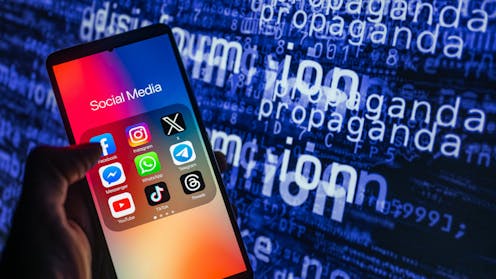
The spread of electoral misinformation and disinformation is undermining democracies around the world.
The World Economic Forum has identified the proliferation of false content as the leading short-term global risk in 2025 for a second consecutive year. Misleading information poses a bigger threat to global GDP, population and natural resources than even climate change or armed conflict.
Here in Australia, is the federal election facing the same threat from misinformation and disinformation? And how concerned should we be?
Fake information is real
Our latest study on public trust shows Australians are encountering electoral misinformation and are worried about it.
We surveyed more than 7,000 people during March and April when the election campaign was heating up. At least two-thirds of respondents said they had already encountered false or misleading election information.

Whether deliberate (disinformation) or unintentional (misinformation), we found Australians were exposed to different types of election falsehoods involving:
Consistent with other Australian and international misinformation studies, people are clearly anxious about being misled. An overwhelming majority of respondents (94%) viewed political misinformation as a problem; more than half regarded it as a “big” or “very big problem”.
An array of falsehoods
Our team, based across four universities, examined the types of electoral misinformation and disinformation Australians reported seeing. Almost two-thirds, 63.1%, encountered falsehoods about issues or candidates, such as misleading claims about parties’ policy proposals.
Thirty-nine percent reported misinformation/disinformation about voting procedures, such as when and how to vote. A similar share, 38.4%, identified fake content about election integrity, including false claims that elections are rigged or that the Australian Electoral Commission is colluding with political parties.
A significant number of people, 20-30%, were also unsure whether they had encountered misleading content. This uncertainty is concerning in itself. Being unable to judge the accuracy of information can undermine the formation of informed opinion.
It also aligns with other research showing many Australians feel they have limited ability to verify information online.
The most prominent examples of misinformation/disinformation related to major election issues, such as:
- Medicare
- nuclear energy
- housing
- cost of living
- climate
The most common names that people associated with misleading information were:
- Donald Trump
- Clive Palmer
- Labor Party
- Liberal Party
Deeper analysis is needed to understand the context of these self-reported claims of misinformation and disinformation during the campaign. However, we do know that those exposed to false content identified it in both mainstream daily news and social media sources.
Should we be alarmed?
Research across the fields of psychology, communication and political science shows exposure is not the same as impact. Yet, misinformation and disinformation can influence attitudes and behaviour among vulnerable groups.
Our own work on the 2023 Voice referendum showed disinformation targeting the Australian Electoral Commission had a small but noticeable effect on public trust, even though trust remained high overall.
In another global study, we found online disinformation can distort perceptions of election fairness.
These findings underscore the need to counter falsehoods. Electoral authorities and political leaders must work to protect democratic trust and prevent the kind of election denialism that led to the January 6 Capitol insurrection in the United States.

Of course, people might not always accurately judge how much misinformation or disinformation they’ve seen. This is a common challenge in studies like ours. But even if their perceptions don’t match reality, simply feeling exposed to false or misleading information is linked to greater political cynicism.
Fighting falsehoods
Encouragingly, most Australians recognise the problem and want action. In our survey, 89% said it’s important to know how to spot it, while 83% agreed the practice makes it harder for others to separate fact from fiction. But only 69% felt false information affected them personally.
Many feel especially vulnerable about false claims about candidates and election issues (see Figure 1). Such falsehoods are currently unregulated at the federal level in Australia. But the AEC ranks among the world’s most innovative electoral authorities in countering disinformation, even without “truth in advertising” laws.
In another, yet unpublished study, we found the AEC is a global role model with its multi-pronged strategy to counter misleading information. Its tools include a public disinformation register, media partnerships, and the “Stop and Consider” campaign, which provides clear, accurate information to help voters think critically before sharing content.
Our own study revealed other encouraging signs. Individuals who are more satisfied with Australian democracy perceive disinformation as less of an existential threat than those who are already dissatisfied. This suggests a positive attitude towards democracy helps protect democratic institutions.
This provides a strong rationale for non-profits such as the Susan McKinnon Foundation to promote the value of democratic governance. The Scanlon Foundation, is also making an important contribution with its recent Voices of Australia podcast series, “Truth, Trust and Politics”.
Whoever wins the election, our study shows one thing is clear – fighting electoral misinformation and disinformation is in everyone’s democratic interest.
Authors: Andrea Carson, 2024 Oxford University visiting research fellow RIJS; Professor of Political Communication., La Trobe University
Read more https://theconversation.com/fake-news-and-the-election-campaign-how-worried-should-voters-be-255514

















