

how 250 years of Black fashion history inspired the 2025 Met Gala
- Written by: Toby Slade, Associate Professor of Fashion, University of Technology Sydney
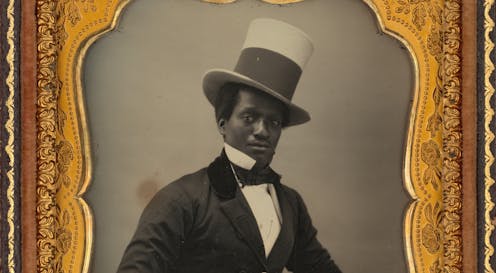
Fashion is one of the most powerful tools we have for understanding ourselves and the world around us. Nowhere is this clearer than in the story of Black American tailoring and the legacy of the Black dandy.
Inspired by scholar Monica L. Miller’s groundbreaking book Slaves to Fashion: Black Dandyism and the Styling of Black Diasporic Identity, the theme of The Metropolitan Museum of Art’s Costume Institute spring 2025 show is Superfine: Tailoring Black Style.
The exhibition charts the evolution of the Black dandy from the 18th century to today. The story it tells is about more than suits. It’s about power, pride, resistance and joy.
Each year, the Met Gala takes its dress code from the institue’s spring exhibition. This year’s is “Tailored for You”. So who is the Black dandy, why are they so important to fashion today, and what can we expect to see on the red carpet?
The birth of the Black Dandy
“Black dandy” is a modern term. Figures like American abolitionist Frederick Douglass (1818–95) or Haitian revolutionary leader Toussaint Louverture (1743–1803) would not have called themselves dandies, but they used style with similar effect: as a tool of resistance, self-fashioning and cultural pride.

French poet Charles Baudelaire (1821–67) first wrote about dandies in 1863, describing them as individuals who elevate style to a form of personal and aesthetic resistance.
Baudelaire’s dandy was not just stylish but symbolic. He was an emblem of modernity itself: a time marked by fluid identities, liminal spaces and the collapse of clear boundaries between gender, authenticity and social order.
Dandyism among Black men took root in the 18th and 19th centuries in both the United States and the Caribbean. Tailoring became a way to reclaim dignity under enslavement and colonialism.
Dandies take the clothing of an oppressor – aristocratic, colonial, segregationist or otherwise – and turn it into a weapon of elegance. Through meticulous style and refinement, dandies make a silent yet striking claim to moral superiority.

Douglass famously appeared in immaculate Victorian suits when campaigning for abolition, consciously dressing in the same style as those who denied his freedom.
Louverture used perfectly tailored French military uniforms during the Haitian Revolution against French colonial rule.
In the 1920s, Harlem dandies wore fine tailoring and flamboyant colours, rejecting the idea that poverty or discrimination should dictate presentation.
In perfectly tied cravats, polished shoes and sharply tailored coats, Black dandies refashion power on their own terms.
Presence through style
Dandies also challenge the narrow rules of masculinity.
Conventional menswear often demands restraint, toughness and invisibility. Dandies dare to embrace beauty, self-adornment and performance. This masculinity can be expressive, creative and even flamboyant.
 Duke Ellington, left, and his big band appear at Bal Pare, in Munich in 1967.
AP Photo/Frings
Duke Ellington, left, and his big band appear at Bal Pare, in Munich in 1967.
AP Photo/Frings
The luxurious silk suits and carefully groomed appearance of American Jazz pioneer Duke Ellington (1899–1974) projected glamour rather than austerity.
The elegantly tailored overcoats and scarves of American poet Langston Hughes (1901–67) suggested a masculinity deeply entwined with creativity and softness.
Figures in Harlem’s ballrooms and jazz clubs blurred gender boundaries decades before mainstream conversations about gender fluidity emerged.
 A street scene in Harlem, New York City, photographed in 1943.
Library of Congress
A street scene in Harlem, New York City, photographed in 1943.
Library of Congress
A tradition of Black tailoring
In a world where Black self-presentation has long been scrutinised and politicised, tailored clothing asserted visibility, authority and artistry. Dandies transformed fashion into a political declaration of dignity, resistance and creative power.
Black American tailoring practices blossomed most visibly in the zoot suits of the Harlem Renaissance, though they also had strong roots in New Orleans, Chicago and the Caribbean.
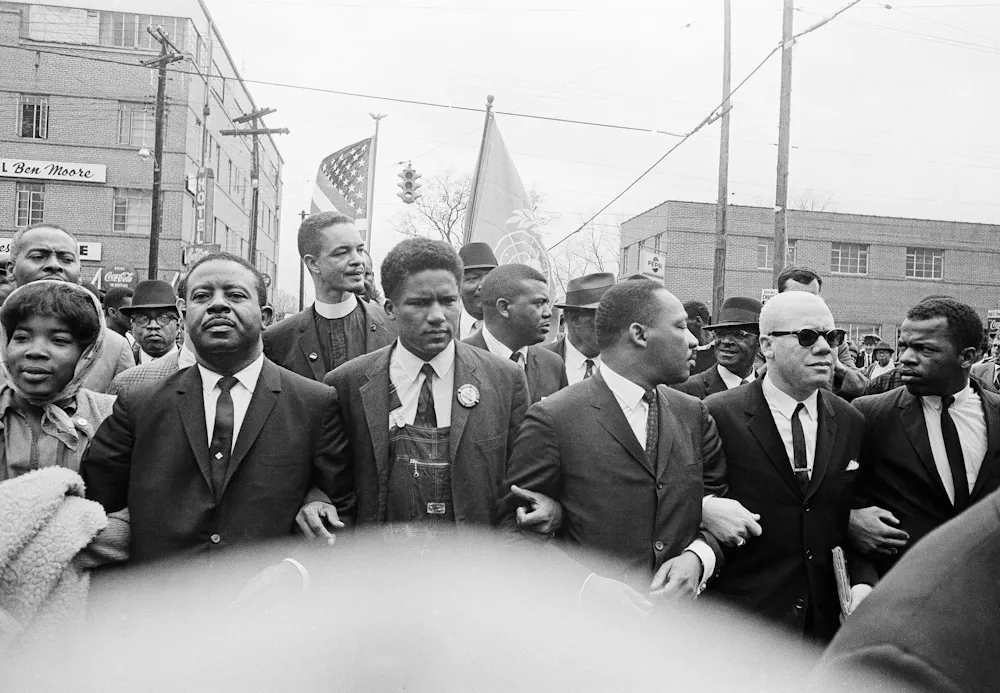 A 1965 Civil Rights march in Montgomery, Alabama. From left: an unidentified woman, Rev. Ralph Abernathy, James Foreman, Martin Luther King Jr, Jesse Douglas Sr., and John Lewis.
AP Photo/File
A 1965 Civil Rights march in Montgomery, Alabama. From left: an unidentified woman, Rev. Ralph Abernathy, James Foreman, Martin Luther King Jr, Jesse Douglas Sr., and John Lewis.
AP Photo/File
As seen in the Sunday Best of the Civil Rights era, Black tailoring walked the line between resistance and celebration: beautiful but with clear political intent.
In the 1970s, the Black dandy became more flamboyant, wearing tight, colourful clothes with bold accessories. He transformed traditional suits with exaggerated shapes, bright patterns and plaids inspired by African heritage.
Artists popular with a white audience like Sammy Davis Jr (1925–90), Miles Davis (1926–91) and James Brown (1933–2006) embraced the aesthetic, contributing to its widespread acceptance.
 Sammy Davis Jr with his first European gold record, 1976.
Nationaal Archief, CC BY
Sammy Davis Jr with his first European gold record, 1976.
Nationaal Archief, CC BY
Meanwhile, a super stylish contingent of Black men in the Congo, La Sapeur, refined their look so spectacularly they would become the benchmark of the Black dandy for generations to come.
The 1990s saw a new era of Black dandyism emerge through luxury sportswear and hip-hop aesthetics.
Designer Dapper Dan (1944–) revolutionised fashion by remixing luxury logos into bold, custom streetwear, creating a distinctive Black aesthetic that bridged hip-hop culture and high fashion.
Musician Andre 3000 (1975–) redefined menswear by blending Southern Black style with bold colour, vintage tailoring and theatrical flair.
Today, the tradition thrives in the style of influencer Wisdom Kaye, the elegance of LeBron James, and the risk-taking of Lewis Hamilton.
 Big Boi (right) and Andre 3000 (left) at the 2003 MTV Video Music Awards.
EPA Photo/Jason Szenes
Big Boi (right) and Andre 3000 (left) at the 2003 MTV Video Music Awards.
EPA Photo/Jason Szenes
Dressing for the red carpet
Tailored for You invites guests to interpret the dandy’s legacy in personal, bold and boundary-pushing ways.
Whether conforming to tradition, subverting expectations or creating something entirely new, this theme is a celebration of the freedom to dress – and be – on your own terms.
The Black dandy is a figure of defiance and desire, of ambiguity and brilliance, of resistance and beauty. Dandyism blurs boundaries between masculinity and femininity, artifice and authenticity, conformity and rebellion. It unsettles fixed identities and reflects broader tensions within modern life.
 The poet and activist Countee Cullen, as depicted by Winold Reiss around 1925.
National Portrait Gallery
The poet and activist Countee Cullen, as depicted by Winold Reiss around 1925.
National Portrait Gallery
Black dandies have shocked, amused, offended, delighted and inspired society since their inception. In the sharp defiance of Douglass’ Victorian suits, the flamboyant spectacle of Harlem ballrooms, and the logo-laced rebellion of Dapper Dan’s streetwear, the Black dandy has continually forced the world to reckon with the politics of presence, pride and performance.
Despite being overlooked by mainstream fashion history, they’ve shaped the way we see elegance, masculinity and self-expression. This Met Gala and the accompanying exhibition are not just a celebration – they are a long-overdue recognition.
Authors: Toby Slade, Associate Professor of Fashion, University of Technology Sydney

















