

Can a wooden spoon really stop a pot from boiling over? Here’s the science
- Written by: Jay Deagon, Senior Lecturer of Home Economics, CQUniversity Australia
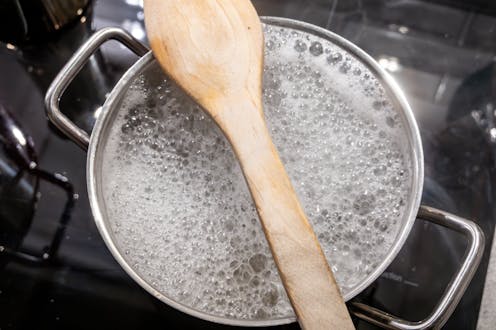
One moment, your spaghetti is happily bubbling away in the pot. A minute later, after busying yourself with something else, you turn around to find a hot mess all over your stove.
Boiling liquid can rocket up very quickly, and we often only have a split second to act. But are there ways to prevent the pot boiling over in the first place? One kitchen hack you may have seen on social media is to place a wooden spoon across the top of the pot.
Does it work? As with many kitchen science questions, there is an answer – and there’s lots of nuance, too.
In short, it will work, but not for long periods of time. Let’s dig into the why.
What causes the bubbles?
Interestingly, a pot of rapidly boiling pure water will not rise up the sides of the pot.
Ingredients added to the water are the culprits for overflow and spillage. Pots of pasta, rice, porridge or milk are the most prone to boiling over and making a mess. A heavy stew is less likely to bubble over – unless you overfill the pot.
In cookery, the key food molecules are water, carbohydrates, proteins, lipids (the collective term for fats and oils) and, to a lesser extent, vitamins and minerals.
The main culprits for rapid boiling and overflow are carbohydrates and proteins. When carbohydrates or proteins (or a combination of both) come into contact with heated water molecules, their properties change and structures rearrange.
Changes can happen quickly if the heat is high. Excited by lots of heat, the water molecules begin to boil rapidly. As this occurs, bubbles form.
Why do the bubbles rise so quickly?
The carbohydrates involved in bubbling up and messing up your kitchen are primarily plant starches. Pasta or porridge products are derived from plant starches such as wheat, rice, potato or corn. If you’re boiling anything with milk, a protein called casein can contribute to the bubbles, too.
Casein and starches are known as colloids. “Colloidal dispersion” means that not all such particles will dissolve into a water solution, because some of these particles are too large. As bubbles form, the larger starch and/or protein particles start to coat the bubbles.
For pasta water or porridge, the heat and starch solution starts to form a gel. This gel becomes sticky and, depending on the type of starch and other additives, the temperature of the boiling solution can rise above 100°C.
So, they’re not just bubbles – they’re hot, sticky bubbles. Filled with air and coated with a sticky starch gel, as the solution continues to boil, the bubbles build on top of each other and rise up the sides of the pot.
It’s a little different with milk. Have you ever noticed a film across the top of boiled milk? Milk skin is formed by heated casein. When heated, the casein can become quite strong – like plastic – and coat each bubble. Milk bubbles are smaller and become more of a foam, but they can still rise quickly.

So, how does a wooden spoon stop the bubbles?
Placing a wooden spoon over a boiling pot acts as an interruption to the bubbles – it lowers the surface temperature and provides a porous surface to burst the bubbles. This stops them from climbing over the edge of the pot.
To understand why, picture another porous surface: the structure of a sponge. Because the sponge has a lot of holes in it, you can blow air through a dry sponge. However, air does not pass through a wet sponge because the holes are filled with water.
Wood is a porous material, and a dry wooden spoon is more porous than when it’s wet. On contact with the wood, the air in the bubbles is released.
But you can’t just leave a wooden spoon over the pot indefinitely and expect it to not boil over. As the spoon is exposed to heat, moisture, sticky starch or casein bubbles, it will soon become the same temperature as the liquid. That means it won’t reduce the surface temperature any more, nor be porous enough to burst bubbles.
This is why some people claim the spoon hack doesn’t work – because it has a limited window of effectiveness.
What should I do instead?
Stirring the pot or using the wooden spoon as a fan would work equally as well.
Better yet, try not to get distracted in the kitchen and select the correct kitchen tools for the job: use a bigger pot, and turn down the heat so it’s not just going full blast.
We like to treat working in the kitchen like a meditation. Remain present and in the moment. If you do get distracted, turn the stove to its lowest setting, switch it off or remove the pot from the heat. The phrase “a watched pot never boils” doesn’t count in this situation. Indeed, a watchful eye on the pot is essential.
Authors: Jay Deagon, Senior Lecturer of Home Economics, CQUniversity Australia

















